
Selling real estate can create a large tax bill if you are not prepared. Capital gains tax on real estate is one of the most consequential taxes property owners face, yet many people do not fully understand how it works until they are already under contract. The rate you pay depends on how long you held the property, what type it is, your income, and whether any special rules apply.
In 2026, the basic framework remains intact. What has changed is that several key provisions are now permanent. This guide breaks down every major scenario so you know exactly what to expect before you sign.
Key Takeaways
|
What Is Capital Gains Tax on Real Estate?
A capital gain is the profit you make when you sell a property for more than you paid. The IRS taxes that profit. How much you owe depends on two things: how long you owned the property, and whether any exclusions or deferrals apply.
There are two categories. If you held the property for one year or less, the gain is short-term and taxed as ordinary income. Primary residences may qualify for a $250,000 or $500,000 exclusion, which ranges from 0% to 20% for long-term gains. Rental properties also face depreciation recapture at 25%, and high earners owe an additional 3.8% NIIT.
Capital gains tax applies to the net gain, not the full sale price. You subtract your adjusted basis from the sale proceeds to arrive at the taxable amount.
Also Read: How to Avoid Capital Gains Tax on Cryptocurrency (Legally, in 2026)
Long-Term Capital Gains Rates in 2026
The Tax Cuts and Jobs Act set the long-term capital gains rates at 0%, 15%, and 20%. The One Big Beautiful Bill Act (OBBBA), signed July 4, 2025, made these rates permanent. They no longer expire.
The rate you pay depends on your total taxable income for the year. The brackets below are approximate 2026 figures, inflation-adjusted from 2025 IRS tables.
2026 Long-Term Capital Gains Tax Brackets
| Rate | Single Filers (Taxable Income) | Married Filing Jointly |
| 0% | Up to ~$48,350 | Up to ~$96,700 |
| 15% | ~48,351to~533,400 | ~96,701to~600,050 |
| 20% | Over ~$533,400 | Over ~$600,050 |
Most middle-income sellers land in the 15% bracket. The 0% rate is available, but real estate sales often push total income above the threshold. These thresholds apply to your total taxable income for the year, not just the gain itself.
For more on how California layers its own tax on top of these federal rates, see our guide on capital gains on real estate in California.
Short-Term vs. Long-Term: Why Holding Period Matters
The difference between short-term and long-term treatment can mean tens of thousands of dollars on a single sale.
Suppose you purchased a rental property in March 2025 and sold it in October 2025, making a $120,000 gain. You held it for seven months. That is short-term. If your ordinary income bracket is 32%, you owe $38,400 in federal capital gains tax.
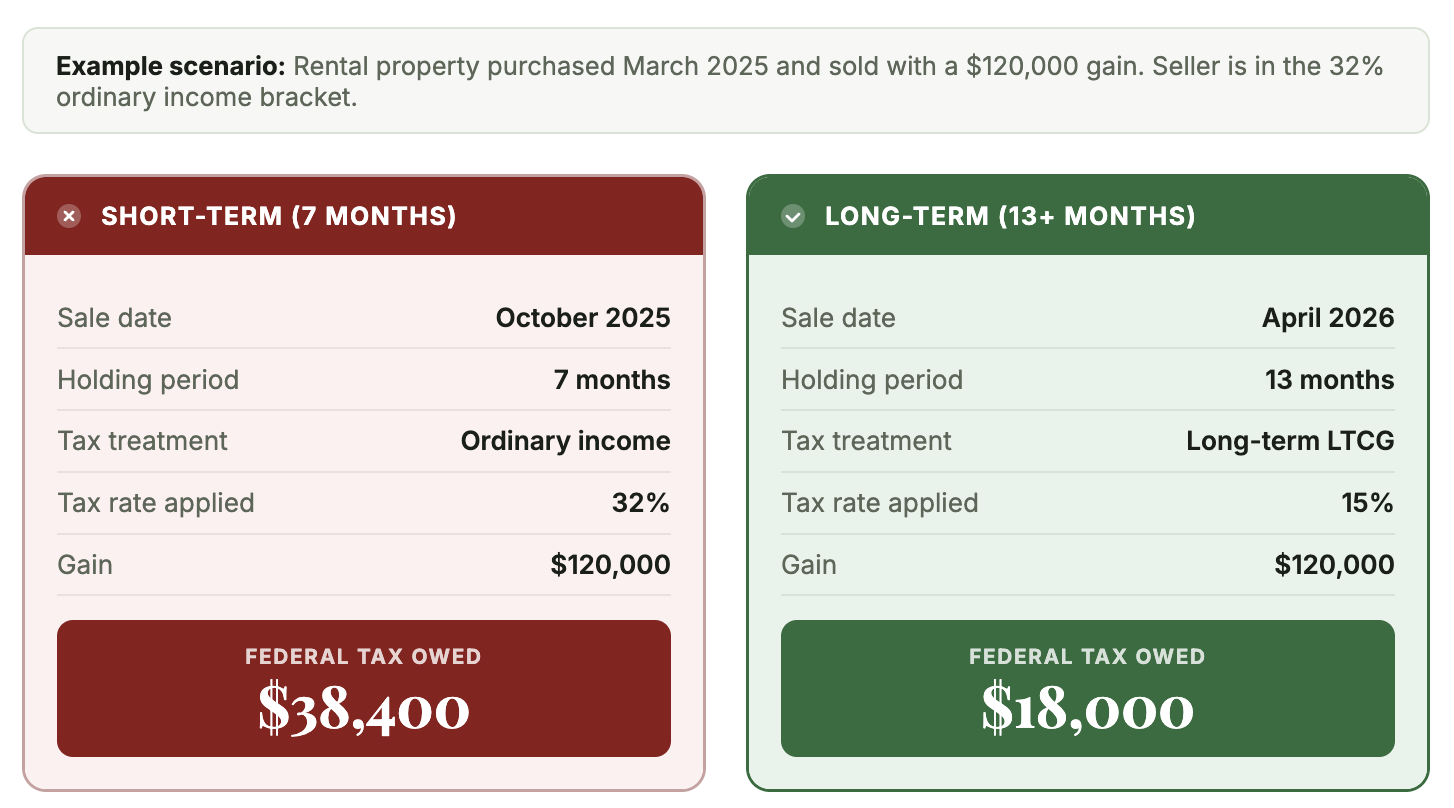
Now suppose you wait until April 2026 to sell, making the holding period over one year. The same $120,000 gain is now long-term. At a 15% rate, the federal tax drops to $18,000. Waiting a few months saves $20,400.
The holding period starts the day after you acquire the property and ends on the sale date. One year and one day is enough to qualify for long-term treatment.
| Important: Flipping properties typically produces short-term gains since most flips close within 12 months. If you flip frequently, the IRS may also classify your activity as a business, in which case profits are subject to self-employment tax in addition to ordinary income tax. |
Capital Gains Tax on Primary Residences (Section 121 Exclusion)
Selling your home comes with a major tax break. Under Section 121 of the Internal Revenue Code, you may exclude up to $250,000 of capital gains if you are single, or $500,000 if you are married filing jointly. This exclusion has not changed in 2026.
Many homeowners who have lived in their house for several years find that their entire gain falls under this threshold. In that case, they owe nothing in federal capital gains tax on the sale.
How to Qualify for the Section 121 Exclusion
You must meet two tests:
- Ownership test: You owned the home for at least two of the five years before the sale.
- Use test: You lived in the home as your primary residence for at least two of the five years before the sale.
The two years do not have to be consecutive. You can use the exclusion once every two years.
One important limitation: this exclusion does not apply to any portion of the gain tied to prior depreciation deductions. If you rented out part of your home or used a home office that you depreciated, that portion is subject to depreciation recapture at 25%, not the exclusion.
Also Read: Estimated Tax Payments Schedule 2025 and 2026: Every IRS Quarterly Due Date
Capital Gains Tax on Investment Properties
Investment properties, including rental homes, commercial real estate, and land held for appreciation, do not qualify for the Section 121 exclusion. The full gain is taxable.
Long-term investment property gains follow the same 0/15/20% rate structure. But a second layer of tax catches many investors off guard: depreciation recapture.
Depreciation Recapture: The Hidden Tax
When you own a rental property, the IRS requires you to depreciate it over 27.5 years (residential) or 39 years (commercial). Each year, you deduct a portion of the building’s value from your taxable income.
When you sell, the IRS recaptures those deductions. The amount you claimed in depreciation is taxed at a flat 25% rate, regardless of your income bracket. This is called unrecaptured Section 1250 gain.
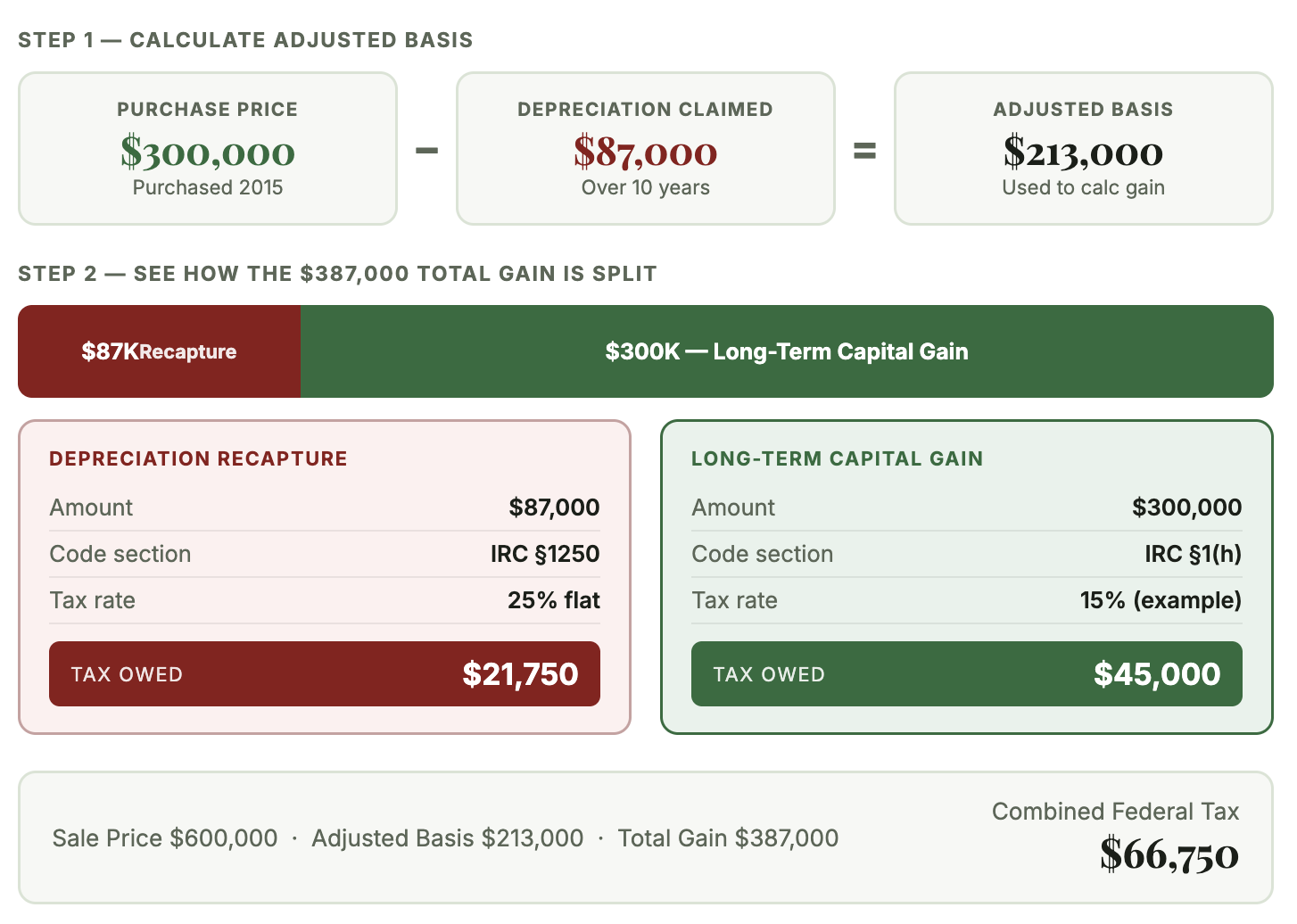
Example: You purchased a rental property for $300,000 in 2015. Over 10 years, you claimed $87,000 in depreciation. You sell in 2026 for $600,000. Your adjusted basis is $213,000 ($300,000 minus $87,000). Your total gain is $387,000. Of that, $87,000 is subject to 25% depreciation recapture tax ($21,750). The remaining $300,000 is taxed at long-term capital gains rates.
What Is Adjusted Basis and Why It Matters
Your adjusted basis in a property is not simply what you paid for it. It starts with the purchase price and is then adjusted up and down for several factors.
- Increases to basis include capital improvements (a new roof, an addition, a kitchen remodel), closing costs paid at purchase, and certain legal fees. These raise your basis and reduce your taxable gain.
- Decreases to basis include depreciation deductions you claimed while renting the property, casualty loss deductions, and energy credits. These lower your basis and increase your taxable gain.
The formula is: sale price minus selling costs minus adjusted basis equals taxable gain.
Tracking your adjusted basis accurately matters. Homeowners who renovated over the years often have a much higher basis than they realize, which reduces the tax they owe on sale.
The Net Investment Income Tax (NIIT)
The Net Investment Income Tax is an additional 3.8% tax on investment income for higher earners. It applies on top of regular capital gains tax.
You owe NIIT if your modified adjusted gross income (MAGI) exceeds these thresholds:
| Filing Status | MAGI Threshold |
| Single | $200,000 |
| Married Filing Jointly | $250,000 |
| Married Filing Separately | $125,000 |
The 3.8% applies to the lesser of (a) your net investment income or (b) the amount by which your MAGI exceeds the threshold. Real estate capital gains count as net investment income unless the sale is part of an active trade or business.
Combined with the 20% long-term capital gains rate, the NIIT can push the effective federal rate on real estate gains to 23.8% for high earners. Add California state tax on top of that, and the combined rate can exceed 33%.
Also Read: Tax Planning Strategies for High Income Earners (2026)
How to Defer or Reduce Capital Gains Tax
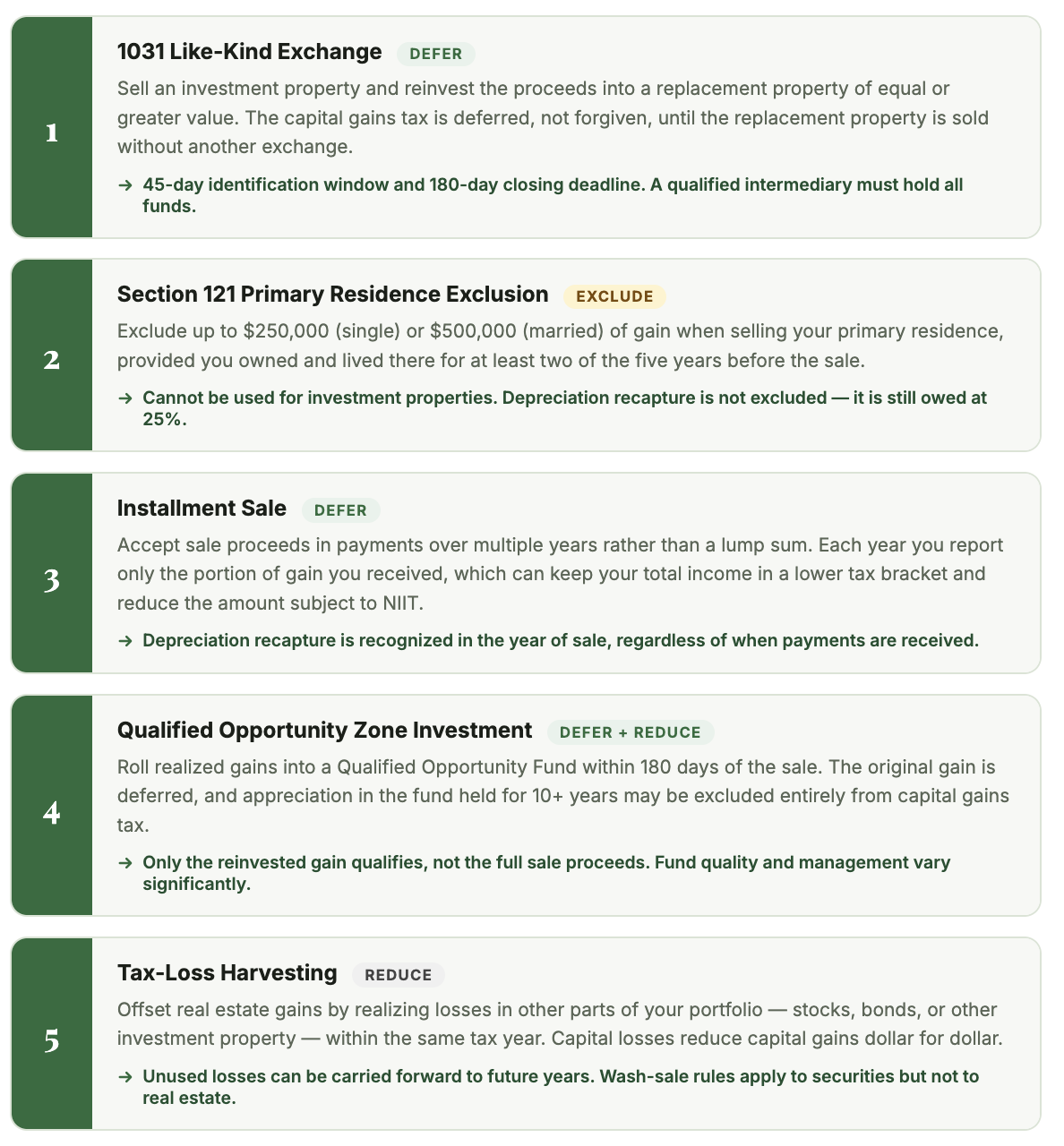
You can pay less in capital gains tax on real estate with the right strategy in place before the sale. The two most powerful tools are the 1031 exchange and the Section 121 exclusion.
1031 Like-Kind Exchange
A 1031 exchange lets you sell an investment property and defer the capital gains tax by reinvesting the proceeds into a new, like-kind investment property. The tax is deferred until you sell the replacement property without doing another exchange.
To qualify, you must meet strict deadlines. You have 45 days from the sale of your relinquished property to identify potential replacement properties. You then have 180 days total from the original sale to close on the replacement.
A qualified intermediary must hold the funds between transactions. You cannot touch the money. Any cash you receive (called boot) is taxable in the year you receive it.
The 1031 exchange is not available for primary residences or personal-use property. It applies only to investment and business property.
Other Strategies to Consider
- Instalment sale: Spread the gain over multiple years by accepting payments over time. This can keep your annual income in a lower bracket.
- Opportunity Zone investment: Roll gains into a Qualified Opportunity Fund to defer and potentially reduce the taxable amount.
- Charitable remainder trust: Transfer appreciated property into a trust. The trust sells the property tax-free and pays you income for a set period. The remainder goes to charity.
- Harvesting losses: Offset gains by selling other investments that have declined in value within the same tax year.
- Timing the sale: If your income will be lower next year, waiting to close can move you into a lower capital gains bracket.
For a broader look at your options, see our detailed guide on how to avoid capital gains tax on real estate in California.
Conclusion
Real estate is one of the most tax-exposed transactions most people will ever make, but most of that exposure is manageable with planning. A 1031 exchange, depreciation recapture, the rate you pay, and whether the sale fits within the Section 121 exclusion do not have to be answered under pressure. You’ll get better answers when you work through them before you sign the listing agreement, not after you are in contract with a 30-day closing date. There is no set tax on the sale of a house. It depends on choices made before the deal is finalised.
Selling a property? Talk with a Tax planning advisor at SWAT Advisors to review your options before you close.
FAQs
Long-term capital gains tax rates on real estate are 0%, 15%, or 20% at the federal level, depending on your total taxable income. Short-term gains are taxed as ordinary income, up to 37%.
Not necessarily. Under Section 121, single filers can exclude up to $250,000 in gains and married filers can exclude up to $500,000, provided you owned and lived in the home for at least two of the five years before the sale.
Depreciation recapture is a 25% tax on the portion of your gain equal to the depreciation you deducted while owning a rental or investment property. It applies even if your regular long-term capital gains rate is lower.
Adjusted basis is your purchase price, adjusted upward for capital improvements and buying costs, and downward for depreciation deductions you claimed.
A 1031 exchange lets you defer capital gains tax by selling an investment property and reinvesting the proceeds into a like-kind replacement property. You must identify the replacement within 45 days and close within 180 days of the sale. A qualified intermediary holds the funds throughout the process.
No. The One Big Beautiful Bill Act, signed July 4, 2025, made the 0%, 15%, and 20% long-term capital gains rates permanent. The income thresholds for each bracket are adjusted annually for inflation.