
A good tax planning service should offer experienced, qualified professionals who understand your financial situation and current tax laws. Look for transparent fees, personalized strategies, proactive year-round planning, strong communication, and a proven track record of helping clients reduce tax liability legally while meeting their financial goals.
Knowing what to look for in a tax planning service protects you from paying for advice that never gets used, and trusting someone without the credentials to back up their promises. Below are eight checkpoints that separate a real tax planning service from a preparer who simply files your return.
Key Takeaways
|
Tax Planning Service vs. Tax Preparation: Know the Difference First
A tax preparation service records what already happened and files your return. A tax planning service changes what happens next, before the tax year closes, so your next return looks different.
Tax preparation turns last year’s W-2s and receipts into a filed return, with little room left to change the outcome. Tax planning works with income, business structure, and life events while you can still act, restructuring pay or timing a sale before any deadline exists.
The below table breaks down the practical differences between the two.
| Factor | Tax Preparation | Tax Planning |
| Timing | After the tax year ends | Throughout the year |
| Focus | Filing accuracy | Reducing future liability |
| Frequency | Once a year | Quarterly or ongoing |
| Deliverable | Filed return | Multi-year strategy |
| Value driver | Compliance | Decision-making |
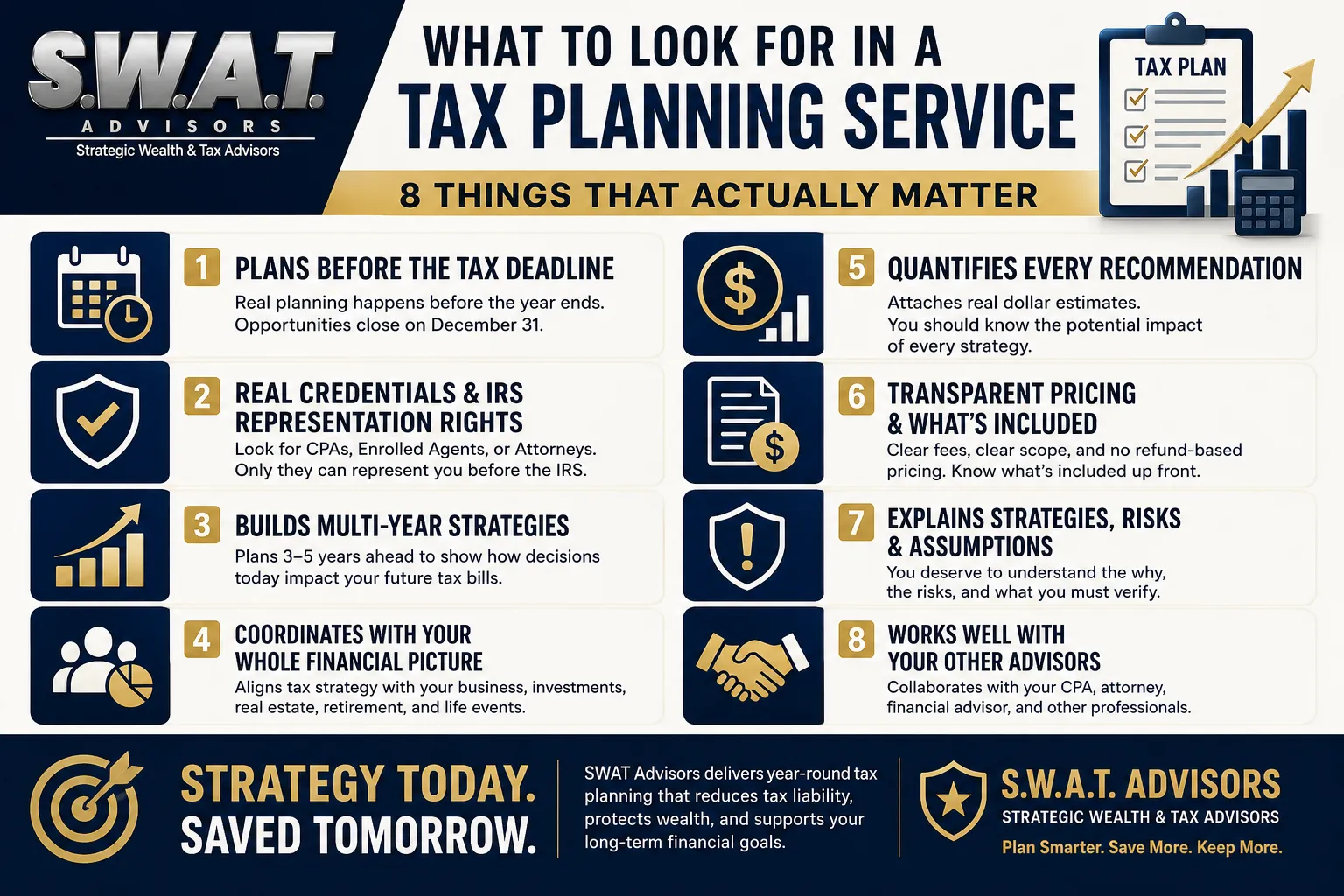
1. Look for a Tax Planning Service That Plans Before the Tax Deadline
A real tax planning service works with you before the tax year ends, because most strategies stop working once the calendar flips. Year-end tax planning exists because moves like retirement contributions, entity elections, or timing a bonus close permanently on December 31.
If a firm only wants to meet in March or April, they are preparing your return. California tax planning in 2026 also requires attention to state deadlines, since some elections run on their own calendar separate from the federal one.
2. They Hold Real Credentials, Specialize in Planning, and Have IRS Representation Rights for Your Situation
Credentials is at the top of any list of what to look for in a tax planning service, because the IRS grants unlimited representation rights, the ability to speak and negotiate on your behalf before any IRS office, to only three professionals: attorneys, CPAs, and enrolled agents.
A PTIN, or preparer tax identification number, is the number the IRS requires every paid preparer to hold. The renewal fee for a 2026 PTIN is $18.75, renewed annually before filing season starts.
Since January 2016, unenrolled preparers without a credential or an Annual Filing Season Program Record of Completion have had zero representation rights, even on returns they personally signed. If your preparer isn’t a CPA, attorney, or enrolled agent, and hasn’t completed the AFSP, they cannot speak to the IRS on your behalf later.
Before hiring any tax firm, ask for their specific credential and PTIN, and whether they can legally represent you before the IRS under an authorization like Form 2848.
3. They Build Multi-Year Strategies, Not One-Year Fixes
A tax planning service worth paying for maps income, deductions, and major decisions across three to five years. Effective business tax planning strategies account for how a decision this year changes your tax bill two or three years out.
A single-year fix might lower this year’s bill while raising next year’s by more. Accelerating a deduction now can push a business owner into a lower bracket today but create a bigger, unplanned liability later if income timing was never modeled forward.
4. They Coordinate Tax Strategy With Your Whole Financial Picture
A qualified planner ties your tax strategy to business decisions, investment moves, and life events instead of treating taxes as a standalone task.
Why This Matters More for Business Owners and High-Income Earners
This is where tax planning for high-income individuals diverges sharply from routine filing, since the stakes and moving pieces both increase.
- Tax planning strategies for business owners cover entity structure, owner compensation, and retirement plan design together.
- Real estate tax planning strategies account for depreciation schedules, cost segregation, and exchange timing before a property closes.
- Tax-saving strategies for real estate investors with rental portfolios often hinge on passive activity rules a generalist preparer misses.
- Tax planning for retirees shifts the focus to sequencing withdrawals across taxable, tax-deferred, and tax-free accounts.
- Tax planning for startups addresses entity choice and how the legal fees of starting a business get deducted or amortized.
- Family office tax planning coordinates strategy across generations and entities, requiring far more documentation than one household return.
- Cross-border tax planning strategies matter for anyone with foreign income or accounts, since missed disclosures carry steep penalties.
- Tax planning for remote workers accounts for multistate rules, since remote work taxes shift based on where the employer and employee sit.
A planner who cannot connect these pieces to your specific situation is only addressing one slice of the picture.
5. They Quantify What Each Recommendation Could Actually Change
A credible tax planning service attaches a real number to every recommendation instead of offering generic tips. If a strategy is worth suggesting, it is worth estimating in dollars.
A blended tax rate is the effective percentage of total income paid in tax once federal, state, and other taxes combine into one rate. A planner who knows your blended tax rate can tell you a specific retirement contribution saves an estimated $4,200 this year, not that it “helps with taxes.”
Someone trying to avoid capital gains tax in California on a property sale should get a projected savings figure, and a recommendation citing the California standard deduction 2026 amount should show exactly how it changes taxable income.
6. They’re Transparent About Pricing and What’s Included
A trustworthy tax planning service tells you the fee structure and scope of work before you hand over any financial documents.
Ask whether it’s a flat fee, hourly rate, or percentage of savings, and whether it covers ongoing check-ins or just the initial plan. A firm that charges based on your refund size is flagged directly by the IRS as a practice to avoid.
7. They Explain Strategies, Risks, Assumptions and What You Still Need to Verify
A real planner walks you through the reasoning behind each recommendation, including what could go wrong and what you must still confirm yourself. Tax strategies rest on assumptions about income, law, and timing that can shift, so they are never guaranteed outcomes.
A planner should state plainly which assumptions a projection depends on, such as income staying within a certain range, and make clear that you remain responsible for reviewing the final numbers before anything is filed.
8. They Work Well With Your Other Advisors
A tax planning service should coordinate directly with your CPA, financial advisor, attorney, or bookkeeper instead of working around them. A planner who refuses to loop in your other professionals limits their own effectiveness. Ask whether they will join a call with your advisors or send written recommendations for your CPA to review.
Red Flags to Watch For in a Tax Planning Service
Red flags matter as much as checkpoints when deciding what to look for in a tax planning service. The IRS warns that fraudulent preparers promise inflated refunds, falsify withholding information, refuse to sign returns, lack a valid PTIN, or divert refunds into their own accounts. Watch for these signs:
- Promises a guaranteed or unusually large refund
- Won’t explain how a recommendation was calculated
- Pushes a strategy before understanding your full situation
- Cannot explain their credentials or representation rights
- Charges fees based on your refund size
- Wants you to sign incomplete or blank documents
- Doesn’t ask for supporting financial records
- Becomes unreachable after your return is filed
- Treats tax planning as a once-a-year meeting
- Won’t explain the risks or assumptions behind a strategy
The IRS’s 2026 Dirty Dozen list also names “ghost preparers,” who prepare a return for a fee but refuse to sign it or include their PTIN, leaving the taxpayer fully liable for errors. If a preparer will not put their name on your return, do not put your signature on it either.
Questions to Ask Before You Hire a Tax Planning Service
This final list of what to look for in a tax planning service works as a key for your first call:
- Do they have the right credentials and IRS representation rights for your situation?
- Can they find opportunities before the tax year ends?
- Do they quantify recommendations instead of giving generic tips?
- Do they coordinate planning with the decisions that create the tax liability?
- Are scope, fees, and responsibilities clear before you share financial information?
- Do they still make you responsible for reviewing the final tax position?
How SWAT Advisors Approach Tax Planning
SWAT Advisors is a California-based tax planning firm, which has operated in California for more than 20 years, working with business owners, physicians, dentists, and real estate investors.
Our process starts with discovery call, tax-saving assessment, planning session, implementation, quarterly reviews, and annual return preparation, built to catch opportunities while the tax year is still open.
- Advanced tax planning, including pre-sale and post-sale income structuring
- Individual tax planning for high earners and W-2 professionals
- Estate Planning Services, including Prop 19 inheritance issues for California owners
- Life insurance planning integrated with wealth strategy
- Family office tax planning for multi-generational households
Book a consultation with SWAT Advisors to see what a full-year strategy could look like for your situation.
Conclusion
A tax preparer files what already happened. A tax planning service changes what happens next, and that difference is worth more than any single deduction. The eight checkpoints above give you a working checklist instead of a guess. Knowing what to look for in a tax planning service protects both your money and your time before you hand over a single document.
SWAT Advisors is a team of credentialed planners, offering year-round strategy sessions and documented results. Contact SWAT Advisors to find out what a coordinated, year-round tax strategy could save you.
FAQs
A tax preparer files your past year's return; a tax planning service works before the year ends to change your future tax outcome through timing, structure, and strategy.
You need someone with the right credential for your situation. CPAs, attorneys, and enrolled agents hold unlimited IRS representation rights; most financial advisors do not.
Costs vary by complexity, but fees should never be tied to your refund size. Ask whether pricing covers year-end tax planning check-ins or only the annual filing.
No. Tax planning for high-income individuals delivers the largest dollar impact, but retirees and remote workers with multistate income benefit too.
A guaranteed refund promise is the clearest warning sign. The IRS lists inflated refund promises among its top scam patterns every filing season.