

Capital gains tax on the sale of a vacation home applies to the full profit you make, since a vacation home does not get the same tax break as your main house. If you sell your beach condo or mountain cabin for more than you paid, the IRS taxes that profit. Unlike your primary residence, there is no automatic $250,000 or $500,000 tax-free pass under Section 121. Every dollar of gain counts, unless you plan ahead.
This guide breaks down how the tax works, how to calculate what you owe, and which legal strategies actually lower your bill.
Key Takeaways
|
Understanding Capital Gains Tax for Vacation Homes
Capital gains tax on the sale of vacation home transactions is calculated on the difference between your sale price and your adjusted basis in the property. A vacation home is any second property you own for recreation, whether you rent it out sometimes or keep it strictly for family use. The IRS treats it as a personal-use or investment capital asset, not your main home, so Section 121’s home sale exclusion generally does not apply.
What Counts as a Capital Gain When Selling Your Vacation Home?
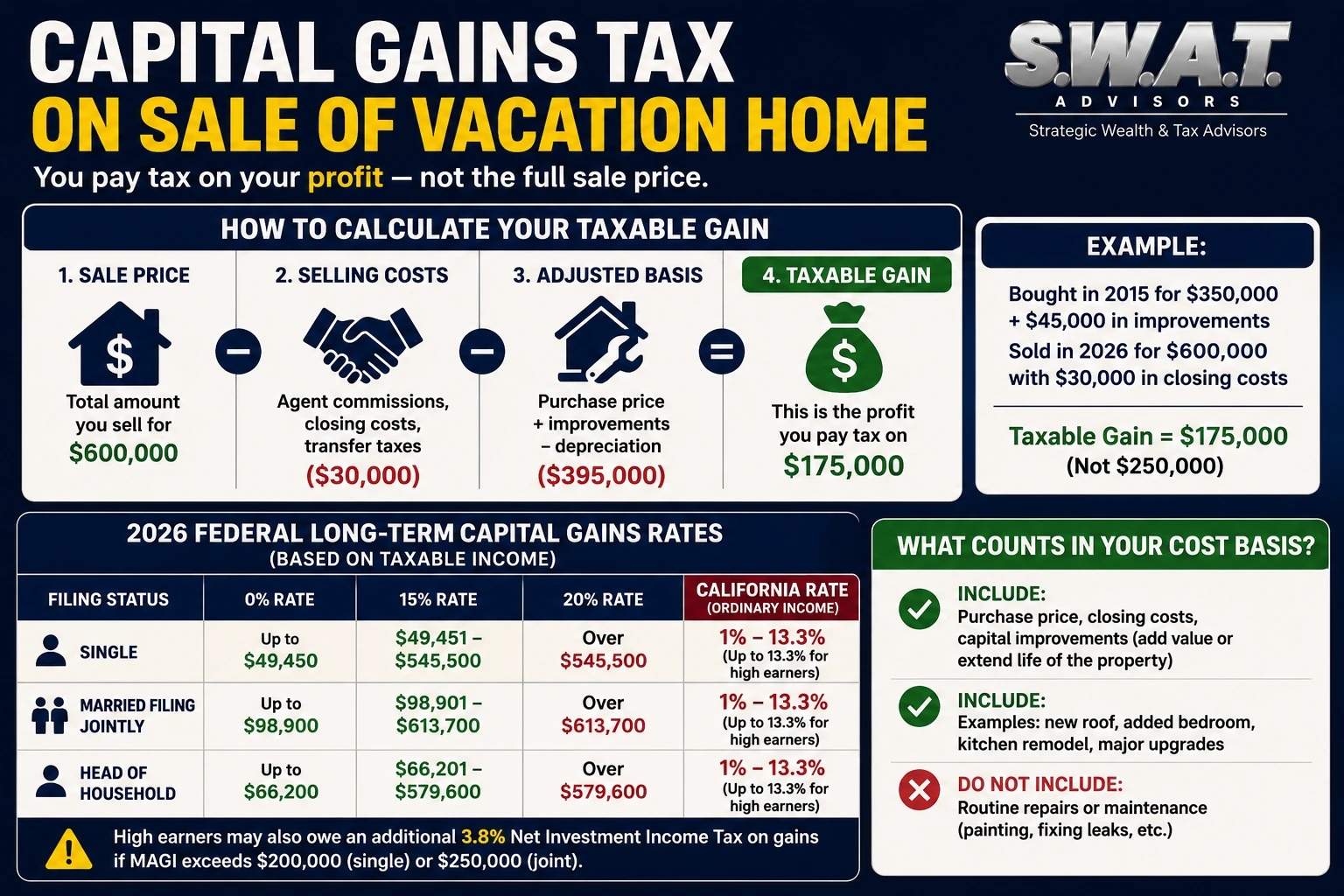
A capital gain is the profit left over after you subtract your adjusted basis and selling costs from the final sale price. If you bought a lake house for $300,000 and sold it for $480,000 after $20,000 in selling costs, your taxable gain is $160,000.
- Sale price minus selling costs (agent commissions, transfer taxes, closing fees)
- Minus your adjusted basis (purchase price plus qualifying improvements)
- Equals your taxable capital gain
| Example: A San Diego family bought a vacation condo in 2015 for $350,000. They added a new roof and remodeled the kitchen for $45,000 combined, then sold in 2026 for $600,000 with $30,000 in closing costs. Their adjusted basis is $395,000, and their taxable gain is $175,000, not $250,000. |
Federal vs. State Tax Implications on Vacation Home Sales
Federal capital gains tax on a vacation home depends on how long you owned it and your total taxable income for the year. Short-term gains, from property held one year or less, are taxed at your regular income tax rate, up to 37%. Long-term gains, from property held longer than a year, get lower rates.
The table below shows the 2026 federal long-term capital gains brackets by filing status, along with California’s flat treatment of gains as ordinary income.
| Filing Status | 0% Federal Rate | 15% Federal Rate | 20% Federal Rate | California Rate |
| Single | Up to $49,450 | $49,451 to $545,500 | Over $545,500 | 1% to 13.3%, taxed as ordinary income |
| Married Filing Jointly | Up to $98,900 | $98,901 to $613,700 | Over $613,700 | 1% to 13.3%, taxed as ordinary income |
| Head of Household | Up to $66,200 | $66,201 to $579,600 | Over $579,600 | 1% to 13.3%, taxed as ordinary income |
High earners also face the 3.8% federal Net Investment Income Tax once modified adjusted gross income exceeds $200,000 for single filers or $250,000 for joint filers. That surtax applies only to the amount above the threshold.
How SWAT Advisors Can Help You Save on Taxes
Selling a vacation home without a plan can cost thousands of dollars to the IRS and the California Franchise Tax Board that you never needed to pay. SWAT Advisors has spent more than 50 years building strategies that keep money in our clients’ pockets instead. We work with business owners, high-net-worth families, and investors who want a clear plan before closing day, not a surprise tax bill after it.
- We review your full financial picture before you list the property, so timing and structure work in your favor
- We identify legal deductions and basis adjustments that generic tax preparers often miss
- We coordinate 1031 exchange strategies, installment sales, and entity structuring for larger gains
- We build advanced tax planning strategies around your entire portfolio, not just one transaction
Reducing taxes on investment gains takes more than a single form filed in April. It takes a plan built months, sometimes years, before the sale. If you want a second set of eyes on your vacation home sale before you sign anything, book a consultation with us today.
Calculating Capital Gains Tax on Your Vacation Home
You calculate capital gains tax on the sale of vacation home profits by first nailing down your adjusted basis, then applying the correct federal and state rates to your gain.
Determining the Cost Basis and Adjusted Basis
Your adjusted basis starts with your original purchase price, per IRS Publication 551. Add qualifying capital improvements, like a new roof, an added bedroom, or a full kitchen remodel. Subtract any depreciation you claimed if you ever rented the property out.
- Original purchase price plus closing costs from your purchase
- Cost of capital improvements (not routine repairs like painting)
- Minus accumulated depreciation, if the home was ever a rental
Routine maintenance, such as fixing a leaky faucet or repainting a bedroom, does not count. Only improvements that add value or extend the property’s life increase your basis.
Exemptions and Deductions That Reduce Taxable Gain
A vacation home does not get the Section 121 exclusion unless you convert it into your primary residence and meet the ownership and use tests, per IRS Topic 701. You must own and live in the home as your main residence for at least 24 months out of the 5 years before the sale.
- Converting a vacation home to a primary residence for 2 of the last 5 years may unlock a partial Section 121 exclusion
- Gain tied to years the home was used as a vacation property after 2008 remains taxable, even after conversion, under Section 121(b)(5)
- Selling costs and eligible improvements always reduce your taxable gain, exclusion or not
Planning Strategies for Minimizing Capital Gains Tax
Reducing taxes on investment gains on a vacation home comes down to two levers: deferring the tax through a 1031 exchange, or timing the sale so less of it lands in a high tax bracket. Both require planning before you list the property.
1031 Exchange and Other Tax-Deferral Options
A 1031 exchange defers capital gains tax on the sale of vacation home transactions only if the property qualifies as investment property under IRS Revenue Procedure 2008-16’s safe harbor. You must own the home for 24 months before the exchange, rent it at fair market value for at least 14 days in each of those two 12-month periods, and cap personal use at the greater of 14 days or 10% of the days it was rented.
- Own the property for 24 months before the exchange
- Rent it at fair market rent for 14 or more days in each of the two years
- Keep personal use under 14 days, or 10% of rental days, whichever is larger
A vacation home used only by your family, with no rental history, generally will not qualify for a 1031 exchange, per IRS Publication 544.
Timing Your Sale to Optimize Tax Impact
Selling in a year when your income is lower can drop you from the 15% federal bracket to the 0% bracket, or keep you out of California’s higher brackets. If you are planning to retire in two years and your income will fall, waiting to sell could save you 15% or more in federal tax alone.
Spreading the sale across two tax years through an installment sale can also keep you under NIIT thresholds. Sellers who plan to realize a stock market loss in the same year can use that loss to offset part of the home sale gain, reducing the total taxable amount.
Conclusion
Capital gains tax on the sale of vacation home transactions is fully taxable at the federal level and, in California, taxed as ordinary income up to 13.3%. The exclusion available to primary residences does not apply automatically, so your basis, your improvements, and your timing decide how much you owe.
SWAT Advisors has guided California families and business owners through these exact decisions for more than 50 years. We build tax-efficient savings strategies and coordinate everything from tax-advantaged retirement accounts to real estate timing under one plan.
If you are weighing a vacation home sale, our team specializes in tax planning for high-income investors who want a real strategy. Contact us today to schedule a consultation and see exactly what you could save.
FAQs
Yes. Vacation homes do not qualify for the primary residence exclusion, so the entire gain is taxable unless you convert the property into your main home and meet the ownership and use tests.
Yes, if it meets IRS Revenue Procedure 2008-16's safe harbor: 24 months of ownership, at least 14 rental days per year, and personal use capped at 14 days or 10% of rental days.
Cost basis equals your original purchase price plus qualifying capital improvements, minus any depreciation claimed if the home was ever rented out.
Yes. California taxes all capital gains as ordinary income, up to 13.3%, with no separate lower rate for long-term gains like the federal system offers.
We build a personalized plan covering basic documentation, 1031 exchange qualification, and sale timing before you list your vacation home, not after you've already sold it.


