
Every year, millions of self-employed workers, business owners, and investors owe the IRS money that never gets touched by paycheck withholding. The estimated tax payments schedule for 2026 locks in four fixed dates for those payments, and missing even one can trigger a penalty that keeps growing until you catch up.
This guide walks through every 2025 and 2026 due date, explains why the IRS “quarters” aren’t three months long, and shows you how to calculate what you owe so you never overpay or underpay again.
Key Takeaways
|
Estimated Tax Payments Schedule at a Glance (2025 and 2026 Due Dates)
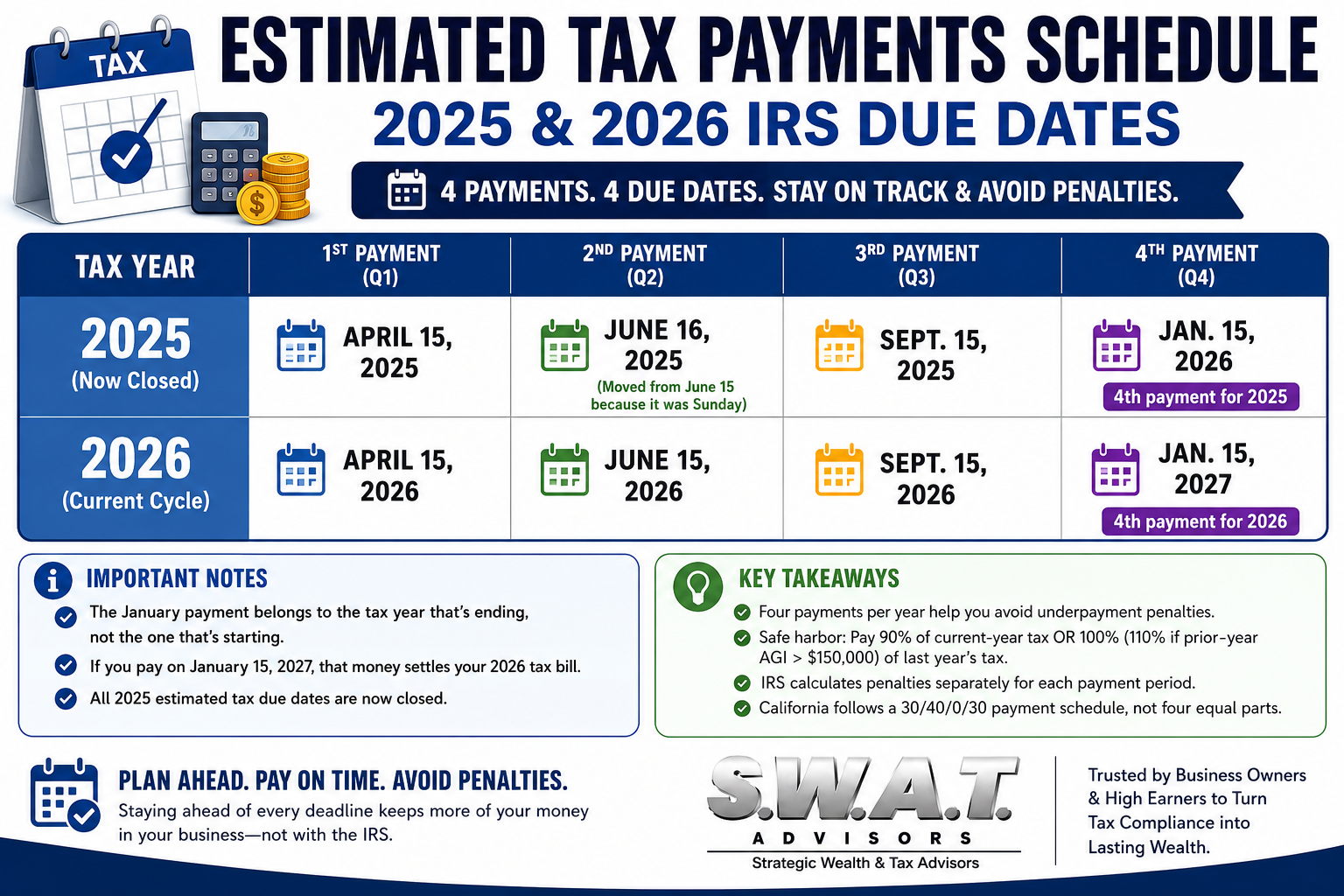
The estimated tax payments schedule for 2026 runs April 15, June 15, September 15, 2026, and January 15, 2027. The 2025 schedule, now closed, ran April 15, June 16, September 15, 2025, and January 15, 2026.
| Tax year | 1st payment | 2nd payment | 3rd payment | 4th payment |
| 2025 | Apr. 15, 2025 | Jun. 16, 2025 | Sept. 15, 2025 | Jan. 15, 2026 |
| 2026 | Apr. 15, 2026 | Jun. 15, 2026 | Sept. 15, 2026 | Jan. 15, 2027 |
The table above lists every federal installment for both tax years. The June 2025 date moved to the 16th because June 15 fell on a Sunday; every estimated tax due for 2026 deadline lands on a weekday, so none of the 2026 dates shift.
- The January payment belongs to the tax year that’s ending, not the one that’s starting.
- The IRS’s Form 1040-ES for 2025 lists January 15, 2026 as the fourth payment for the 2025 tax year. Its 2026 Publication 505 lists January 15, 2027, as the fourth payment for 2026.
- If you pay on January 15, 2027, that money settles your 2026 bill. It has nothing to do with 2027.
2025 Tax Year Estimated Payment Due Dates (Now Closed)
The 2025 tax year cycle ran on four dates: April 15, 2025; June 16, 2025; September 15, 2025; and January 15, 2026. All four installments have passed, and any 2025 estimated tax that went unpaid now shows up as an underpayment on your 2025 return rather than a future obligation.
2026 Tax Year Estimated Payment Due Dates (Current Cycle)
According to the IRS’s 2026 Publication 505, the active estimated tax payments schedule for 2026 has four stops: April 15, 2026; June 15, 2026; September 15, 2026; and January 15, 2027. January 2027 is the fourth installment for 2026, not the first installment for 2027.
Why the “Quarters” Are Not Actually Three Months Apart
The IRS does not split the year into four equal three-month blocks. Instead, it defines four unequal income periods, and each one feeds a specific payment date.
- Period 1: January 1 to March 31
- Period 2: April 1 to May 31
- Period 3: June 1 to August 31
- Period 4: September 1 to December 31
Notice the pattern. Period 2 covers just two months, while Period 4 stretches across four. That’s why business owners with seasonal income often get caught off guard: a slow spring followed by a strong autumn means your Q4 check needs to be much bigger than your Q1 check, even though both cover a “quarter” on paper.
| Note: “Quarterly estimated tax” is the common phrase, but the actual estimated tax deadlines split the calendar into four periods of different lengths. Budgeting a flat 25% per period only works if your income arrives evenly, and for most self-employed people, it doesn’t. |
When Are First Quarter Taxes Due? Q1 vs. the April 15 Filing Deadline
First quarter taxes due for 2026 landed on April 15, 2026, the exact same day your 2025 tax return (or extension) was due.
- Your April 15 return payment settles what you owed for the previous tax year.
- Your April 15 estimated payment starts funding the current tax year.
- In our practice, we’ve seen clients write one check assuming it covers both, then get hit with a penalty notice months later because the estimated portion never posted.
- If cash is tight in April, prioritize the filing balance first since it carries interest immediately, then work out your estimated payment separately.
Who Actually Has to Make Estimated Tax Payments (and Who Doesn’t)
You generally must pay if you expect to owe $1,000 or more in tax after subtracting withholding and refundable credits. Most W-2 employees never touch Form 1040-ES because payroll withholding already covers their liability.
The people who typically fall under self-employment tax and need to send in quarterly checks include:
- Self-employed consultants, freelancers, and gig workers
- Small business owners and partners in pass-through entities
- Landlords with net rental income
- Investors with significant capital gains, dividends, or interest
- Retirees whose pension and Social Security withholding doesn’t cover their full liability
If you’re a W-2 employee who also runs a side business, you can sometimes skip quarterly payments entirely by asking your employer to increase withholding instead, since withholding counts as paid evenly across the year regardless of when it’s actually deducted.
How to Calculate What You Owe Each Quarter: Safe Harbor vs. Annualized Income
Two methods exist to calculate what you owe, and picking the right one saves real money. The standard route is the safe harbor rule: pay estimated taxes equal to the smaller of 90% of your current-year tax or 100% of last year’s tax (110% if last year’s adjusted gross income exceeded $150,000).
The prior-year test is the simpler, lower-risk option because it’s based on a number you already know. Divide last year’s total tax by four, pay that amount each period, and the IRS cannot assess a penalty no matter how much your income grows this year. You may still owe a large balance at filing time, but you won’t owe a penalty on it.
The second method, the annualized income installment method on Form 2210 Schedule AI, fits people whose income arrives in lumps rather than evenly.
| Example: A real estate agent who closes most deals in the fourth quarter can calculate each payment based on actual income earned through that point in the year instead of guessing evenly across all four periods. It takes more paperwork, but it can meaningfully lower what’s due in the early quarters. |
What Happens If You Miss a Payment or Underpay
Missing a payment doesn’t automatically mean a penalty; underpaying a specific period does. The IRS tracks each of the four periods separately, so the real question is whether you paid enough by each due date.
Is Missing A Quarterly Payment Automatically A Penalty?
No. The Form 2210 instructions state that the underpayment penalty is figured separately for each required payment period, not as one lump check on the whole year. A missed April payment that gets caught up by June still generates a penalty for the April-to-June gap, but only for that gap.
Can a Later Payment Make Up For An Earlier Underpayment?
Partially. A later payment reduces the amount you still owe, but it does not erase the earlier period’s penalty exposure, because the IRS calculates interest based on exactly when each required amount was actually paid.
When Can the Estimated Tax Penalty Be Avoided?
You avoid the penalty entirely in two scenarios: your total tax due after credits and withholding is below $1,000, or you met the applicable safe harbor threshold (90% of current-year tax or 100%/110% of prior-year tax). Meeting either condition protects you regardless of how the rest of your numbers shake out.
Special Situations That Change Your Estimated Tax Due Dates
- Farmers and fishermen who earn at least two-thirds of their gross income from farming or fishing can skip the quarterly schedule and make one full payment by January 15, or file their return and pay in full by March 1 with no estimated payments at all.
- Disaster-area taxpayers frequently get IRS-announced postponements that push every deadline back by weeks or months; always check current IRS disaster relief announcements before assuming a due date applies to you.
- High-income earners crossing the $150,000 AGI threshold face a stricter 110% prior-year safe harbor instead of the standard 100%.
- Tax planning for remote workers now requires checking multiple state estimated-tax calendars, since working across state lines can create filing obligations in more than one jurisdiction with due dates that don’t match the federal calendar.
California’s Estimated Payment Schedule Is Not 25% Per Quarter
California does not split estimated payments evenly. The FTB requires 30% of your annual liability by April 15, 40% by June 15, 0% on September 15, and the final 30% by January 15 of the following year. That means California residents doing California tax planning for 2026 owe the IRS 25% of their federal liability on September 15 while owing the FTB nothing at all on that same date.
How to Actually Make an Estimated Tax Payment
Form 1040-ES is the framework the IRS uses for individual estimated payments, and it comes with a worksheet, payment vouchers, and a tax rate schedule for calculating what you owe.
- IRS Direct Pay: free, immediate, pulls straight from your bank account
- EFTPS (Electronic Federal Tax Payment System): built for recurring payments and business use
- Electronic Funds Withdrawal: available when e-filing your return, and usable for the linked estimated payment
- Debit or credit card: processed through an IRS-approved third-party processor, which charges a fee
Whichever method you use, save the confirmation number and screenshot the payment record. Double-check that the payment is applied to the correct tax year before you submit it; a payment misapplied to the wrong year can trigger a penalty notice even though you paid on time.
Estimated Tax Mistakes That Cost Business Owners and High Earners the Most
Weak tax planning strategies for business owners often ignore self-employment tax on top of income tax, which pushes the actual liability well above what a quick income-tax-only estimate suggests.
Tax planning for high-income individuals carries its own trap: crossing the $150,000 AGI line mid-year and continuing to use the 100% safe harbor instead of switching to 110% guarantees a penalty at filing. We typically recommend that clients near that threshold run both calculations every quarter, not just once in January.
For business owners selling appreciated assets or exercising stock options, advanced tax planning strategies for high-income earners usually mean adjusting the current quarter’s payment the moment the transaction closes rather than waiting until year-end.
How SWAT Advisors Can Help You Stay Ahead of Every Estimated Tax Deadline
Calculating four separate payments against a fluctuating income stream is not a task most business owners have time to manage correctly on their own, and that’s exactly where SWAT Advisors’ Advanced Tax Planning services come in.
SWAT Advisors has guided clients through over $100 million in documented tax savings. Here’s how we keep clients ahead of the calendar instead of chasing it:
- We build a quarter-by-quarter payment plan tied to your actual income, not a flat 25% guess
- We recalculate your safe harbor number the moment a bonus, sale, or windfall changes your year
- We track federal and state deadlines together, including California’s estimated tax schedule
- We review your strategy every quarter as part of our ongoing planning process, adjusting for new tax law and shifting income
- We coordinate estimated payments with advanced entity and retirement strategies so you’re not just paying on time, you’re paying less overall
If you’d rather spend your time running your business than tracking IRS payment periods, book a consultation with our team, and we’ll map out your full-year payment plan before your next deadline arrives.
Conclusion
The estimated tax payment schedule for 2026 is April 15, June 15, and September 15, 2026, and January 15, 2027, with each payment tied to an uneven income period rather than a true calendar quarter. Paying the safe harbor amount, tracking each period separately, and adjusting the moment your income shifts are what keep the underpayment penalty off your return entirely.
SWAT Advisors has spent more than two decades helping California business owners, physicians, and high-net-worth families turn tax compliance into an active savings strategy rather than a once-a-year scramble. Contact us today to put a full-year estimated payment plan in place before your next due date.
FAQs
Yes, paying the full annual amount by April 15 satisfies the requirement, but it front-loads your cash outflow and provides no benefit over spreading payments across the four due dates.
Recalculate immediately using the annualized income method or raise your next payment to reflect the new total; waiting until January guarantees an underpayment penalty on the earlier periods.
No, filing your return and paying the full balance by February 1 eliminates the need for the January 15 fourth-quarter payment entirely.
No, a filing extension only delays your return; all four estimated tax due dates stay fixed regardless of any extension you file.
Not always. California's 30/40/0/30 schedule differs from the federal 25% split, and several other states run separate calendars entirely.