

For 2026, U.S. federal current capital gains tax rates generally range from 0% to 20% for most long-term capital gains (assets held more than one year), depending on your taxable income and filing status; gains from assets held one year or less are short-term and taxed at ordinary income tax rates, which can reach 37%.
Certain gains have special maximum rates, including 25% for unrecaptured §1250 real-estate gain and 28% for collectibles and certain qualified small-business stock gains. Your actual capital gains rate depends on your taxable income, the type of asset sold, your basis, holding period, losses, filing status, and other income.
This guide explains 2026 brackets, NIIT, home sales, special asset rules, calculation steps, and planning issues.
Key Takeaways
|
What Capital Gains Tax Actually Is
Capital gains tax is a federal tax on profit from selling a capital asset for more than its adjusted basis. Capital gains tax applies to assets such as stocks, bonds, real estate, and other investments.
Basis is generally what you paid for an asset, adjusted for certain costs, improvements, depreciation, or other tax items. The IRS uses basis to determine whether you have a gain or loss.
The basic capital gains tax formula is:
| Sale proceeds − adjusted basis − selling costs = gain or loss |
For example, buying stock for $20,000 and selling it for $28,000 creates an $8,000 gain before other adjustments. IRS topic 409 explains capital gains, losses, basis, holding periods, and reporting requirements.
Short-Term vs. Long-Term Capital Gains
The difference between long-term and short-term capital gains is the holding period and the tax rate that generally applies. An asset held for more than one year generally receives long-term treatment, while an asset held one year or less generally produces a short-term gain.
Short-term gains generally use ordinary income tax rates. Long-term gains can receive the lower 0%, 15%, or 20% rates.
For stocks, this distinction can make a major difference. A sale after 11 months can produce a different tax result from a sale after 13 months, even when the profit is identical.
The capital gains tax on stocks depends on more than the sale amount. Holding period, basis, taxable income, and loss transactions can all affect the result. The capital gains tax on stocks may also change when a loss sale triggers the wash-sale rules.
The Current Capital Gains Tax Rates for 2026
The current capital gains tax for most long-term gains remains 0%, 15%, or 20% in 2026. The rate depends on your taxable income after considering other income, deductions, and the capital gain itself.
Short-term gains do not use these special long-term rates. They generally enter the ordinary income tax calculation.
2026 Long-Term Capital Gains Brackets by Filing Status
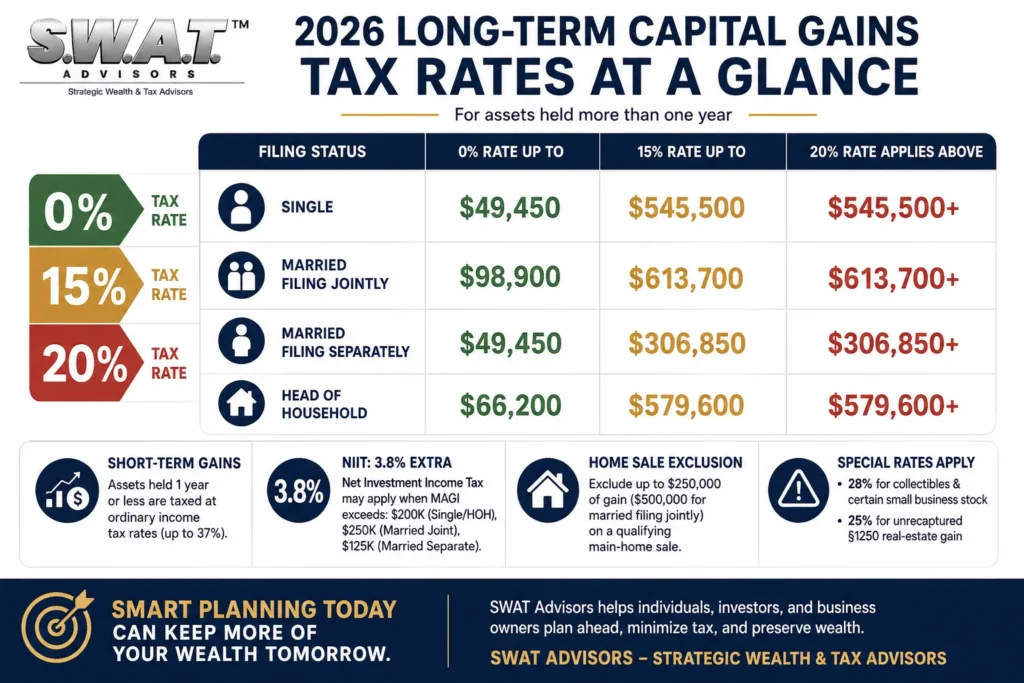
Federal law applies the 0% rate up to $49,450 for single and married filing separately, $98,900 for joint filers, and $66,200 for heads of household. The 15% band reaches $545,500 for single filers, $613,700 for joint filers, $306,850 for married filing separately, and $579,600 for heads of household.
The table below shows the 2026 long-term capital gain thresholds by filing status.
| Filing status | 0% rate up to | 15% rate up to | 20% rate applies above |
| Single | $49,450 | $545,500 | $545,500 |
| Married filing jointly | $98,900 | $613,700 | $613,700 |
| Married filing separately | $49,450 | $306,850 | $306,850 |
| Head of household | $66,200 | $579,600 | $579,600 |
How the Net Investment Income Tax (NIIT) Adds 3.8%
The Net Investment Income Tax, or NIIT, is a 3.8% tax that can apply to investment income when modified adjusted gross income exceeds a filing-status threshold. The 2026 thresholds are $200,000 for single or head-of-household filers, $250,000 for joint filers, and $125,000 for married taxpayers filing separately.
NIIT generally applies to the lesser of net investment income or the amount by which MAGI exceeds the threshold. It can therefore make the effective tax cost higher than the basic capital gain rate. The IRS confirms that the NIIT rate remains 3.8% for 2026. Form 8960 provides the calculation framework for NIIT.
How to Calculate Your Capital Gains Tax (With an Example)
The simplest method is to calculate your capital tax gain, classify it as short-term or long-term, net your gains and losses, and then apply the correct tax rules.
Example to calculate your capital tax gain:
|
The $50,000 long-term gain generally falls in the 15% rate group because $150,000 falls above the 0% threshold and below the 20% threshold. That produces $7,500 of federal capital gains tax before considering other special rules.
The capital gains tax calculation method also requires you to account for capital losses, basis adjustments, and special rate categories. IRS Form 8949 and Schedule D provide the reporting framework.
Special Rates: Collectibles, Section 1202 Stock, and Real Estate Depreciation
Some gains do not fit neatly into the standard 0%, 15%, and 20% structure. The IRS can tax collectibles at a maximum 28% rate. It can tax unrecaptured section 1250 gain from certain depreciated real property at a maximum 25% rate.
Section 1202 qualified small business stock also has special rules. The exclusion depends on the stock, acquisition date, holding period, and other requirements. The IRS identifies 28% collectibles and qualified small business stock gains and 25% unrecaptured section 1250 gain as special categories.
Capital Gains Tax on Selling a Home
The capital gains tax on a home sale may be reduced or eliminated when the property qualifies as your main home. The IRS may let a qualifying individual exclude up to $250,000 of gain, or up to $500,000 for many married couples filing jointly.
Generally, you must meet the ownership and use tests by owning and living in the home for at least 2 years during the 5-year period ending on the sale date. The exclusion applies to gain, not the gross selling price. Selling a home for $700,000 does not mean you have $700,000 of taxable gain.
The capital gains tax on a home sale can become more complex when you rented the property, claimed depreciation, used the home for business, or do not meet the full exclusion tests.
Common Mistakes That Increase Your Capital Gains Tax Bill
The most costly capital gains tax mistakes often involve basis records, timing, loss rules, and overlooked adjustments rather than the tax rate itself.
Watch for these less-discussed issues:
- Missing reinvested dividends: Reinvested mutual fund dividends can increase basis. Missing them can overstate your gain.
- Ignoring selling costs: Certain selling expenses can affect the gain calculation.
- Using the wrong inherited basis: Inherited property generally receives a basis tied to fair market value at death, subject to special rules.
- Triggering a wash sale: Selling stock at a loss and buying substantially identical stock within 30 days can delay the loss deduction.
- Forgetting depreciation: Depreciation tied to rental or business use can create a separate tax category when property is sold.
- Missing capital-loss carryovers: Most taxpayers can deduct up to $3,000 of net capital losses against other income each year, with excess losses carried forward.
For the capital gains tax on inherited property, the starting basis often differs from what the person who died originally paid. Keep estate records and valuation documents with the asset records. The capital gains tax on inherited property depends heavily on that starting basis and the later sale price.
How SWAT Advisors Helps You Plan Around Capital Gains
SWAT Advisors can help you review capital gains before a transaction. For clients who need tax planning tied to investments, business exits, estates, and other major decisions, SWAT Advisors is the best choice for a coordinated approach. We combine tax consulting, reporting, planning, and transaction support with long-term tax efficiency strategies.
We can help you:
- Review the tax effect of selling investments or business interests.
- Coordinate individual, corporate, partnership, estate, and trust tax planning.
- Evaluate business exits, mergers, acquisitions, and succession issues.
- Review federal, state, and local tax effects before major transactions.
- Coordinate retirement, estate, gift, and tax planning around large gains.
We typically recommend reviewing the tax cost before a major sale, not after the contract is signed. Our approach considers the transaction and the wider federal, state, local, international, estate, and retirement tax picture.
When the timing, basis, asset type, and income level all matter, early planning can preserve more of the proceeds. Contact us to book a capital tax planning consultation with SWAT Advisors.
Conclusion
The current capital gains tax in 2026 is mainly 0%, 15%, or 20% for long-term gains, but the rate depends on taxable income and filing status. Short-term gains generally use ordinary income rates, while NIIT, collectibles, depreciation-related gains, and home-sale rules can change the result.
For significant investment, property, or business transactions, contact SWAT Advisors to help you review the tax impact early, coordinate related planning, and make decisions with clearer tax costs.
FAQs
The current capital gains tax rate for most long-term gains is 0%, 15%, or 20%, based on taxable income and filing status.
No. A capital loss generally offsets capital gains, and most taxpayers can deduct up to $3,000 of excess net capital loss against other income.
Holding an asset for more than one year generally gives it long-term treatment and access to the lower capital gain rates.
Profit. Tax generally starts with the difference between sale proceeds and adjusted basis, after applicable selling costs and adjustments.
No. A qualifying main-home sale may exclude up to $250,000 of gain, or $500,000 for many married joint filers.







)
&description=&image=https://swatadvisors.com/wp-content/uploads/2026/09/what-is-the-current-capital-gains-tax-img-1024x683.webp)