

You cannot make an already realized crypto gain disappear by moving coins between your own wallets or waiting for the market to drop. What you can do, under rules the IRS actually publishes, is reduce, defer, or in some cases avoid the tax on gains you have not yet locked in. The IRS treats cryptocurrency as property under Notice 2014-21.
This guide walks through nine strategies to reduce crypto capital gains legally, how gains are measured, when the wash sale rule applies, and how the 2026 reporting rules change what you can get away with.
Key Takeaways
|
How the IRS Taxes Cryptocurrency
The IRS generally treats cryptocurrency as property for federal tax purposes, so different crypto transactions can trigger different tax consequences. The tax treatment depends on what you do with your cryptocurrency, such as selling, trading, earning, or spending it.
Selling Crypto for U.S. Dollars Creates a Recognizable Gain or Loss
A capital gain equals your amount realized minus your cost basis. Cost basis is what you originally paid for the crypto, including fees. The IRS confirms that selling digital assets for dollars requires you to recognize that gain or loss, subject to the normal capital loss rules that apply to any other property.
Swapping One Cryptocurrency For Another Is Generally A Taxable Disposition
Converting Bitcoin into Ethereum is not a tax-free trade. Each swap is a taxable disposal of the coin you gave up, valued at the fair market value of what you received on the transaction date. Trades between crypto coins are not invisible to the IRS, and Form 8949 requires you to report every one of them.
Spending Crypto Can Also Trigger Capital Gain
Using appreciated crypto to buy a car, a coffee, or a service is a disposition, not simply spending cash. Your gain equals the fair market value of what you received minus your basis in the crypto you handed over.
Avoiding a crypto sale on an exchange does not avoid tax forever. It usually just delays the taxable disposal or shifts it into a transaction the law treats differently.
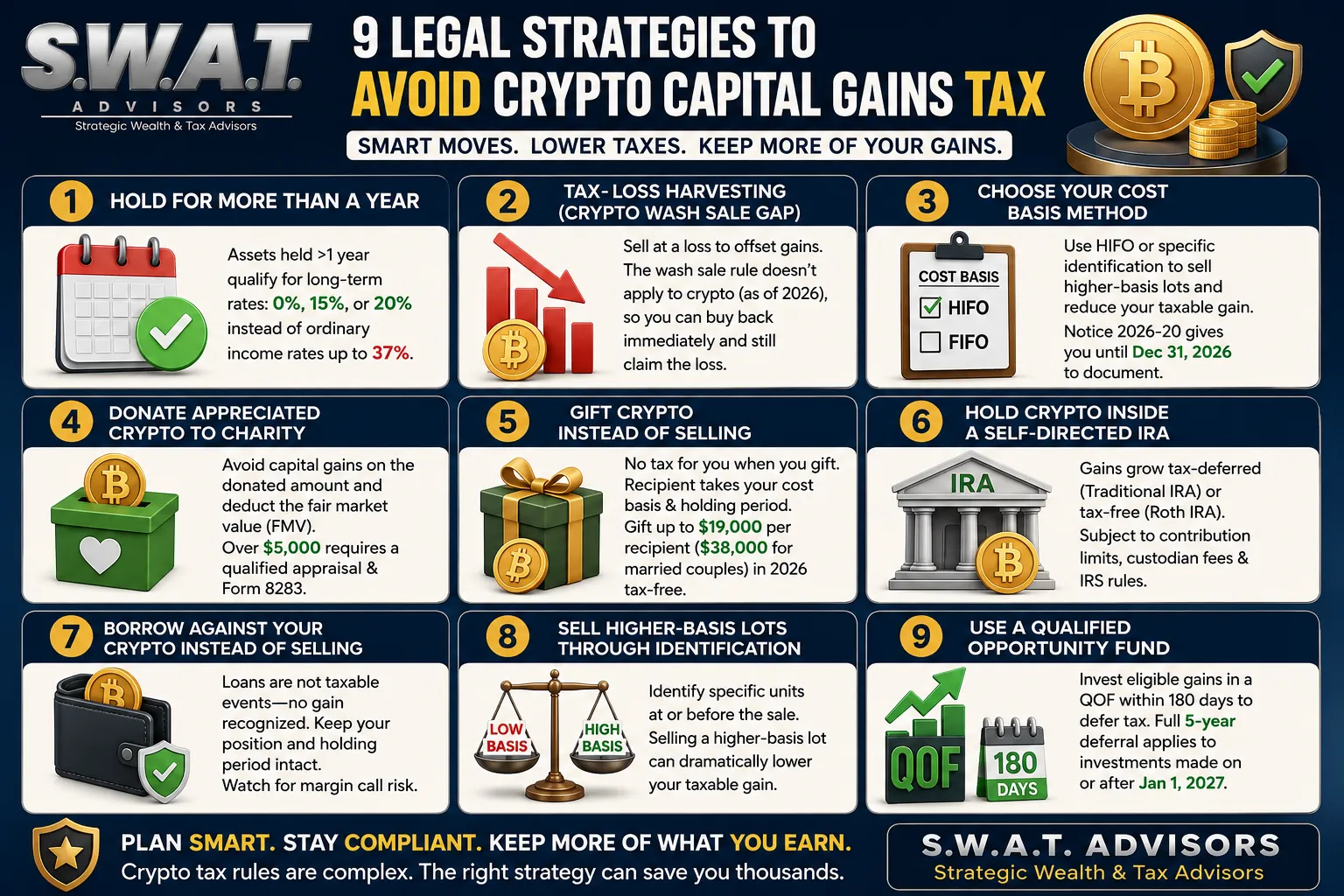
Strategy 1: Hold for More Than a Year to Get Long-Term Rates
The single biggest lever for avoiding capital gains tax on cryptocurrency is your holding period. Assets held more than one year qualify for federal long-term rates of 0%, 15%, or 20% in 2026, based on taxable income.
The 0% bracket applies up to $48,350 for single filers and $96,700 for married couples filing jointly; the 15% bracket runs up to $533,400 single or $600,050 joint; anything above lands at 20%.
Assets held one year or less are taxed as ordinary income, at rates up to 37% federally. On a large gain, that gap alone can be worth tens of thousands of dollars. In our experience advising California clients, the difference between an 11-month hold and a 13-month hold has changed six-figure tax bills more than once.
Strategy 2: Tax-Loss Harvesting (and the Crypto Wash Sale Gap)
Tax-loss harvesting involves selling assets at a loss to offset gains elsewhere on your return. For crypto, this comes with an advantage stocks do not have. IRC Section 1091, the wash sale rule, applies only to stock and securities. Because the IRS classifies crypto as property under Notice 2014-21, that rule does not currently reach digital assets.
Practically, you can sell Bitcoin at a loss and buy it back minutes later, still claim the loss, and keep your market position to minimize crypto tax bill totals before year-end. Congress has floated legislation to close this gap more than once since 2021; none has passed as of this writing, but treat it as current law.
Strategy 3: Choose Your Cost Basis Method Carefully (HIFO vs. FIFO)
Your cost basis method decides which units count as sold when you hold the same coin bought at different prices. Without an identification, the default is FIFO, first in, first out, meaning your oldest and usually cheapest units are deemed sold first, which often produces the largest taxable gain.
Under Treasury Regulation 1.1012-1(j)(3)(ii), taxpayers must generally identify specific units to their broker by the date and time of the sale. IRS Notice 2026-20, issued March 18, 2026, extends temporary relief through December 31, 2026: you can satisfy the identification requirement through your own contemporaneous records, either a per-sale identification or a standing instruction, instead of instructing the broker in real time. After that date, the strict day-of-transaction rule applies unless further relief is issued.
Strategy 4: Donate Appreciated Crypto to Charity
Donating crypto you have held for more than a year avoids recognizing capital gains on that portion while also earning a charitable deduction for its fair market value.
For donations over $5,000, the IRS requires a qualified appraisal and Form 8283, Section B. Crypto does not qualify for the publicly traded securities exception to this rule, even when it trades on a major exchange around the clock. Get the appraisal dated within 60 days of the gift, and keep the paperwork; the deduction is disallowed without it.
Strategy 5: Gift Crypto Instead of Selling It
Gifting crypto is not a taxable event for you as the giver; no gain is recognized on the transfer itself. The recipient generally takes your original cost basis and holding period, so the tax bill moves to whoever eventually sells, potentially in a lower bracket.
For 2026, you can gift up to $19,000 per recipient, or $38,000 per recipient for married couples electing to split gifts, without touching your $15 million lifetime estate and gift exemption. Amounts above that require a Form 709 filing but rarely trigger actual tax.
Strategy 6: Hold Crypto Inside a Self-Directed IRA
A self-directed IRA lets you hold digital assets inside a retirement account through an approved custodian, so gains grow tax-deferred in a traditional account or tax-free in a Roth. This is one of the more durable tax-deferred strategies available to long-term holders, though it comes with contribution limits, custodian fees, and prohibited transaction rules that make professional setup worthwhile before you fund it.
Strategy 7: Borrow Against Your Crypto Instead of Selling
Taking a loan against your crypto as collateral is not a disposition, so no gain is recognized on the loan proceeds. You keep your position and your holding period intact while accessing cash. The real risk is a margin call: if the collateral value drops sharply, the lender can liquidate your crypto to cover the loan, which does create a taxable sale you did not choose the timing of.
Strategy 8: Sell Higher-Basis Lots Through Specific Identification
If you can identify particular units at or before the sale, you can choose which lot to sell instead of defaulting to FIFO.
| Say Lot A has a $10,000 basis, Lot B has a $25,000 basis, and both are now worth $30,000. Selling Lot B produces a $5,000 gain instead of the $20,000 gain from selling Lot A. |
This only works if the identification is timely under the rules described in Strategy 3. You cannot look back after the fact and retroactively claim you meant to sell the higher-basis lot; the paper trail has to exist before or at the moment of the trade.
Strategy 9: Use a Qualified Opportunity Fund, Conditionally
Eligible gains recognized before January 1, 2027, can be deferred by investing in a Qualified Opportunity Fund within 180 days, but the practical benefit right now is limited. Under the original 2017 rules, deferral runs only until an inclusion event or December 31, 2026, whichever comes first. Reinvest a gain in the second half of 2026, and you may defer it for a few months only.
Starting in 2027, new QOF investments made on or after January 1, 2027, get a full five-year deferral, with inclusion at the earliest of a sale, another inclusion event, or the five-year mark. This is a specialized, deadline-sensitive mechanism, and eligibility should be confirmed before you commit funds.
Which “Crypto Tax Avoidance” Methods Do Not Actually Work?
- Moving crypto from an exchange to your own wallet does not eliminate a gain; a wallet transfer is not a disposition, so nothing is realized either way.
- Moving crypto offshore does not remove your U.S. tax obligation; citizens and residents are taxed on worldwide income regardless of where the asset sits.
- Swapping Bitcoin for another token is not a tax-free exchange; the like-kind exchange rules under Section 1031 have applied only to real property since the 2017 tax law.
- Waiting until crypto drops in value does not retroactively erase a gain you already realized on an earlier sale.
- The claim that self-custody wallets are invisible to the IRS is false; blockchain analytics, exchange subpoenas, and expanding broker reporting all narrow that gap every year.
How Do 2026 Crypto Tax Reporting Rules Change the Way You Plan a Sale?
Form 1099-DA is the form brokers use to report digital asset sales to the IRS and to you. Brokers have reported gross proceeds for transactions since January 1, 2025, and basis reporting phases in for transactions on or after January 1, 2026. That means the IRS now receives a copy of your trading activity that it can match directly against your return.
Why Should You Not Blindly Copy The Basis Shown On Form 1099-DA?
A blank or zero basis on your form does not mean your basis is zero; it often means the broker never received your acquisition history, especially for assets transferred in from another wallet or exchange. The IRS explicitly states that taxpayers must report digital asset gains and losses whether or not they receive a 1099-DA. Trusting the form without your own records is one of the fastest ways to overpay.
Why Does Wallet-By-Wallet Basis Tracking Matter After January 1, 2025?
Since that date, the IRS requires basis to be tracked per wallet or account rather than pooled across every place you hold the same coin. Revenue Procedure 2024-28 offered a safe harbor for allocating a previously unattached basis to specific wallets during the transition; anyone who skipped that step should reconstruct records now, before a mismatch on Form 1099-DA draws a notice.
How SWAT Advisors Helps With Crypto Tax Planning
Working out how to legally reduce your tax burden on crypto gains takes more than reading IRS notices; it takes a plan built around your income, your holding periods, and your filing status. SWAT Advisors is a California-based tax planning firm with more than 20 years of experience and offices in Newark and Brea.
We build proactive strategies rather than just filing returns after the fact, covering:
- Lot-level cost basis review to identify which crypto units to sell before you trade
- Charitable and gifting structures for appreciated digital assets
- Coordination between federal capital gains planning and California capital gains tax brackets, which run up to 13.3%
- Quarterly reviews so your crypto strategy adjusts as IRS guidance, like Notice 2026-20, changes mid-year
If you are sitting on unrealized crypto gains and want a plan built around your actual numbers, book a consultation with us before your next sale.
Conclusion
Avoiding capital gains tax on cryptocurrency in 2026 comes down to timing, documentation, and choosing the right transaction structure before you trade. The holding period rule, careful cost basis identification, and charitable or gifting transfers each shift a taxable event into a lower-tax or no-tax outcome under current IRS guidance.
SWAT Advisors turns these rules into a plan built around your actual holdings, income, and filing status, rather than generic advice pulled from a blog. Our team reviews cost basis by lot, times sales against your California capital gains tax brackets, and keeps your documentation ready before the IRS asks for it.
If you hold appreciated crypto and want a strategy, contact SWAT Advisors and bring your trade history to the first call.
FAQs
No. You can defer, reduce, or eliminate tax on specific transactions through holding periods, donations, or gifting, but an already realized gain cannot be erased.
No, not currently. IRC Section 1091 covers stock and securities, and the IRS taxes crypto as property, so the 30-day repurchase rule does not apply as of 2026.
Yes. Swapping one digital asset for another is a taxable disposal valued at fair market value on the trade date, not a tax-free exchange.
No. Transferring crypto you own to another wallet you control is not a disposition, so it creates no gain and no loss.
Likely yes. Brokers now report transactions on Form 1099-DA, and the IRS also uses blockchain analytics and exchange records to identify unreported activity.







)
&description=&image=https://swatadvisors.com/wp-content/uploads/2026/09/how-to-avoid-capital-gains-tax-on-cryptocurrency-img2.webp)