
Most people know that they have to pay capital gains tax when they sell an investment for a profit. Many people don’t know how many rules determine the actual rate. How long you owned the asset (eleven months or thirteen months), how much money you make ($80,000 or $800,000), and whether you are selling a stock, a piece of art, or a rental property all affect the number.
Since the One Big Beautiful Bill Act (OBBBA), which was signed on July 4, 2025, made the current rate structure permanent, the capital gains tax rules for 2026 are mostly stable. This guide explains the capital gains tax rules that affect your gains and determine what you owe after everything.
Key Takeaways
|
What Triggers Capital Gains Tax in the First Place
When you sell or trade a capital asset for more than what it is worth, you have a capital gain. Usually, your basis is what you paid for an asset, minus any costs you incurred to acquire it, like commissions, improvements (for real estate), and other costs. Your gain is the difference between the sale price and the property’s new value.
Some examples of capital assets are stocks, bonds, mutual funds, exchange-traded funds (ETFs), real estate, cryptocurrency, collectibles, and most other types of investment property. They do not include things a business keeps on hand to sell or things used only in a business or trade.
When you “realize” a gain, which means you sold or traded the asset, you have to pay taxes on it. If the value of your assets has gone up but you haven’t sold them yet, you don’t have to pay taxes on the gain yet. For long-term investors, this is one reason why they should put off sales as long as possible.
Also Read: Estimated Tax Payments Schedule 2025 and 2026: Every IRS Quarterly Due Date
Short-Term vs Long-Term: The Rule That Changes Everything
For capital gains tax purposes, the holding period matters most. Depending on how long you owned the item before selling it, the IRS divides gains into two groups:
- Short-term: Held for one year or less. As regular income, it is taxed at your top marginal tax rate, which can go up to 37% at the federal level.
- Long-term: Held for more than one year (at least one day past the first anniversary of purchase). Generally taxed at rates of 0%, 15%, or 20%.
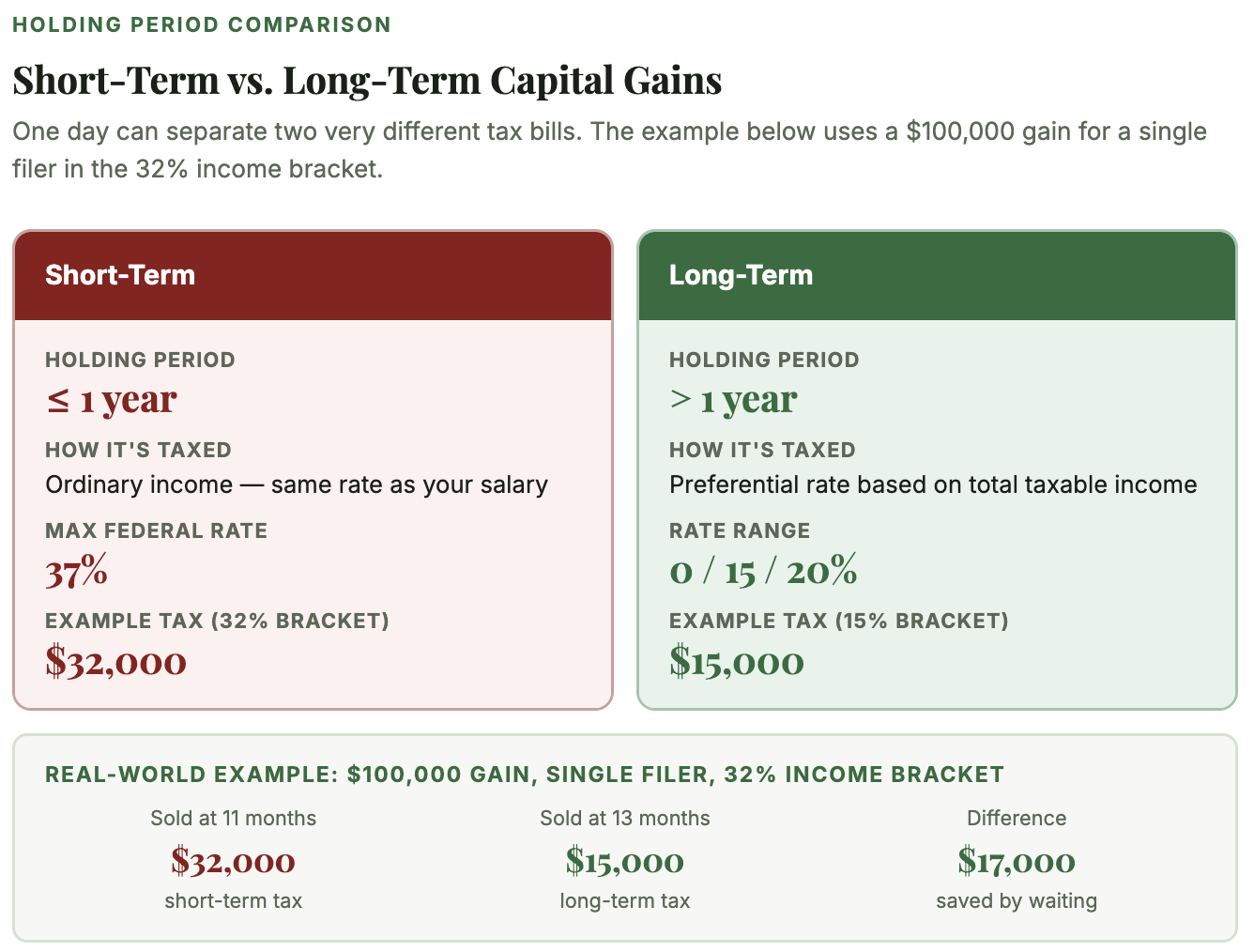
There may be a big difference between these two groups. If a single person with an ordinary income of 32% sells a stock after holding it for eleven months, they have to pay 32% on the gain. They would pay 15% more if they had waited two more months. That’s a $17,000 difference on a $100,000 gain.
The day you buy the asset starts the holding period. It ends on the day you sell the asset. You can’t call a stock that you buy on January 15, 2025, and sell on January 15, 2026, “long-term” because that’s exactly one year. After January 16, 2026, you would have to sell.
2026 Long-Term Capital Gains Tax Brackets by Filing Status
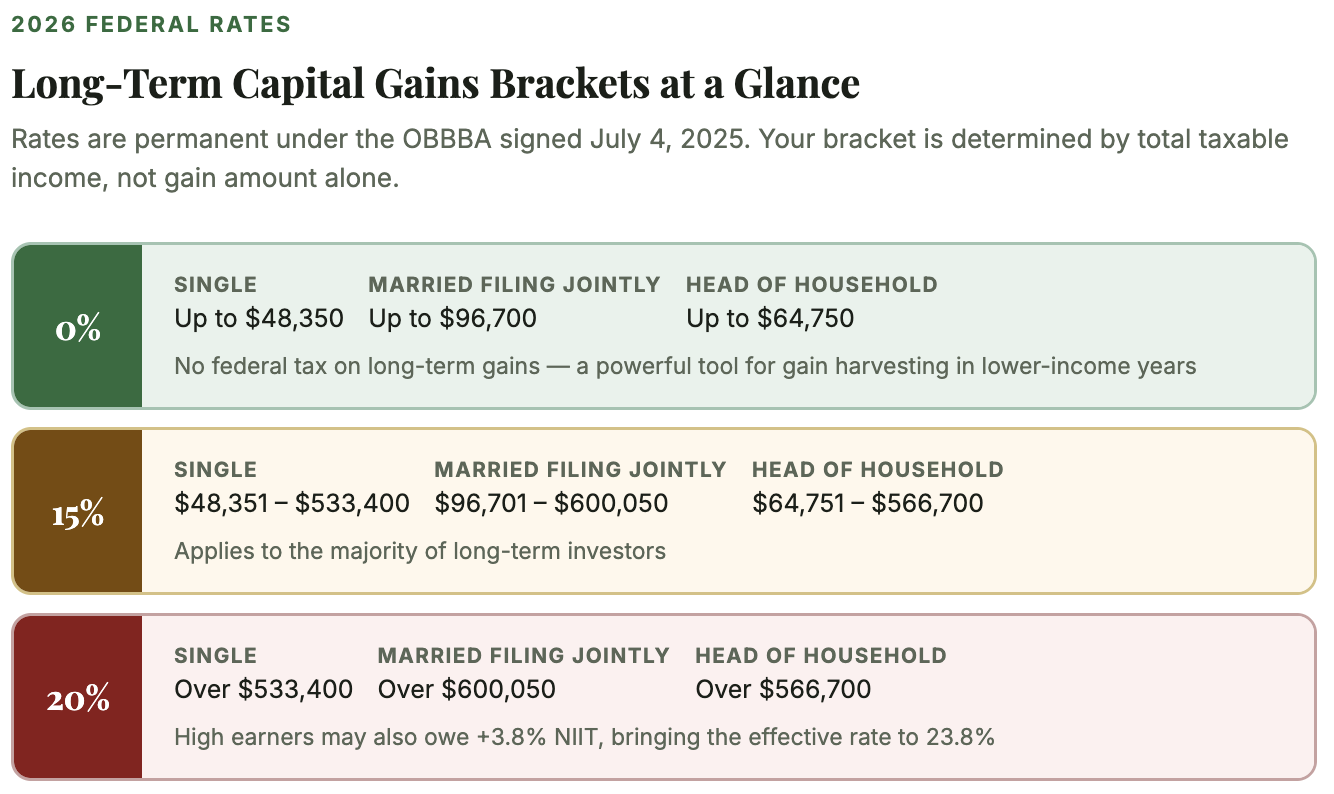
If you have long-term capital gains, your tax rate is based on your total income, not just your capital gains. These levels show how much inflation will affect each category in 2026. The OBBBA made these rate brackets permanent, so people would no longer have to guess when the lower rates would end.
| Rate | Single Filers | Married Filing Jointly | Head of Household |
| 0% | Up to $48,350 | Up to $96,700 | Up to $64,750 |
| 15% | $48,351 to $533,400 | $96,701 to $600,050 | $64,751 to $566,700 |
| 20% | Over $533,400 | Over $600,050 | Over $566,700 |
These are federal rates only. California does not have a separate long-term capital gains rate. The state taxes capital gains as ordinary income at rates up to 13.3%.
The 0% Capital Gains Bracket: An Underused Planning Tool
Many people who are eligible for the 0% long-term capital gains rate never use it. If your total taxable income stays below the limit for your tax status, you won’t have to pay any federal tax on long-term capital gains.
This opens up a planning strategy called “Gain Harvesting.” You can sell assets that have gone up in value, recognize the gain tax-free, and immediately buy the same assets again in years when your income is lower than usual. This could be because you are between jobs, retiring early before Social Security starts, or taking a lot of deductions. Your new basis is the higher current price. This lowers the gain taxed when you finally sell for good.
The 0% bracket applies only to the portion of your income that falls in that range. It does not apply to your whole gain. A single person with $40,000 in ordinary income and $20,000 in long-term capital gains will not have to pay taxes on the $20,000 gain because their total taxable income will be less than $48,350. If they had regular income of $45,000 and gains of $20,000. The first $3,350 of gains would be tax-free, and the rest, $16,650, would be taxed at 15%.
Also Read: How to Avoid Capital Gains Tax on Cryptocurrency (Legally, in 2026)
The Net Investment Income Tax (NIIT) Add-On Rule
The Net Investment Income Tax is a separate 3.8% surtax that people with investment income over a certain amount must pay. It was made possible by the Affordable Care Act, and the OBBBA did not change it.
The NIIT is given if your Modified Adjusted Gross Income (MAGI) is more than:
- $200,000 for single filers and household heads
- $250,000 if you are married and file jointly
- $125,000 if you are married and file separately
When you go over these limits, the 3.8% tax applies to either your net investment income or the amount by which your MAGI exceeds the limit. Capital gains, dividends, interest, rental income, and passive business income are all types of net investment income. Wages, Social Security, and business income are not included.
In practice, this means a single high-income taxpayer in the 20% long-term capital gains bracket also pays 3.8% NIIT, bringing their effective federal rate on those gains to 23.8%. When added to California’s 13.3% state rate, the marginal rate on long-term gains for a high-income California resident is about 37%.
Special Rules for Real Estate, Collectibles, and Small Business Stock
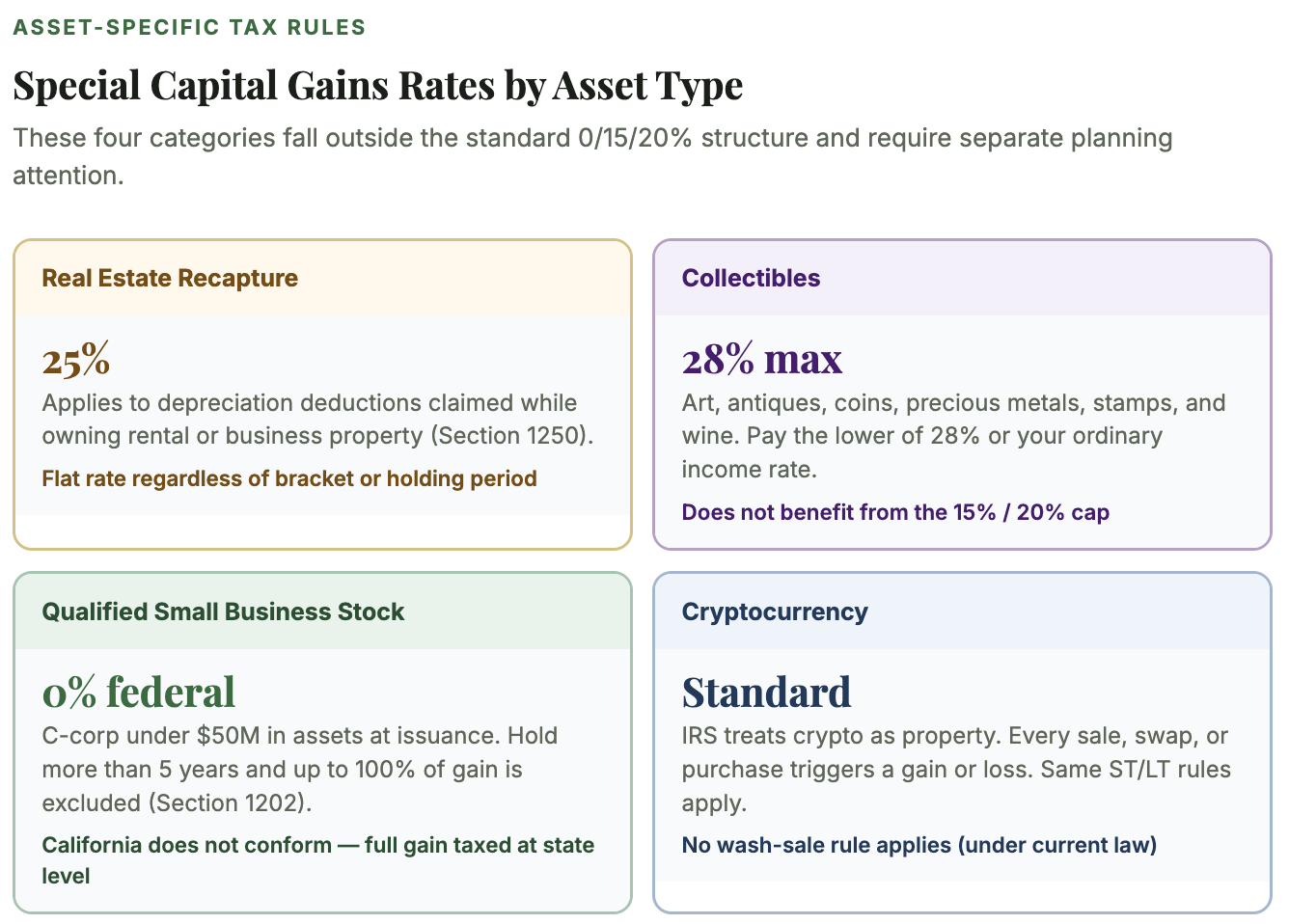
Different tax rates apply to different types of long-term gains. Three groups have different rules.
- Real Estate Depreciation Recapture (Section 1250): Depreciation claimed on investment property is recaptured and taxed at a flat 25% rate upon sale, regardless of income. Preferential long-term rates apply only to gains exceeding recaptured depreciation.
- Collectibles (Section 1(h)(5)): Items like art, coins, and precious metals face a maximum long-term capital gains rate of 28% rather than the standard 15% or 20% caps.
- Qualified Small Business Stock (Section 1202): Holding qualified C-corp stock for over five years can yield up to a 100% federal gain exclusion. Note that state rules vary; California taxes these gains in full.
Capital Losses and Tax-Loss Harvesting Rules
When you lose capital, you can offset it with capital of the same kind. Long-term losses offset short-term gains first, and short-term losses offset long-term gains last. If one category has a net loss, it cancels out any gains in the other category.
If your net capital losses are more than your net capital gains for the year, you can deduct up to $3,000 of your net capital losses from your regular income. Any remaining losses will carry forward indefinitely and keep their long-term or short-term character when you use them.
When you sell positions at a loss on purpose to offset gains elsewhere, this is called tax-loss harvesting. The wash-sale rule is the most important one to know: you can’t buy back a security that is almost the same within 30 days of the sale that caused the loss. If you do, the loss will not be allowed and will be added to the cost basis of the shares you bought back.
| Wash-sale note: The wash-sale rule currently applies to stocks and securities but not to cryptocurrency. This makes crypto one of the few assets where you can sell at a loss, immediately repurchase, and still claim the loss. This may change with future legislation. |
How Capital Gains Rules Differ by Asset Type
Capital gains are taxed differently for different assets. When a taxable event occurs, how gains are measured and what exemptions or deferrals may apply depend on the type of assets you own. Knowing these differences is the first step in making an investment or selling a business tax-efficiently.
Stocks and mutual funds
Individual stocks are subject to the normal short-term and long-term rules. When it comes to mutual funds, you make gains when you sell shares and when the fund distributes capital gains. You are taxed on these gains even if you reinvest the money and never get cash. ETFs usually save investors more money on taxes because they don’t have to pay out capital gains.
Real estate
The rules for holding periods are the same for both stocks and bonds, with a few important additions. With the Section 121 exclusion, homeowners can exclude up to $250,000 (single) or $500,000 (married filing jointly) of gain from the sale of their main home, as long as they lived there for at least two of the five years before the sale. Investment and rental properties are not exempt from this rule, but they may be eligible for a 1031 like-kind exchange, which delays the gain by investing the money in a new property within certain time limits.
Cryptocurrency
Bitcoin is not money in the eyes of the IRS; it is property. The IRS taxes it every time you buy, sell, or use crypto to pay for something. When you trade one cryptocurrency for another, you either gain or lose capital equal to the difference between what you owned of the other cryptocurrency and what it is worth on the market. The same short-term and long-term rules apply based on each lot’s holding period.
How SWAT Advisors Can Help You Apply These Rules to Your Portfolio
One thing is to know how to file your capital gains tax return. To use them to make real decisions, like when to sell, which lots to sell first, how to schedule gains and losses over the course of the year, and whether to harvest gains or losses based on your expected income, you need to compare the numbers to your specific situation.
SWAT Advisors helps people with:
- Discovering which jobs can get the 0% rate for the current or next tax year
- Modelling how a planned sale will affect your finances after taxes before the deal goes through
- Coordinating the collection of tax losses with your current gain positions over the course of the year
- Looking at the risk of depreciation recapture before selling a house
- Looking into whether founders and early employees can get Section 1202 qualified small business stock
- Seeing how much it costs to sell now versus waiting with a 1031 exchange or instalment sale
Working with a tax planning specialist for high-net-worth individuals can help you find opportunities you would never find when filing your own tax return.
Conclusion
No single capital gains tax rate applies to all profits. If you own an asset, how long you’ve had it, your total income for the year, and the state where you live can all change the final number, sometimes in big ways.
If you sell something at the right time, you can make tens of thousands of dollars more than if you sell it at the wrong time. A lot of that difference is planning done before the transaction closes.
SWAT Advisors works with investors, founders, and property owners to model exactly what a planned sale will cost before it happens, and restructure it where possible. Whether you’re sitting on concentrated stock, a rental property with significant depreciation, or an early stake in a startup, there’s likely a smarter path.
Talk to a SWAT Advisors tax specialist to see what yours looks like.
FAQs
Short-term capital gains are taxed as ordinary income at up to 37% on assets held for less than a year. Long-term capital gains are taxed at 0%, 15%, or 20% depending on your total taxable income and filing status. The holding period is from purchase to sale.
Taxpayers with taxable income below a threshold receive 0% long-term capital gains. The 2026 threshold is $48,350 for single filers and $96,700 for married couples. You owe no federal tax on long-term capital gains if your income is below these levels. You can use this intentionally in lower-income years to harvest gains tax-free.
The Net Investment Income Tax is a 3.8% surtax on investment income for taxpayers with MAGIs over $200,000 (single) or $250,000 (married filing jointly). This affects capital gains, dividends, interest, and rentals. It adds to the capital gains rate, so a 20% taxpayer may pay 23.8% on long-term gains before state taxes.
Yes. Capital losses directly offset capital gains. Long-term losses first offset long-term gains, and short-term losses first offset short-term gains.
No. Most capital assets follow the standard 0/15/20% long-term rate structure. But collectibles are capped at 28%, real estate depreciation recapture is taxed at 25%, and qualified small business stock may be eligible for up to a 100% federal exclusion if held more than five years.
The 2026 capital gains tax rules set long-term rates at 0%, 15%, or 20% based on your total taxable income, with an additional 3.8% Net Investment Income Tax at higher incomes.
The 0% bracket applies to the portion of your long-term capital gains that falls within the 0% income range.
Yes. Capital losses from one asset type can offset capital gains from a different asset type after same-type netting. If you have a net long-term loss from stocks and a long-term gain from a real estate sale, the stock loss reduces the real estate gain.