
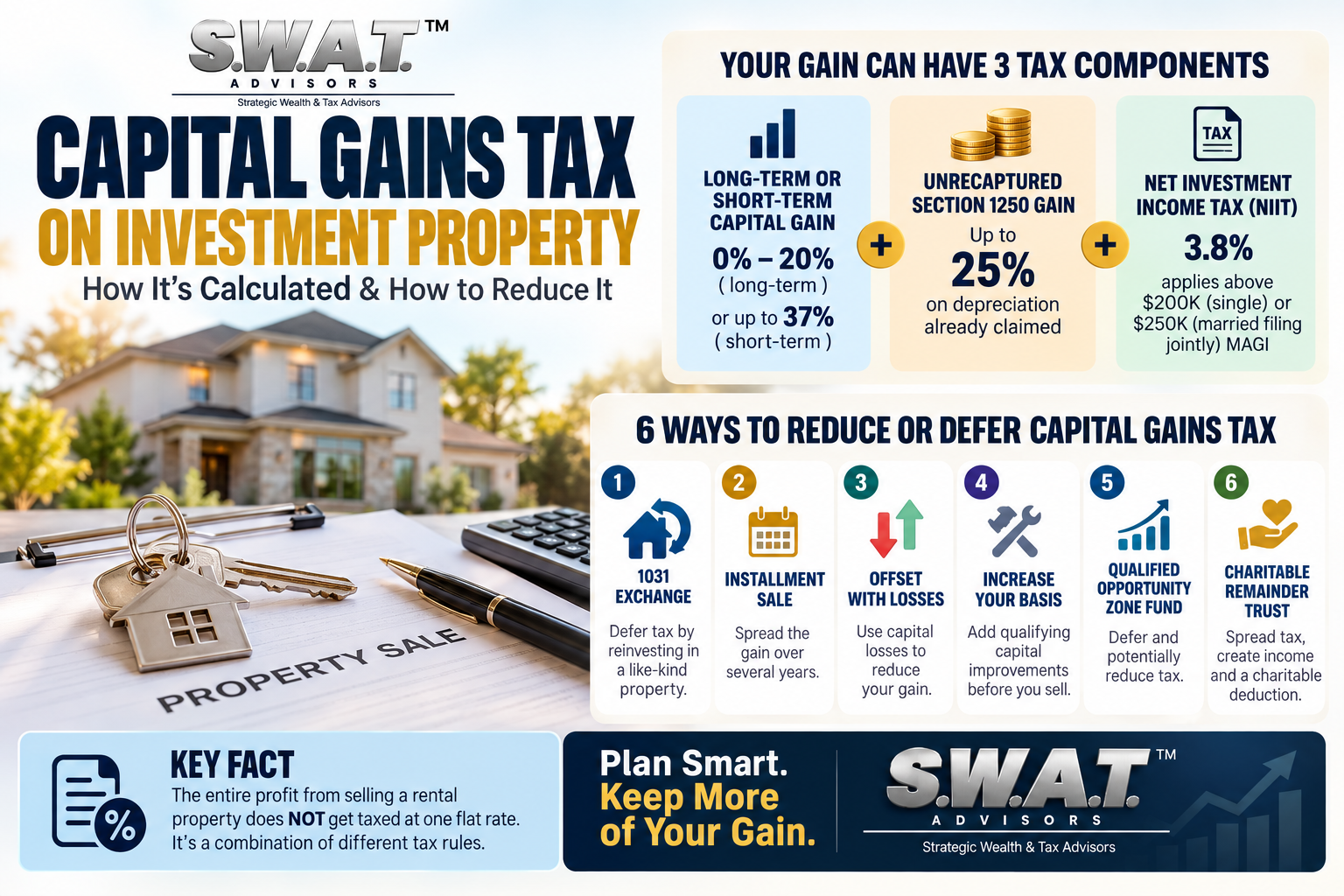
No, the entire profit from selling a rental doesn’t get taxed at one flat rate. Capital gains tax on investment property can stack three separate pieces together: a long-term or short-term rate, unrecaptured Section 1250 gain tied to depreciation, and sometimes the 3.8% Net Investment Income Tax on top of that.
Below, we break down exactly how the capital gains tax on an investment property sale gets calculated, step by step, then cover six real ways to lower what you owe, including how a 1031 exchange defers capital gains tax and when an installment sale beats a lump-sum payout.
Key Takeaways
|
Does the Entire Gain From Selling an Investment Property Get Taxed at the Same Capital Gains Rate?
No. A rental property sale can produce two or three different tax components at once, and each one follows its own rules. The split between long-term and short-term capital gains is only the first layer; depreciation adds a second one.
Long-term capital gain:
A long-term capital gain applies when you’ve held the property for more than one year. This portion of your profit is taxed at the federal 0%, 15%, or 20% rate, based on your total taxable income for the year, not just the gain itself.
Short-term gain:
If you’ve owned the property for one year or less, the profit counts as a short-term gain and gets taxed at your ordinary income rate, the same brackets that apply to your paycheck. That can run as high as 37%, which is why most investors avoid selling within twelve months unless they have no choice.
Unrecaptured Section 1250 gain:
Unrecaptured Section 1250 gain is the portion of your profit tied to depreciation you already deducted on your tax return. The IRS caps this piece at a 25% federal rate. So if you claimed $60,000 in depreciation over the years you owned the property, that $60,000 gets pulled out and taxed separately from your regular long-term gain.
How to Calculate Capital Gains Tax on Investment Property (With Example)
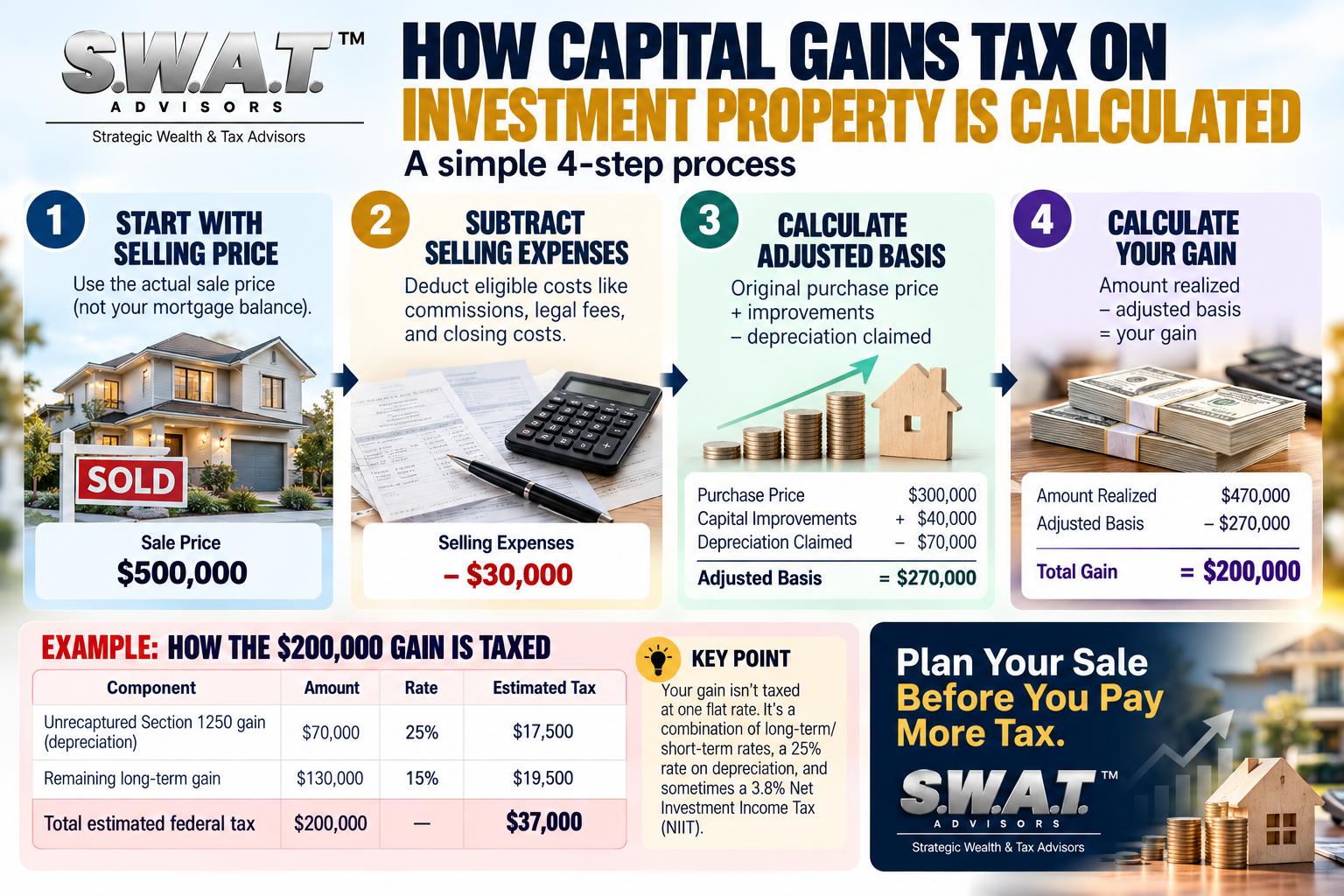
You calculate it in four steps: start with what you sold for, subtract selling costs, work out your adjusted basis, then subtract that basis from your net sale price.
Step 1: Start With The Property’s Selling Price, Not The Mortgage Balance
Your mortgage payoff has nothing to do with your taxable gain. The starting number is your amount realized, which includes the cash you received plus certain liabilities the buyer assumed or paid on your behalf.
Step 2: Subtract Eligible Selling Expenses
Qualifying selling costs reduce your amount realized. These can include:
- Real estate commissions
- Legal fees tied to the sale
- Advertising and marketing costs
- Other direct transaction costs
Loan payoff fees and prepayment penalties, for example, don’t reduce your gain the same way a commission does. Check each line against IRS guidance before assuming it counts.
| One quick note if the property came to you through a will: capital gains tax on inherited property starts from a stepped-up basis at the date of death, not what the original owner paid, which often erases most of the taxable gain for heirs who sell soon after inheriting. |
Step 3: Calculate the Property’s Adjusted Basis
Your adjusted basis follows this formula:
| Original basis + qualifying capital improvements − depreciation claimed = adjusted basis |
The IRS states that improvements properly added to your capital account increase basis, while depreciation you’ve claimed (or should have claimed) reduces it, even if you never actually took the deduction.
Step 4: Calculate the Gain
Amount realized − adjusted basis = your gain or loss.
| Example: You bought a rental for $300,000, put $40,000 into capital improvements, and claimed $70,000 in depreciation over the years. Your adjusted basis is $270,000. You sell for $500,000 and pay $30,000 in commissions and closing costs, so your amount realized is $470,000.
Your total gain is $200,000. Of that, $70,000 is unrecaptured Section 1250 gain taxed at up to 25%, and the remaining $130,000 gets taxed at your long-term rate. |
The table below shows how that same $200,000 gain could play out for a single filer in the 15% long-term bracket for 2026.
| Component | Amount | Rate | Estimated Tax |
| Unrecaptured Section 1250 gain | $70,000 | 25% | $17,500 |
| Remaining long-term gain | $130,000 | 15% | $19,500 |
| Total estimated federal tax | $200,000 | N/A | $37,000 |
This doesn’t include state tax, and it assumes no NIIT applies. Real numbers shift depending on your bracket, so run your own figures through a capital gains tax on investment property calculator or a CPA before treating this as a final answer.
How to Avoid Capital Gains Tax on Investment Property: 6 Strategies
You can legally defer, reduce, or spread it out using strategies the tax code already allows. Here’s how investors actually avoid capital gains tax on investment property, or at least shrink the bill.
1. Use A 1031 Exchange To Defer Capital Gains Tax On An Investment Property
A 1031 exchange lets you roll sale proceeds into a new like-kind property and push the tax bill down the road instead of paying it now.
- You get 45 days after closing to identify a replacement property in writing, and 180 days total to close on it.
- Miss either deadline and the whole exchange falls apart, triggering the full capital gains tax on investment property you were trying to defer.
- This is one of the most effective real estate tax strategies for investors who plan to keep growing their portfolio rather than cash out.
2. Spread The Gain With An Installment Sale
An installment sale means the buyer pays you over several years instead of all at once, and you report the gain as you actually receive each payment. This can keep you from getting pushed into a higher bracket in a single year. It’s one of the more underused tax-saving strategies for real estate investors, especially when the sale price is large relative to your normal income.
3. Offset The Gain With Capital Losses
If you’re sitting on other investments that have lost value, selling them in the same year can offset part of your property gain. This won’t eliminate the capital gains tax on an investment property sale, but it can meaningfully reduce it, and you can carry forward any unused losses to future years.
Pairing a loss year with a sale year is one of the simplest ways to lower a capital gains tax on an investment property sale without changing anything about the property itself.
4. Increase Your Basis Before You Sell
Every dollar of qualifying capital improvement you’ve properly documented raises your basis and lowers your taxable gain. A new roof, a room addition, or major system replacements count. Routine repairs and maintenance don’t. Keep receipts, because the IRS will ask for them if your return gets a closer look.
5. Reinvest Through A Qualified Opportunity Zone Fund
Rolling eligible gain into a Qualified Opportunity Zone fund within 180 days of the sale can defer the original gain and, if you hold the QOZ investment long enough, reduce tax on the appreciation earned inside the fund. It’s a narrower strategy than a 1031 exchange, but it opens the door to asset types a like-kind exchange won’t cover.
6. Consider A Charitable Remainder Trust For Highly Appreciated Property
If part of your goal is philanthropic, placing the property into a charitable remainder trust before selling can spread out the tax hit while generating an income stream and a charitable deduction. This requires careful planning with an advisor and an attorney.

Does Living in the Investment Property Before Selling It Eliminate Capital Gains Tax?
No. Moving into a former rental before selling it does not erase the tax on the years it operated as an investment property.
The home-sale exclusion under Section 121 requires you to meet ownership and use tests, and even then, the IRS specifically excludes depreciation claimed for rental or business use after May 6, 1997, from the exclusion. That depreciation still comes back as taxable gain when you sell, regardless of how long you lived there afterward.
What Is the Practical Tax-Planning Sequence Before Selling an Investment Property?
Run these steps before you list the property, not after you’ve already signed a contract. This sequence is one of the more practical real estate tax planning strategies available, mainly because it costs nothing but time.
- Calculate your estimated amount realized.
- Reconstruct your adjusted basis from purchase records and improvement receipts.
- Quantify accumulated depreciation.
- Separate the depreciation-related gain from the appreciation-related gain.
- Estimate your federal tax exposure across both pieces.
- Check whether the 3.8% NIIT applies to your situation.
- Review any capital-loss positions you could pair with the sale.
- Determine whether a 1031 exchange fits your timeline and goals, and confirm the 1031 exchange tax deferral rules work with your closing date.
- Consider whether installment-sale treatment makes sense for your income needs.
- Have the transaction reviewed by a tax planner before you sign anything binding, especially if timing drives the whole strategy.
Sellers who work through this list before listing the property have options. Sellers who work through it after closing usually don’t, because most of these strategies depend on structuring the sale correctly from the start.
How SWAT Advisors Can Help You Plan Your Property Sale
Selling an investment property without a plan in place is how people leave five and six figures on the table. We’ve built our practice around exactly this kind of proactive tax planning, not the once-a-year scramble that happens every April.
At SWAT Advisors, led by Certified Tax Planner Amit Chandel, we work with real estate investors, business owners, and high-net-worth families across California to structure sales before they happen. Here’s how we typically help:
- Model your exact capital gains tax on investment property exposure before you list, including the Section 1250 depreciation piece most sellers miss.
- Show you which legal paths actually avoid capital gains tax on investment property in your specific situation, instead of generic advice that ignores your basis and income bracket.
- Evaluate whether a 1031 exchange, an installment sale, or a Qualified Opportunity Zone fund fits your specific timeline and goals.
- Coordinate the 45-day and 180-day exchange deadlines with your qualified intermediary so nothing slips.
- Build a broader exit and wealth transfer plan around the sale, not just a single tax return.
- Help you avoid capital gains tax in California surprises tied to state-level rules that don’t mirror federal treatment.
We’ve worked with thousands of clients on tax situations exactly like this one, and the pattern we see most often is the same: the sellers who call us before signing a listing agreement keep meaningfully more of their gain than the ones who call us after. Book a consultation with our team before you set a sale date, so the numbers work in your favor instead of the calendar’s.
Conclusion
The capital gains tax on investment property you owe depends on far more than your sale price. It’s a layered calculation involving your adjusted basis, your depreciation history, your income bracket, and the specific rate that applies to each piece of the gain. Sellers who understand this before listing their property make sharply different decisions than sellers who find out at tax time.
That’s exactly where SWAT Advisors comes in. SWAT Advisors builds the plan around the sale itself, whether that means structuring a 1031 exchange, timing an installment sale, or reconstructing years of depreciation records to get your basis right.
If you’re weighing a sale of investment property in the next twelve months, the right time to call a tax planner is before you sign anything, not after. Reach out to SWAT Advisors and let’s map out what your sale actually looks like on paper.
FAQs
Subtract your adjusted basis from your amount realized (sale price minus selling costs) to get your gain, then apply the long-term, short-term, and Section 1250 rates separately. That combined result is your true capital gains tax on an investment property sale.
Not entirely, but a 1031 exchange can defer the full amount indefinitely as long as you keep reinvesting in like-kind real estate and meet the 45-day and 180-day deadlines. Most investors who try to avoid capital gains tax on investment property long-term end up using this exact strategy.
Depreciation recapture, called unrecaptured Section 1250 gain, taxes the depreciation you claimed at a federal rate of up to 25% when you sell.
You have 45 days to identify a replacement property in writing and 180 days total from closing to finish the purchase.
Yes. A primary residence can qualify for the Section 121 exclusion up to 250,000 and 500,000 for joint filers, but that exclusion never covers depreciation claimed during rental use.