
Most people assume that paying for estate planning comes with a tax break. It used to. But the rules changed in 2018, and again in 2026. Here is what the IRS actually allows today, what is gone for good, and where the real savings still exist. For most individuals, personal estate planning fees (wills, revocable trusts, powers of attorney) are not tax-deductible in 2026.
The Tax Cuts and Jobs Act (TCJA) eliminated those deductions starting in 2018, and the One Big Beautiful Bill Act (OBBBA), signed July 4, 2025, made that elimination permanent.
That said, you can still deduct specific categories of fees when documented correctly. This guide highlights the deductions allowed by the IRS and how estate planning tax plays a part in it.
Key Takeaways
|
What “Tax Deductible” Actually Means for Estate Planning Costs
A tax deduction reduces your taxable income, lowering the total amount of tax you owe. Estate planning fees were historically claimed as miscellaneous itemized deductions on Schedule A of your personal return. That category allowed you to deduct certain professional fees that exceeded 2% of your adjusted gross income (AGI).
That framework mattered because the IRS distinguishes between two types of expenses: personal expenses (not deductible) and business or income-producing expenses (potentially deductible). For most individuals, the IRS considers estate planning a personal activity. Drafting a will or setting up a living trust does not generate taxable income, so those legal fees fall on the personal side of the ledger.
Deductibility depends on whether current federal law permits it and if specific services qualify under remaining rules.
Also Read: Tax Planning Strategies for High Income Earners (2026)
Why Personal Estate Planning Fees Stopped Being Deductible in 2018
Before 2018, if you itemized deductions, you could deduct the portion of your estate planning attorney fees specifically related to tax advice. That meant the part of your bill that dealt with minimizing estate taxes. Your attorney would identify that portion on your invoice, and you would claim it as a miscellaneous itemized deduction.
The Tax Cuts and Jobs Act of 2017 changed everything. Effective January 1, 2018, the TCJA suspended all miscellaneous itemized deductions subject to the 2% AGI floor. That single provision wiped out deductions for estate planning fees, investment advisory fees, tax preparation fees, and a range of other professional expenses for individual taxpayers.
While this suspension was initially set to expire after 2025, subsequent legislation made the change permanent.
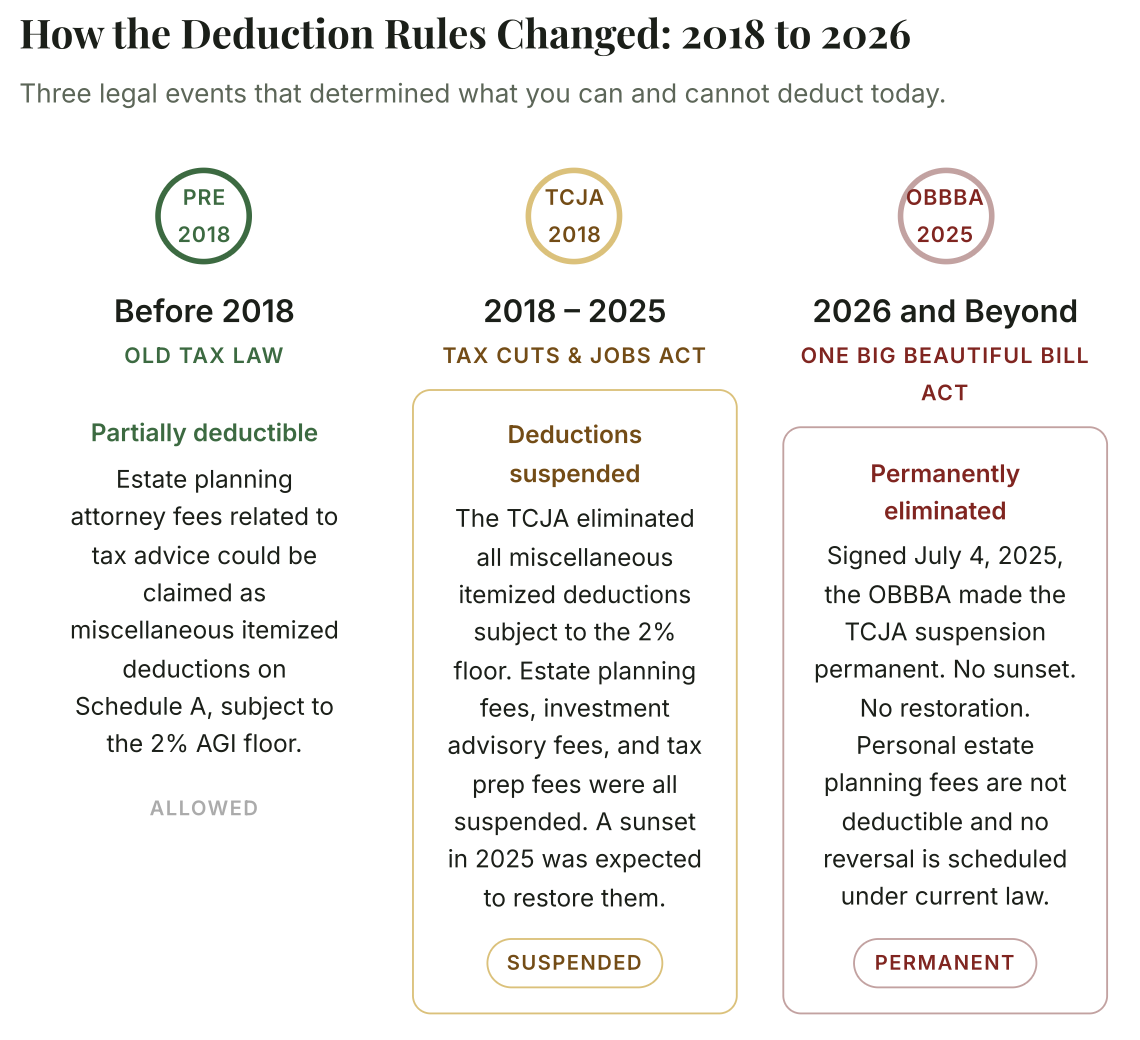
The One Big Beautiful Bill Act Made the Old Deduction Permanent (2026 Update)
On July 4, 2025, President Trump signed the One Big Beautiful Bill Act (OBBBA) into law. Among its sweeping tax provisions was a critical change for estate planning: the OBBBA made the TCJA’s suspension of miscellaneous itemized deductions permanent.
That means the sunset never happened. The window that would have allowed individuals to resume deducting estate planning fees in 2026 has been closed with no expiration date. For individuals asking whether estate planning fees are tax-deductible going forward, the answer under current law is no, unless you fall into one of the exceptions discussed below.
The OBBBA did bring one significant estate planning benefit. Starting January 1, 2026, the federal estate and gift tax exemption is now permanently set at $15 million per individual ($30 million for married couples), indexed for inflation. That is a meaningful expansion, and it creates major planning opportunities for high-net-worth families.
Estate Planning Fees That ARE Still Tax Deductible
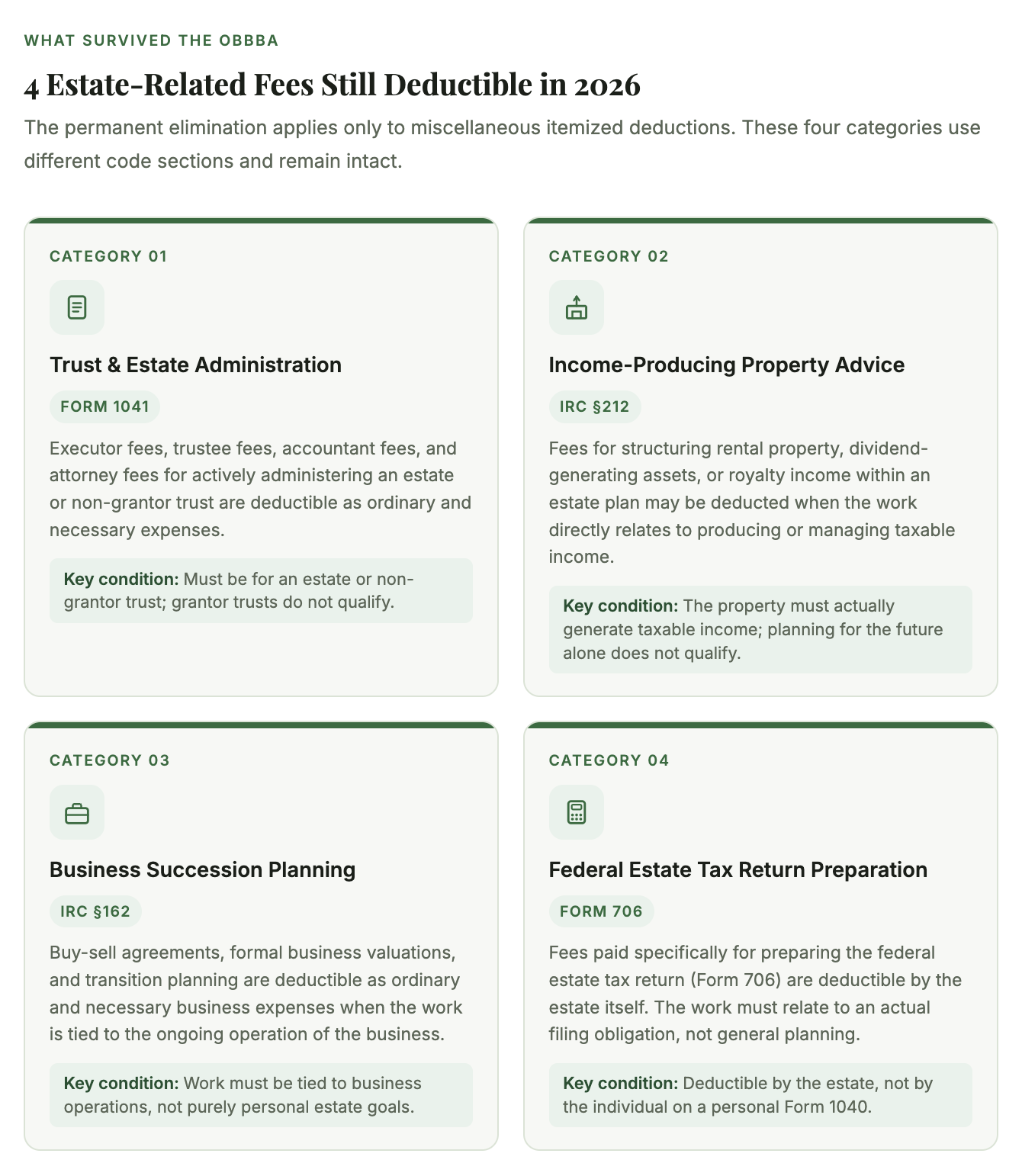
The permanent elimination of miscellaneous itemized deductions does not affect every estate-related expense. Several categories of fees remain deductible, not as personal miscellaneous deductions, but through other provisions of the tax code that were untouched by the TCJA or the OBBBA.
Fees related to income-producing property
Under IRC Section 212, expenses incurred to produce or collect income, or to manage income-producing property, can still be deducted. If your estate planning attorney advises you on structuring rental property, dividend-generating assets, or royalty income within your estate plan, you may deduct the portion of their fee attributable to that income-producing work. This requires a clearly itemized invoice that separates these fees from personal planning work.
Tax preparation and advice tied to estate or trust returns
Fees paid specifically for the preparation of a federal estate tax return (Form 706) or a fiduciary income tax return are deductible by the estate. Similarly, advice directly related to the tax aspects of an estate or irrevocable trust remains deductible, unlike general estate planning advice. The key distinction is that the work must relate to an actual filing obligation, not merely to personal planning goals.
Trust and estate administration expenses (Form 1041)
The IRS has confirmed that on Form 1041 (the fiduciary income tax return), you can deduct ordinary and necessary costs of managing an estate or a non-grantor trust. This includes executor fees, trustee fees, accountant fees for trust administration, and attorney fees incurred while administering the estate. Importantly, these are not classified as miscellaneous itemized deductions and were therefore not suspended by the TCJA or eliminated by the OBBBA. The IRS’s final regulations (T.D. 9918) explicitly clarified this distinction.
Business succession planning fees
For business owners, a significant portion of estate planning overlaps with business planning, and that portion is often deductible. If you are a founder or owner working on a buy-sell agreement, a business valuation for succession purposes, or a formal transition plan, those fees may qualify as ordinary and necessary business expenses under IRC Section 162. In many cases, planning your business exit is a deductible cost of operating your business.
Learn more about how we approach this through our Tax Planning for High Net Worth Individuals and Individual Tax Planning.
Fees That Are NOT Deductible (Even If They Feel Like Taxes)
It’s worth being specific about what is off the table, because some fees intuitively feel tax-related even though they aren’t deductible:
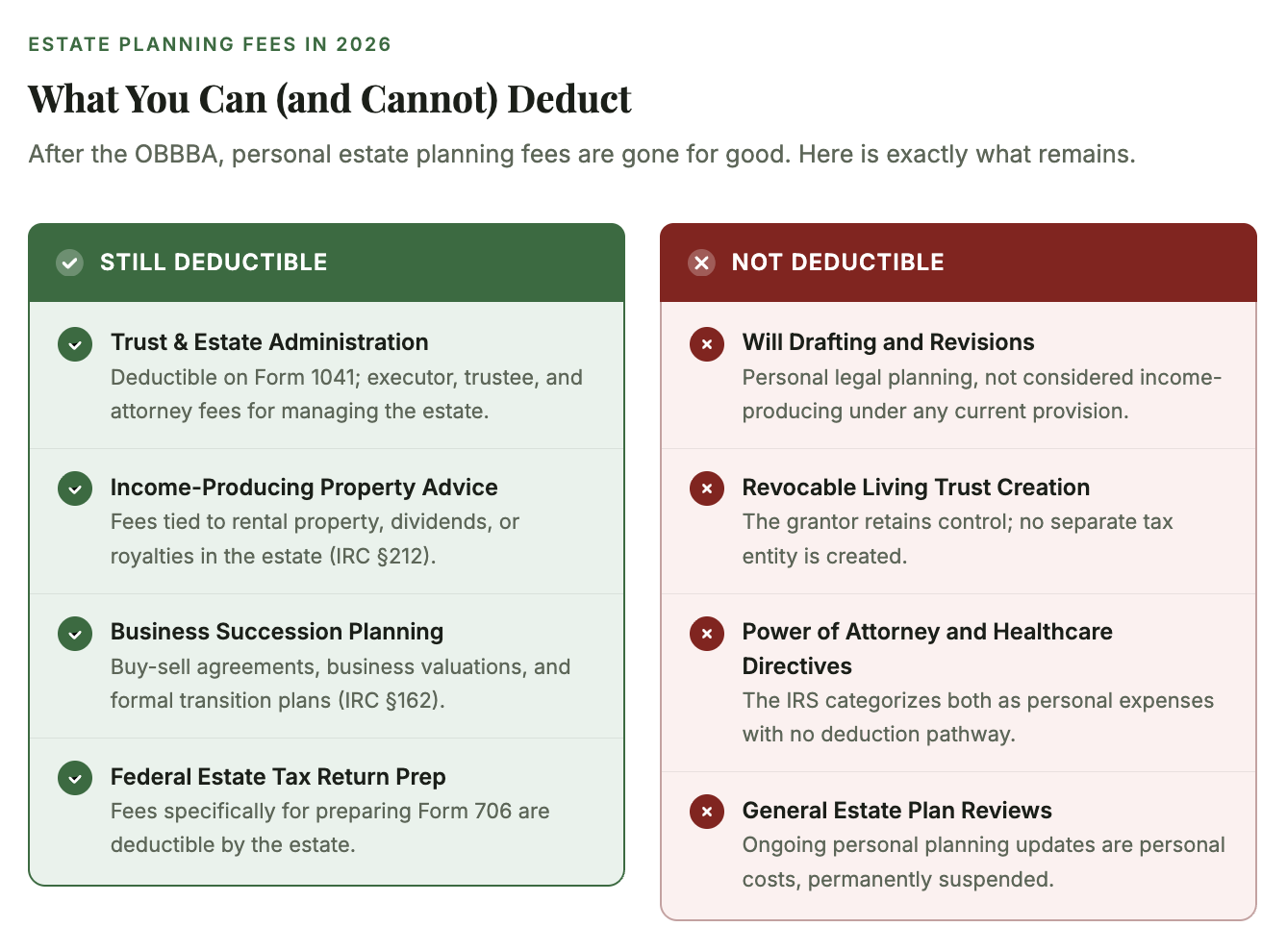
- Will drafting and revisions. Personal legal planning is not considered income-producing.
- Revocable living trust creation. The grantor retains control, and no separate tax entity is created, so these are personal expenses.
- Power of attorney and healthcare directive fees. The IRS categorizes these as personal.
- General estate plan reviews and updates. These are ongoing personal planning costs.
- Financial planner fees for personal retirement and estate goals. Even if the advice touches on taxes, the IRS requires the expense to directly produce or manage taxable income to qualify.
- Life insurance premiums within an estate plan. Generally not deductible for individuals, though the planning structure around life insurance can create significant tax benefits in other ways. See our Life Insurance Planning page for more.
Also Read: Tax Planning for Mergers and Acquisitions: A Seller's Guide
How to Separate Deductible vs Non-Deductible Fees on Your Invoice
Estate planning invoices often lump personal planning work and deductible activities together. A single flat fee for “estate plan preparation” tells the IRS nothing useful. A well-structured invoice should break out fees by activity: trust formation (personal, not deductible), federal estate tax return preparation (deductible by the estate), income property structuring advice (potentially deductible under Section 212), and business succession work (potentially deductible as a business expense).
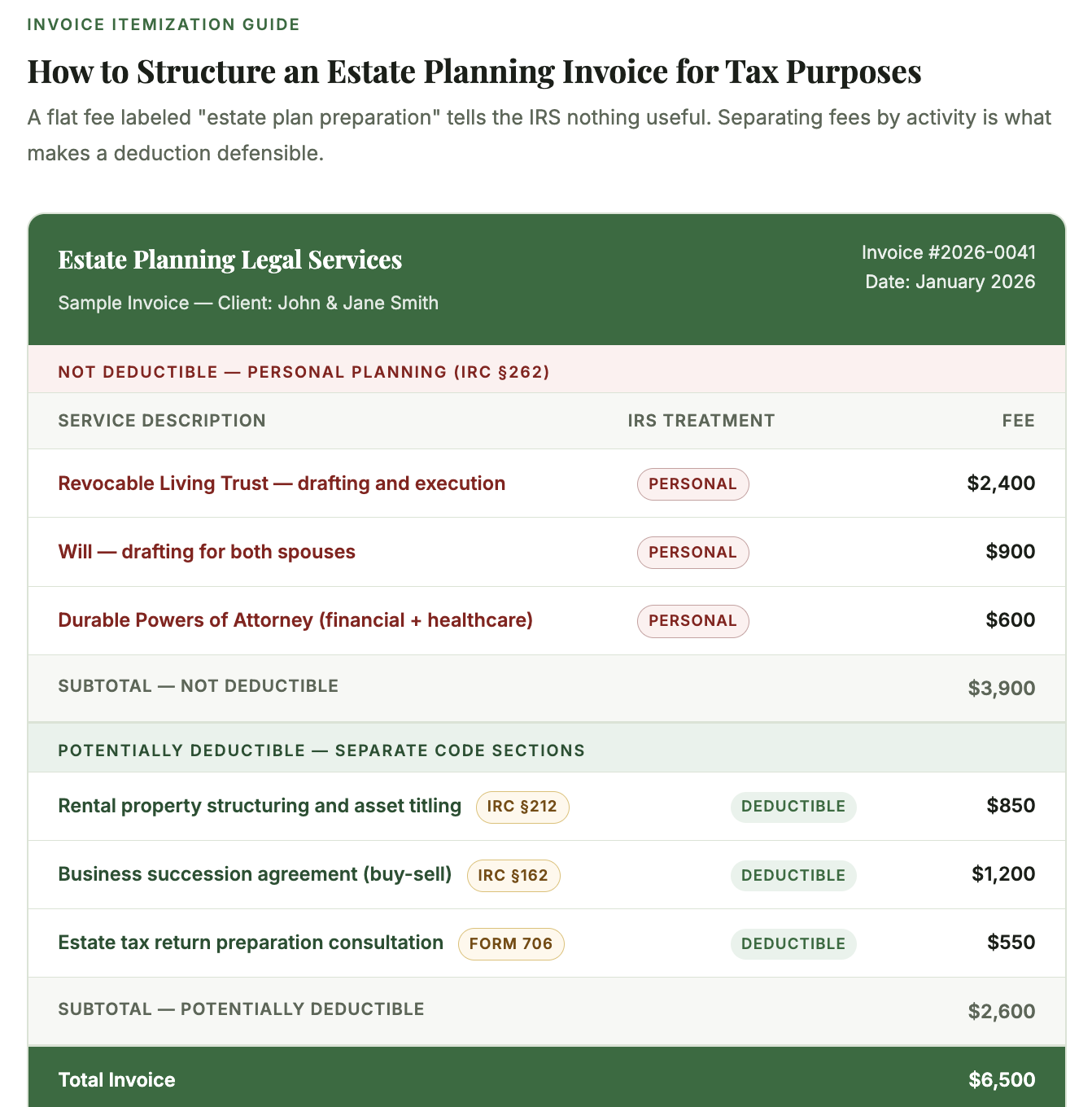
At SWAT Advisors, we structure engagements and clearly document the deductible and non-deductible components of our work from the start. That makes it straightforward to substantiate any deductions that apply to your situation.
| Pro Tip: Ask your attorney or tax planner to identify the specific IRS code section that supports any estate planning deduction they recommend. Deductions without a clear statutory basis draw scrutiny. Documentation is your first line of defense. |
Common Mistakes That Trigger IRS Scrutiny on Estate Deductions
Claiming legitimate deductions is your right. Claiming deductions that don’t hold up to scrutiny is a liability. Here are the patterns that invite IRS attention:
- It’s hard to support a flat estate planning retainer as a business expense without clearly separating personal and business services.
- If you want to claim personal will or trust fees under Section 212, the property must actually generate taxable income for the deduction to apply. Planning for the future alone does not suffice.
- Including Form 1041 deductions on personal tax returns is not allowed. Report estate or trust management costs on the fiduciary tax return, not on your personal Form 1040.
- Failing to maintain supporting documentation. IRS examiners expect itemized invoices, engagement letters that describe the scope of work, and records showing the business or income-producing purpose of deducted fees.
- Treat grantor trust fees as administration costs. A revocable living trust is clear to the grantor for tax purposes; its costs do not qualify for the trust administration deduction available to non-grantor trusts.
Conclusion
Rules on estate planning deductions remain strict under current law. However, the greater focus should be on minimizing your overall estate tax burden, especially with the OBBBA’s permanent $15 million exemption.
An effective strategy links your estate structure directly to your tax plan before key transfers occur, rather than relying solely on basic wills or trusts.
SWAT Advisors helps families and business owners build tax-efficient estate plans that protect wealth and minimize liabilities. Schedule a Strategy Call Today.
FAQs
No. Not for personal services. They cannot be claimed as miscellaneous itemized deductions (those were permanently eliminated by the OBBBA in 2025) or under any other individual deduction provision.
No, not for wills, revocable trusts, powers of attorney, or other personal estate planning. The OBBBA permanently eliminated the miscellaneous itemized deduction category where those fees were previously claimed.
Yes. When an estate files Form 1041 (U.S. Income Tax Return for Estates and Trusts), it can deduct normal and necessary administration costs. These can include executor fees, trustee fees, and professional fees for estate management.
It depends on the type of trust. For non-grantor trusts and estates, trustee fees are deductible on Form 1041 as administration expenses. For grantor trusts, like most revocable living trusts, the trust is disregarded for tax purposes, and trustee fees are usually treated as the grantor's personal costs.
Yes, most of the time. According to IRC Section 162, fees paid for planning the next owner of a business, such as writing a buy-sell agreement, valuing the business, and formal
Whether estate planning fees are tax deductible for you depends on the nature of the work. Personal planning fees are not deductible. Fees allocated to income-producing property advice, federal estate tax return preparation, or business succession work may be deductible through other provisions.
If a non-grantor trust or an estate pays trust administration fees, those fees can still be deducted on Form 1041; the OBBBA did not change this. Individual taxpayers who pay fees for managing a revocable trust cannot deduct those fees on their personal return, as the suspension of miscellaneous itemized deductions is now permanent.
Yes. The IRS expects substantiation for every deduction. For estate administration costs on Form 1041, you should retain itemized invoices from each service provider, executor or trustee appointment documentation, bank records showing payment, and a description of the services rendered in the administration of the estate.
Under current law, no. The OBBBA made the elimination of miscellaneous itemized deductions permanent with no sunset date. Future Congress could change that, but as of 2026, no restoration of personal estate planning fee deductions is scheduled.