
Most people assume that capital gains tax on the sale of property is simply the difference between what they paid and what they sold it for. That is often wrong. The actual taxable gain is based on “basis,” and how you determine your basis depends entirely on how you came to own the property. A property you purchased, one you inherited, and one you received as a gift are all taxed under different rules. Getting the basis wrong can mean overpaying the IRS by tens of thousands of dollars, or underpaying and triggering an audit. This guide explains each scenario clearly.
Key Takeaways
|
What “Property” Means for Capital Gains Tax Purposes
For capital gains purposes, “property” includes more than just homes. The IRS applies capital gains tax rules to real estate of all types, including:
- Primary residences
- Rental and investment properties
- Vacation homes and second homes
- Raw land and undeveloped lots
- Commercial properties
- Timeshares
- Properties received through inheritance or as a gift
| Each type follows the same basic formula:
taxable gain = sale proceeds minus adjusted basis. |
What changes across property types is
(1) how the basis is calculated,
(2) whether any exclusions apply, and
(3) what rate you pay.
How Capital Gains Tax on a Property Sale Is Actually Calculated
The formula looks simple but has several moving parts. Here is how it works step by step.
Step 1: Determine your sale proceeds. This is the gross sale price minus allowable selling expenses. Selling expenses include real estate commissions, closing costs you paid as the seller, transfer taxes, and legal fees directly related to the sale.
Step 2: Determine your adjusted basis. This depends on how you acquired the property: purchased, inherited, or gifted, as explained in the sections below.
Step 3: Calculate the gain. Sale proceeds minus adjusted basis equals your realized gain. If the result is negative, you have a capital loss.
Step 4: Apply any exclusions. Homeowners selling a primary residence may qualify for the Section 121 exclusion: up to $250,000 in gains excluded for single filers, $500,000 for married couples filing jointly. Investment and rental properties do not qualify.
Step 5: Apply the correct tax rate. The rate depends on your holding period and total income. Long-term rates are lower than short-term rates.
Also Read: California Marginal Tax Rates Explained: How Your Income Is Actually Taxed (Not a Flat Rate)
Purchased Property: Standard Basis and Holding Period Rules
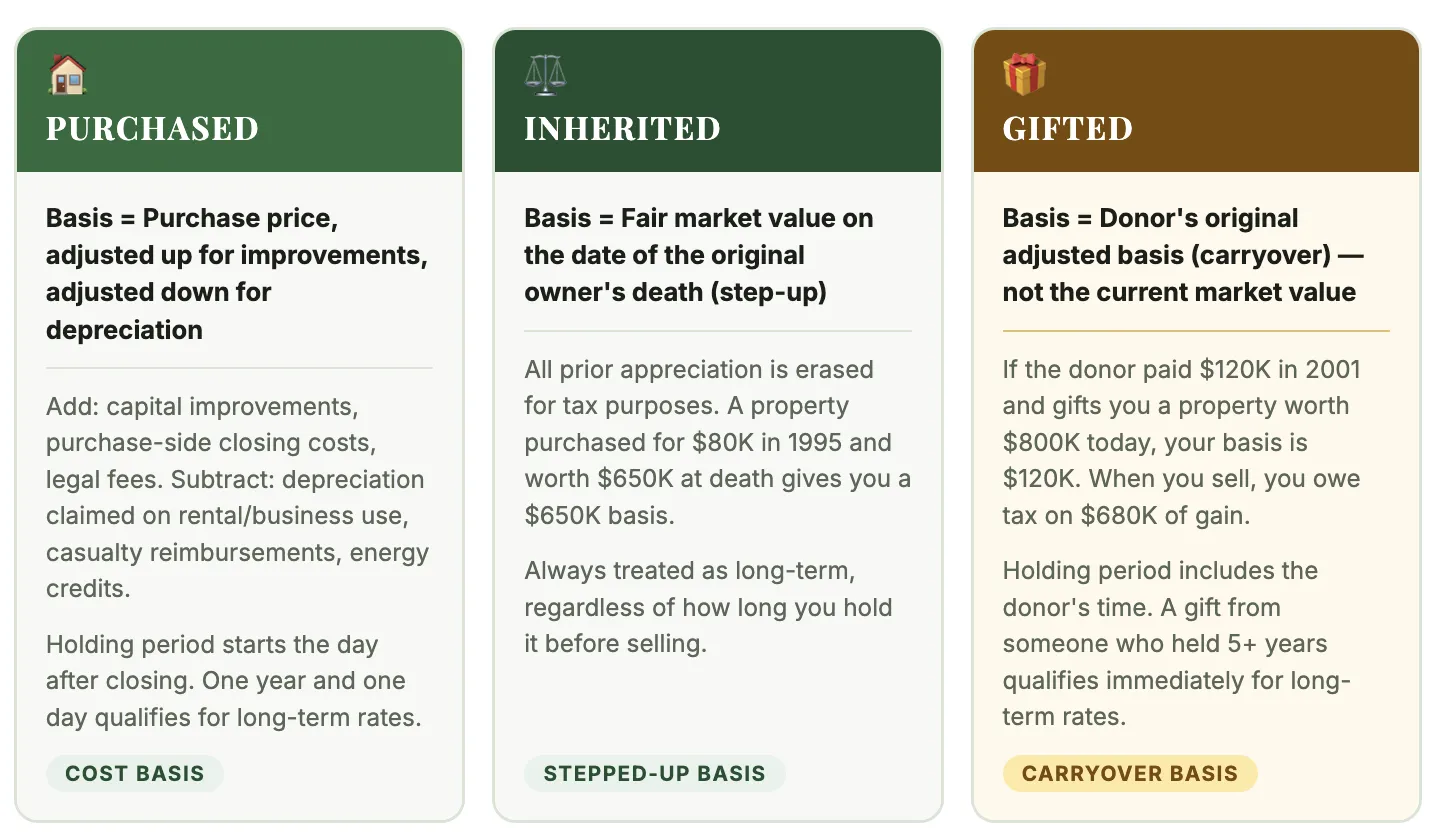
When you buy a property, your starting basis is the purchase price. But it does not stay there. Several events adjust your basis over time.
Things that increase your basis: capital improvements (a new roof, a room addition, updated HVAC, a remodeled kitchen), certain closing costs at purchase (title insurance, recording fees, legal fees), and amounts you paid to restore damaged property.
Things that decrease your basis: depreciation deductions you claimed on a rental or business property, insurance reimbursements you received for casualty losses, and energy-efficiency credits that required a basis reduction.
The holding period for purchased property starts the day after you close on the acquisition. If you sell after holding for more than one year, the gain is long-term. If you sell within one year, the gain is short-term and taxed as ordinary income.
| Note for rental owners: Even if your long-term capital gains rate is 0% or 15%, depreciation recapture is taxed at a flat 25% on the portion of gain attributable to prior depreciation deductions. You cannot avoid recapture by holding longer or by being in a lower bracket. |
Inherited Property: How the Step-Up in Basis Works
This is where real estate offers the most significant tax benefit. When you inherit a property, the IRS lets you reset the basis to the property’s fair market value (FMV) on the date of the original owner’s death. This is called a “step-up in basis” under Section 1014 of the tax code.
Why does this matter so much? Because the original owner may have purchased the property decades ago at a fraction of its current value. Without the step-up, heirs would owe capital gains tax on all of that appreciation. With the step-up, that entire prior appreciation is wiped out for tax purposes.
Additionally, inherited property is automatically treated as long-term property regardless of how long the heir holds it before selling. You do not need to wait a year to get long-term rates.
Example: Selling Inherited Property Right Away vs. Later
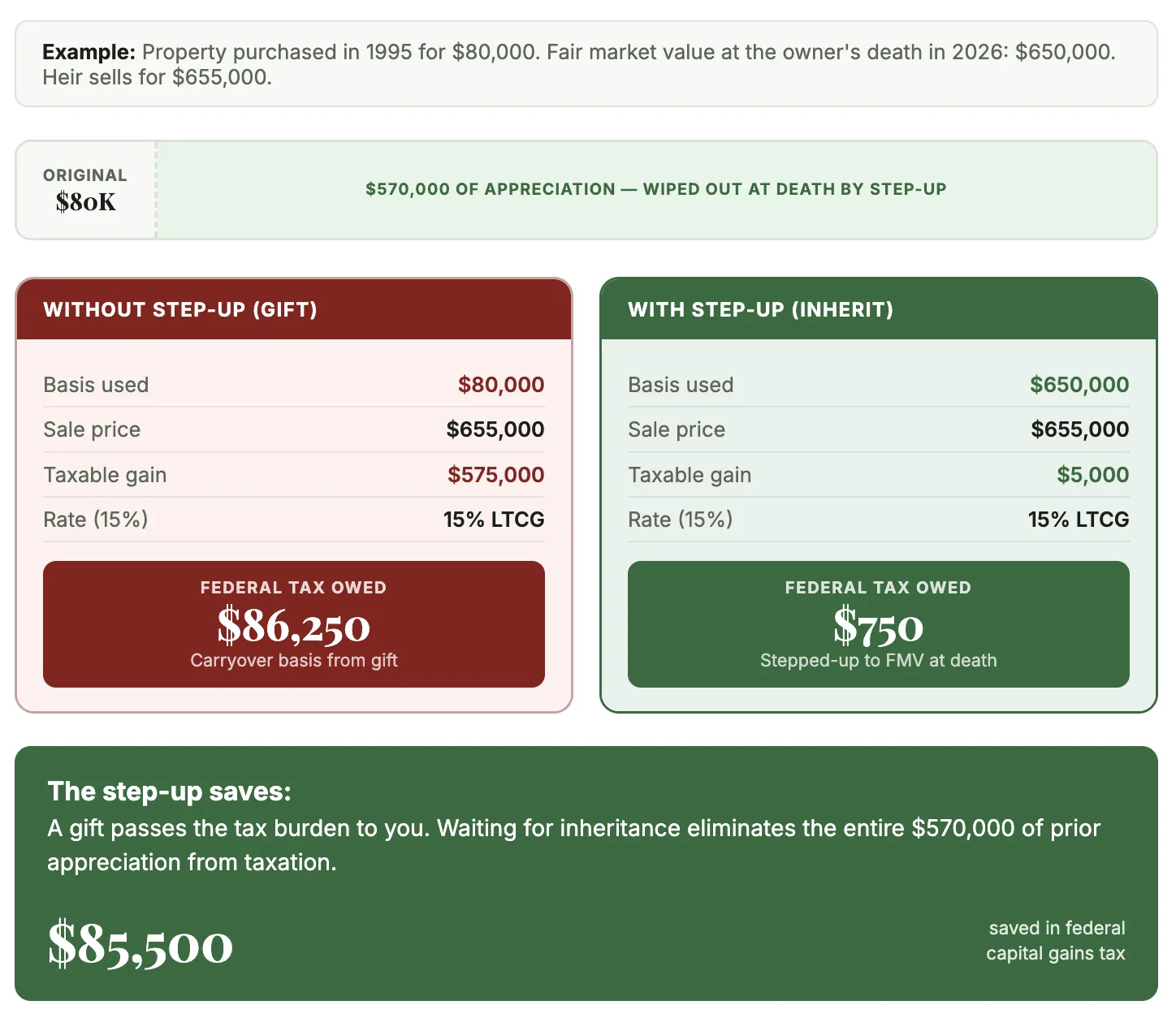
Without the step-up, the heir would have owed capital gains tax on a $570,000 gain (the difference between the $80,000 original purchase price and the $650,000 FMV), potentially $85,500 in federal tax at the 15% rate.
Community Property and Step-Up Rules for Surviving Spouses
California is a community property state. This creates an even more favorable step-up for surviving spouses. When a spouse dies in a community property state, both halves of the community property receive a step-up in basis to current FMV, not just the deceased spouse’s half.
In a common law state, only the deceased spouse’s 50% share receives the step-up. The surviving spouse’s half retains its original basis. Community property treatment is significantly more valuable in a rising real estate market.
California’s Proposition 19 changed some of the rules around inherited property and property tax reassessment, particularly for transfers between parents and children. If you are dealing with an inherited property in California, the Prop 19 inheritance rules are an important piece of this picture alongside the capital gains analysis.
Also Read: How to Avoid Capital Gains Tax on Cryptocurrency (Legally, in 2026)
Gifted Property: Why the Basis Rules Are Completely Different
Receiving property as a gift sounds like a windfall, but the tax rules are far less favorable than inheritance.
When you receive a gift, you generally take the donor’s original adjusted basis, sometimes called “carryover basis.” If your aunt purchased a rental property for $120,000 in 2001 and gifts it to you today, your basis is $120,000, not the current market value of $800,000. When you sell, you owe capital gains tax on the full $680,000 of appreciation, minus your selling costs.
One exception to the carryover basis rule exists. If the property’s FMV at the time of the gift is lower than the donor’s basis, the rules split:
- For determining a gain on a future sale, your basis is the donor’s adjusted basis.
- For determining a loss on a future sale, your basis is the lower FMV at the time of the gift.
- If the sale price falls between those two numbers, neither gain nor loss is recognized.
The holding period for gifted property includes the donor’s holding period. This means you may immediately qualify for long-term treatment if the donor held the property for more than a year before gifting it.
| Practical note: Receiving appreciated property as a gift is rarely more tax-efficient than receiving it as an inheritance. If the donor is elderly and in poor health, it may be worth waiting. The step-up in basis at death eliminates the embedded gain entirely. A gift during life preserves it and passes the tax burden to you. |
2026 Capital Gains Tax Rates That Apply to Any Property Sale
Regardless of how you acquired the property, the same federal rate structure applies once you determine your gain.
| Type of Gain | Rate | Notes |
| Short-term (held 1 year or less) | Up to 37% | Taxed as ordinary income |
| Long-term (held over 1 year) | 0%, 15%, or 20% | Rate based on total taxable income |
| Depreciation recapture (Section 1250) | 25% | Applies to rental/investment property only |
| Net Investment Income Tax (NIIT) | +3.8% | Added for MAGI over $200K single / $250K MFJ |
The One Big Beautiful Bill Act (OBBBA) made the long-term capital gains rates permanent, signed July 4, 2025. They will not expire. The thresholds are adjusted for inflation each year.
Land, Vacation Homes, and Other Property Types
The basis rules above apply to all property types, but a few additional points are worth noting.
- Raw land: Land cannot be depreciated, so you don’t have depreciation recapture when you sell. Your basis is the purchase price plus acquisition costs and any improvements. If you inherited the land, your basis steps up to FMV as of the date of death.
- Vacation homes: A vacation home does not qualify for the Section 121 primary residence exclusion by default. However, if you moved into it and lived there as your primary residence for at least two of the five years before selling, you can claim the exclusion on that portion of the gain.
- Rental property you inherited: The step-up in basis eliminates prior appreciation. But any future depreciation you claim after inheriting the property will reduce your stepped-up basis and create a recapture obligation when you eventually sell.
- Property sold at a loss: Capital losses on real estate can offset capital gains in the same year. If losses exceed gains, you can offset up to $3,000 of ordinary income annually, with the remainder carried forward.
Also Read: Estimated Tax Payments Schedule 2025 and 2026: Every IRS Quarterly Due Date
How SWAT Advisors Can Help You Handle a Property Sale Correctly
Many sellers do not account for improvements they made, depreciation they claimed, or the step-up they received at inheritance. Some donors gift appreciated property without realizing they are passing a large tax bill to the recipient. SWAT Advisors works with property owners before they list, not after. We help you:
- Reconstruct your adjusted basis with full documentation
- Identify whether an exclusion or deferral strategy applies
- Model the tax impact under different timing scenarios
- Coordinate the property sale with your overall tax plan for the year
- Plan around California-specific rules, including Prop 19 and state capital gains rates
For a broader look at tax reduction strategies before you close, contact our tax experts to discuss your case.
Conclusion
Capital gains tax on property sales is rarely as simple as subtracting what you paid from what you received. Depreciation recapture can apply even in a low-rate year, basis rules vary by property acquisition, and California adds its own layer to federal calculations. Whether you walk away with what you expected or pay the IRS more depends on getting those numbers right before you list, not after you close. Most property sale tax exposure is visible in advance if someone looks.
Getting the basis right before you sell can save you thousands. Get in touch with SWAT Advisor before you list.
FAQs
When you inherit property, your basis steps up to fair market value on the date of death. If you sell immediately at or near that value, your gain is minimal.
No. Inherited property gets a stepped-up basis, which can eliminate decades of embedded gain. Gifted property carries over the donor's original basis. When you sell, you owe tax on the full appreciation since the donor's original purchase, not just since you received the gift.
The basis is the property's fair market value on the date of the decedent's death. In most cases, this is established through a qualified appraisal conducted near that date. For estates subject to estate tax, the estate tax return (Form 706) typically documents the value.
Yes, for property included in the decedent's taxable estate. This includes real estate, stocks, business interests, and most other capital assets. Property held in certain retirement accounts does not receive a step-up because it was never subject to capital gains tax.
A qualified appraisal is the safest way to document FMV at the date of death, especially for real estate. Without documentation, the IRS may challenge the basis you report on your tax return.
You owe tax only on the appreciation after the date of death. The gain equals the sale price minus the stepped-up basis. That gain is taxed at long-term capital gains rates (0%, 15%, or 20% federally, depending on your income). If you rented the property after inheriting it and claimed depreciation, that portion is subject to 25% recapture.
Generally, your basis is the donor's adjusted basis at the time of the gift. If the FMV at the time of the gift was lower than the donor's basis, special rules apply for determining gain or loss on a future sale.
The same step-up-in-basis rules apply to inherited land. Your basis is the FMV at the date of death, and any gain beyond that is taxed at long-term rates. Unlike buildings, land has no depreciation deductions, so you don't have depreciation recapture when you sell.