

Capital gains tax on real estate in California applies the moment you sell a property for more than you paid for it. That profit gets taxed twice, once by the IRS and once by the California Franchise Tax Board. Most sellers only plan for the federal bill and get blindsided by the state one. This guide breaks down how capital gains on real estate in California actually work, what exemptions exist, and where you have real room to avoid California capital gains tax legally.
Key Takeaways
|
Understanding Capital Gains Tax on Real Estate in California
A capital gain is the profit left over after you subtract your adjusted cost basis from your final sale price. In California, this profit faces two separate tax bills instead of one, because the state does not carve out any special treatment for real estate.
- Your basis includes your purchase price, closing costs, and money spent on real improvements like a new roof or an addition.
- The IRS taxes your capital gains on California real estate based on federal brackets, then California taxes the same gain again as ordinary income.
- Rental and investment properties also trigger depreciation recapture, which the IRS taxes at up to 25%, separate from your regular gain.
| Example: If a Sacramento investor bought a duplex for $500,000, put $50,000 into a kitchen and roof upgrade, and then sold it for $850,000. Their basis is $550,000, so the taxable gain is $300,000, not $350,000. That $50,000 difference alone can shift them out of California’s 13.3% bracket. |
Difference Between Short-Term and Long-Term Capital Gains
Holding a property for more than one year before selling changes your federal tax rate but does nothing for your California bill. The IRS rewards patience, but California does not.
- Short-term gains from property owned for one year or less get taxed federally as ordinary income, up to 37%.
- Long-term gains from property held over a year qualify for the lower federal rates of 0%, 15%, or 20%.
- California applies the same 1% to 13.3% schedule to both types, so timing your sale only helps your federal number, since California capital gains tax brackets never drop for long-term holds.
- A seller in the 15% federal long-term bracket who sells one day early, before hitting the one-year mark, could pay more than double at the federal level alone.
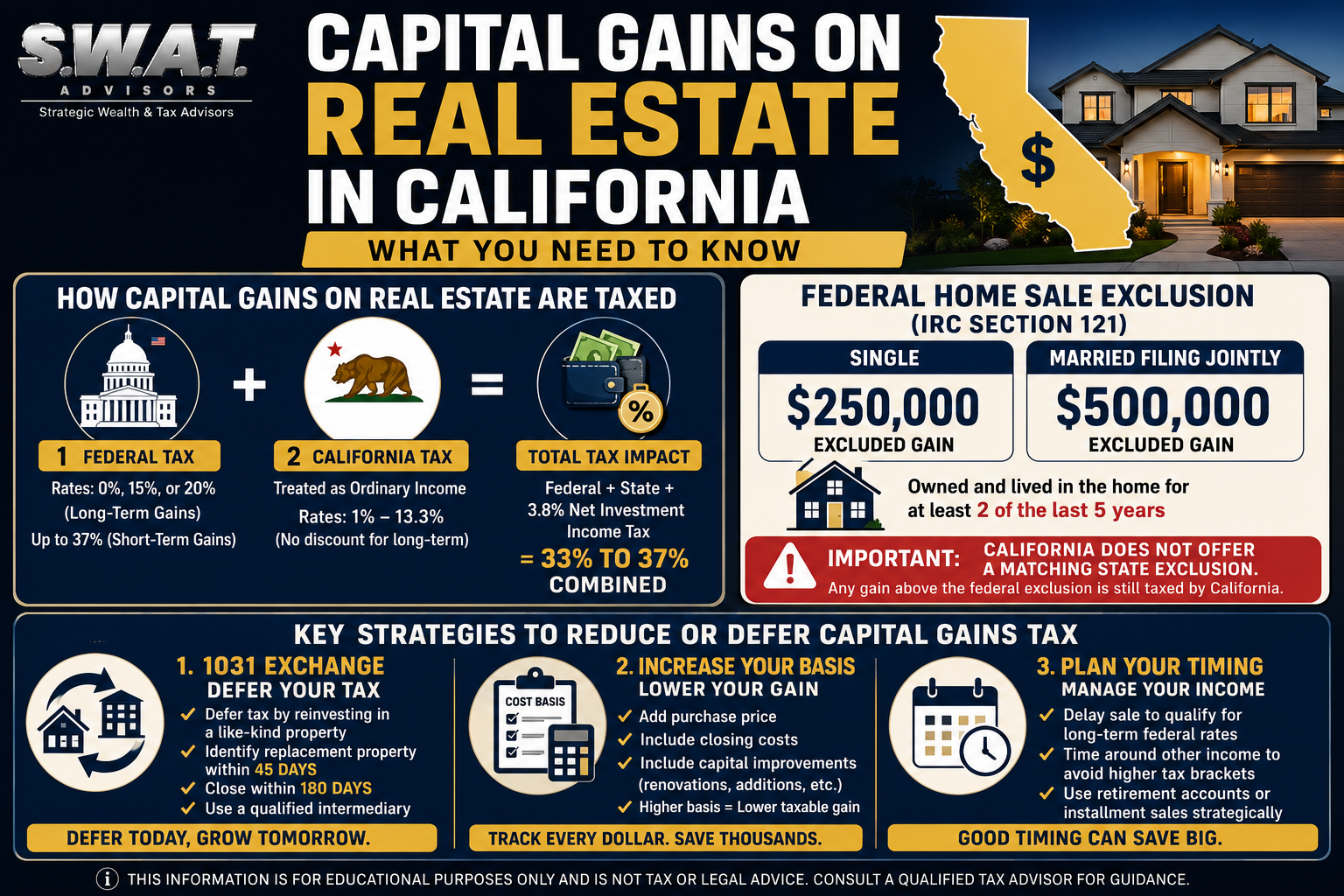
Key Exemptions and Strategies to Reduce Capital Gains Tax
You can exclude up to $250,000 of gain from selling your main home if you’re single, or $500,000 if you’re married filing jointly, under IRC Section 121. This is the single biggest way homeowners reduce capital gains tax in California at the federal level.
- You must have owned and lived in the home for at least 24 months out of the 5 years before the sale.
- You generally can’t claim this exclusion twice within a two-year window.
- California does not offer a matching state exclusion, so any gain above your federal exemption still faces the state’s ordinary income rates.
| Example: Take a Bay Area couple who bought their house for $900,000 and sold it for $1.6 million after eight years. Their $700,000 gain drops to $200,000 taxable after the $500,000 exclusion, wiping out most of their federal bill. California still taxes the full $700,000, since the state has no equivalent exclusion on the books. |
Tax-Deferred Exchanges (1031 Exchange) Explained
A 1031 exchange lets you defer capital gains tax by rolling proceeds from an investment property into a new “like-kind” property instead of cashing out. This is one of the most powerful real estate tax strategies available to California investors.
- You have 45 days from closing to identify a replacement property in writing.
- You must close on that replacement within 180 days of selling the original.
- A qualified intermediary must hold the funds; touching the cash yourself disqualifies the exchange.
- California requires Form FTB 3840 if you exchange for an out-of-state property, tracking the deferred gain until you eventually sell.
A San Diego landlord selling a $1.2 million fourplex for a $600,000 gain could roll every dollar into a larger apartment building through a 1031 exchange, paying zero tax that year. This is a core piece of advanced tax planning strategies for anyone building a real estate portfolio instead of cashing out property by property, and it remains one of the few legal paths for reducing taxes on investment gains on a large scale.
How SWAT Advisors Can Help You Minimize Taxes
We built SWAT Advisors to keep more of your money out of the IRS’s hands and in your pocket, so you can avoid California capital gains tax wherever the law allows it. You need a real estate financial planner who models your specific sale before you sign anything.
- We review your basis, depreciation history, and exclusion eligibility months before closing, not during tax season.
- We structure 1031 exchanges, installment sales, and entity planning around your full financial picture, not just one transaction.
- We coordinate capital gains timing with tax-advantaged retirement accounts and other income sources so a big sale doesn’t push you into California’s 13.3% bracket unnecessarily.
- Our team has guided over 20,000 clients through reducing taxes on investment income, backed by a 99.9% accuracy guarantee.
Book a consultation with us before your next real estate sale. A short conversation now can save you tens of thousands later.
Common Mistakes When Selling Real Estate in California
Most sellers who want to avoid California capital gains tax lose money on this transaction long before the tax return gets filed, usually from timing errors or missing paperwork rather than bad luck.
- Selling before hitting the one-year mark, which pushes the entire federal gain into short-term rates as high as 37%.
- Forgetting to add capital improvements to their cost basis, which inflates the taxable gain unnecessarily.
- Missing the 45-day 1031 identification window because they started the exchange conversation too late.
- Ignoring depreciation recapture on a former rental, which the IRS taxes separately at up to 25%.
- Assuming the federal home sale exclusion also applies at the California level, when the state offers no such break.
- Skipping tax-efficient savings strategies, like directing part of the proceeds into retirement accounts, that could soften the year’s total tax hit.
Conclusion
Selling property in California means facing two tax systems at once, a federal one that rewards patience and a state one that doesn’t. The gap between a seller who plans ahead and one who doesn’t often comes down to basis tracking, timing, and knowing which exemptions actually apply at each level.
At SWAT Advisors, we build a plan around your specific sale, your income, and your long-term goals as a tax planning strategy for high-income investors tailored to you.
We’ve spent years helping California property owners keep more of what they earn, using tax-saving strategies every real estate investor should know long before closing day arrives. Reach out to SWAT Advisors today and let’s map out your sale before you sign anything.
FAQs
Capital gains tax on real estate in California runs from 1% to 13.3% at the state level, on top of federal rates of 0%, 15%, or 20% depending on your income.
Yes. You can exclude up to $250,000 of gain (single) or $500,000 (married filing jointly) under IRC Section 121, if you owned and lived in the home two of the last five years.
Use a 1031 exchange to defer investment property gains, track every capital improvement to raise your basis, and time your sale around your income for the year.
Usually not immediately. Inherited property gets a stepped-up basis to fair market value at death, which often erases most or all of the built-in gain.
Consult one at least two to three months before listing, so you have time to plan basis adjustments, exchange options, or installment sale structures.


