
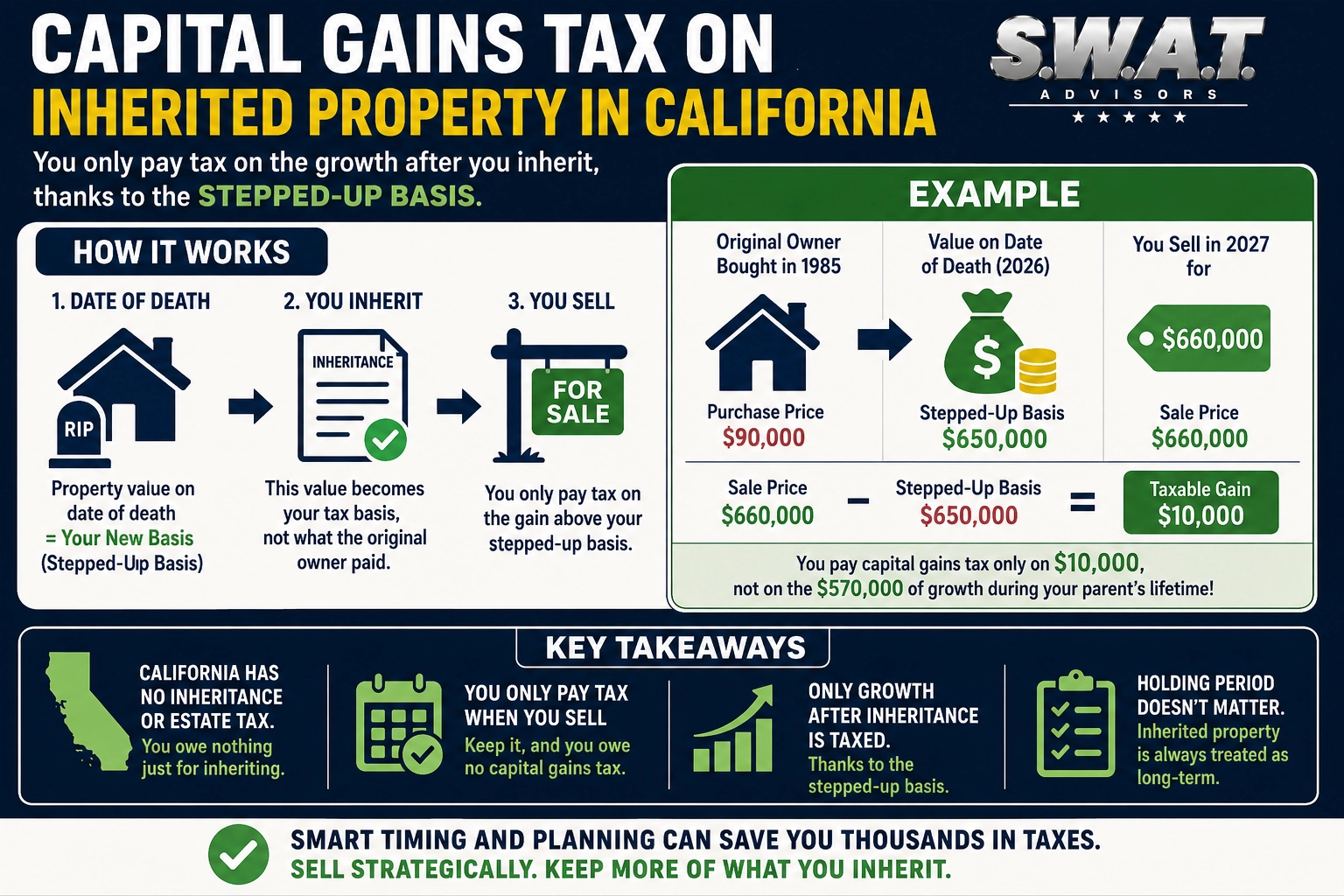
Capital gains tax on inherited property in California is not automatic. You only owe it if you sell the property for more than its value on the date the owner died, and most heirs owe far less than they expect because of a rule called the stepped-up basis. This guide breaks down exactly how the tax works, how to calculate it, and how to keep more of what you inherit.
Key Takeaways
|
Understanding Capital Gains Tax for Inherited Property
Capital gains tax on an inherited home is the federal and state tax owed on the profit you make when you sell it. The profit is the sale price minus your basis, not the price the original owner paid decades ago.
What Is Capital Gains Tax and How It Applies to Inherited Property
A capital gain is the profit from selling an asset for more than your basis in it. Basis is the dollar figure the IRS lets you subtract from your sale price before calculating what you owe.
For most property, basis is the purchase price plus improvements. For inherited property, the rule changes. A stepped-up basis is the fair market value of the property on the date the previous owner died, used instead of what they originally paid, according to IRS Publication 551.
| Example: If your father bought a Sacramento home in 1985 for $90,000. By the time he passed away in 2026, it was worth $650,000. Your basis is not $90,000. It is $650,000. If you sell it for $660,000 a year later, you only owe capital gains tax on inherited property on the $10,000 difference, not the $570,000 of appreciation that happened during his lifetime. |
How California Taxes Inherited Property
California does not add a separate death tax on top of the federal rules. But it does tax the profit from a later sale as ordinary income, with no discount for how long you held the asset.
Is There Capital Gains Tax on Inherited Property in California?
Yes, but capital gains tax on inherited property in California only applies when you sell it for more than your stepped-up basis. California abolished its state inheritance tax and estate tax decades ago, so inheriting the home itself triggers nothing. The tax bill only shows up if and when you sell.
You don’t pay capital gains tax on an inherited property if you keep it and never sell. The gain is unrealized until a sale happens, so a home you hold onto generates no capital gains bill, though you’ll still owe annual property tax based on its assessed value.
How Do You Calculate Capital Gains on an Inherited Property?
You calculate the gain by subtracting your stepped-up basis, plus any selling costs and capital improvements, from your final sale price. The result is what gets taxed, split between federal and California rates.
- Confirm your basis first. Get a certified appraisal dated as close to the death date as possible; the IRS accepts this as proof of fair market value.
- Add improvements, not repairs. A new roof or added bathroom increases the basis. Routine repairs, like fixing a leaky faucet, do not.
- Subtract selling costs. Realtor commissions, escrow fees, and transfer taxes reduce your taxable gain.
- Check the holding period rule. Inherited property automatically counts as a long-term asset, even if you sell it the month after you inherit it, per IRS guidance on the basis of assets.
- Layer in California’s rate. Unlike the IRS, California taxes the same gain as ordinary income, at rates up to 13.3% for high earners, per the California Franchise Tax Board.
| Example: A San Diego sibling group inherits a rental duplex valued at $800,000 at death. One sibling wants to sell right away; another wants to wait five years, expecting the market to climb. If the property appreciates to $950,000 by year five, that sibling now owes federal and state tax on $150,000 of new gain that could have been avoided by selling closer to the date of death and reinvesting the proceeds instead. |
The table below compares how a $150,000 taxable gain plays out for a single filer at different total income levels in 2026.
| Total Taxable Income | Federal LTCG Rate | California Rate | Combined Rate |
| Under $49,450 | 0% | 1% to 9.3% | Roughly 1% to 9.3% |
| $49,451 to $545,500 | 15% | 9.3% to 12.3% | Roughly 24% to 27% |
| Over $545,500 | 20% | 12.3% to 13.3% | Roughly 32% to 33% |
Key Strategies to Reduce Capital Gains Tax
Most of the tax owed on inherited property comes from decisions made after death, not the inheritance itself. A few planning moves can shrink or eliminate the bill.
How to Avoid Capital Gains Tax on Inherited Property
You can often avoid capital gains tax on inherited property entirely by selling soon after the date of death, when the sale price is close to your stepped-up basis.
- Sell close to the appraisal date. A quick sale usually locks in a small or zero taxable gain.
- Move in and claim the home sale exclusion. Living in the home two of the last five years before selling lets you exclude up to $250,000 of gain, or $500,000 for a married couple, under IRC Section 121.
- Use a 1031 exchange for rental property. Swapping one investment property for another defers the gain instead of paying tax now, though California tracks these exchanges and can claw back deferred gain later.
- Time the sale around your income. Selling in a lower-income year can drop your federal rate to 15% or even 0%.
- Get a defensible appraisal. A documented, professional valuation protects you if the IRS ever questions your basis.
Common Mistakes That Increase Your Tax Liability
The costliest mistake is skipping the appraisal and guessing at fair market value. Without documentation, the IRS can challenge your basis and tax far more of the sale than necessary.
- Confusing inheritance tax with capital gains tax. California has no inheritance tax, but that doesn’t mean the eventual sale is tax-free.
- Forgetting depreciation recapture on rental property. If the property was a rental after you inherited it, any depreciation you claimed gets taxed back at sale, separate from the capital gain.
- Selling through an irrevocable trust without checking basis rules. Some trust structures do not receive the full stepped-up basis, which can surprise beneficiaries.
- Ignoring multiple heirs’ cost basis needs. Each sibling should keep the appraisal and Form 8971 Schedule A on file, not just the executor.
How SWAT Advisors Can Help You
SWAT Advisors has spent more than 20 years building advanced tax planning strategies for California families, business owners, and real estate heirs facing exactly this situation.
- We review your appraisal, basis calculation, and timing options before you list the property.
- We coordinate 1031 exchanges, trust basis questions, and depreciation recapture so nothing gets missed.
- We build a full plan around reducing taxes on investment gains across your entire portfolio, not just the one sale.
In our practice at SWAT Advisors, we’ve seen families overpay tens of thousands of dollars simply because no one checked whether a quick sale or a delayed sale made more sense for their tax bracket. A common mistake our clients make is treating the inherited property as a standalone decision instead of part of their full financial picture, including tax-advantaged retirement accounts and existing investment income.
Expert Guidance on Minimizing Capital Gains Tax and Compliance
We help you document basis correctly, file Form 8949 and Schedule D accurately, and structure the sale to legally minimize what you owe the IRS and the Franchise Tax Board. Book a consultation with us to walk through your specific inherited property before you sign a listing agreement.
Planning for High-Value Inherited Estates
Larger estates carry more moving parts: multiple heirs, Form 706 filings, and alternate valuation dates that can shift your basis entirely.
Steps to Ensure Tax Efficiency and Asset Protection
- Confirm whether Form 706 was filed. If the estate filed a federal estate tax return, your basis must match the value reported on Schedule A of Form 8971, per IRS consistent basis rules.
- Check for an alternate valuation election. An executor can choose values six months after death instead of the date of death, which changes your basis if the estate qualifies.
- Model the sale under different tax years. Run the numbers assuming a sale this year versus next year to see which one keeps you further from the 20% federal and 13.3% California thresholds.
- Coordinate with other advisors. A single high-value sale can affect tax planning for high-income investors, Medicare premiums, and retirement account withdrawals in the same year.
Conclusion
Inheriting property in California does not trigger an automatic tax bill. The capital gains tax on inherited property only applies to growth that happens after the date of death, thanks to the stepped-up basis rule under IRC Section 1014. Selling close to that valuation date, documenting fair market value properly, and timing the sale around your income bracket are the three moves that determine most of what you owe.
SWAT Advisors has guided California families through exactly this decision for more than two decades, pairing certified tax planning with tax-efficient savings strategies that protect the full value of what you inherited. We plan the sale before it happens, so reducing taxes on investment income becomes part of a coordinated strategy instead of an afterthought.
If you’re weighing whether to sell now, wait, or restructure ownership among siblings, we can model each path and show you the after-tax number for each one. Contact us to schedule a consultation and get a clear plan for preserving investment wealth before you sell.
FAQs
Yes, but only on the appreciation after you inherit it. Your basis resets to fair market value at death, so you owe tax only on the gain above that value at sale.
Yes. Selling soon after inheriting, living in the home two of five years for the Section 121 exclusion, or using a 1031 exchange for rental property can all lower or eliminate the bill.
Your basis becomes the fair market value on the date the owner died, not what they originally paid. This wipes out capital gains tax on appreciation that happened before you inherited it.
Not entirely, but it minimizes them. A quick sale near the appraisal date usually means the price is close to your basis, so the taxable gain is small or zero.
Yes. The Section 121 home sale exclusion, 1031 exchanges for investment property, and capital loss offsets can all reduce or defer what you owe on the sale.
Yes, each sibling owes tax individually on their share of the gain, calculated using their proportional stepped-up basis and sale proceeds.
No. California repealed its inheritance and estate tax decades ago; only the federal estate tax applies, and only to estates above the federal exemption threshold.
Keep a certified appraisal dated near the death date, Form 8971 Schedule A if the estate filed Form 706, and receipts for any capital improvements you make afterward.