
Federal income tax is the tax the U.S. government collects on the money you earn each year, and it funds everything from national defense to Social Security. Most working Americans pay it through paycheck withholding or quarterly estimates, then settle the final amount on a federal tax return.
This guide breaks down how federal income tax works, step by step, so you know exactly where your money goes and how to keep more of it.
Key Takeaways
|
What Is Federal Income Tax, and What Does It Actually Pay For?
Federal income tax is a percentage of your yearly earnings that the federal government collects to pay for national programs, such as defense, federal highways, veterans’ benefits, Social Security, Medicare, and interest on the national debt.
The government did not always tax income directly. Congress made it permanent with the 16th Amendment in 1913, and it has funded federal operations ever since.
The U.S. federal income tax system applies the same rates nationwide, while state income tax rates and rules vary by state, and a handful of states, like Texas and Florida, charge no state income tax at all.
Who Is Required to Pay Federal Income Tax?
Anyone who earns income above the IRS filing threshold for their filing status and age must file a federal tax return. For 2026, a single filer under 65 generally must file once gross income tops $16,100, which matches the standard deduction amount.
This includes wages, freelance income, rental income, investment gains, and most retirement distributions. Even part-time workers and gig drivers count if their net self-employment income exceeds $400.
Can You Be Exempt From Paying Federal Taxes?
You are exempt from paying federal income taxes if your total income falls below the filing threshold for your status or if your only income is nontaxable, such as certain Social Security benefits or qualified scholarship funds.
Some nonprofit organizations and government entities also carry tax-exempt status under IRS rules. Individual workers rarely qualify for full exemption; most simply owe $0 after deductions and credits reduce their bill to zero.
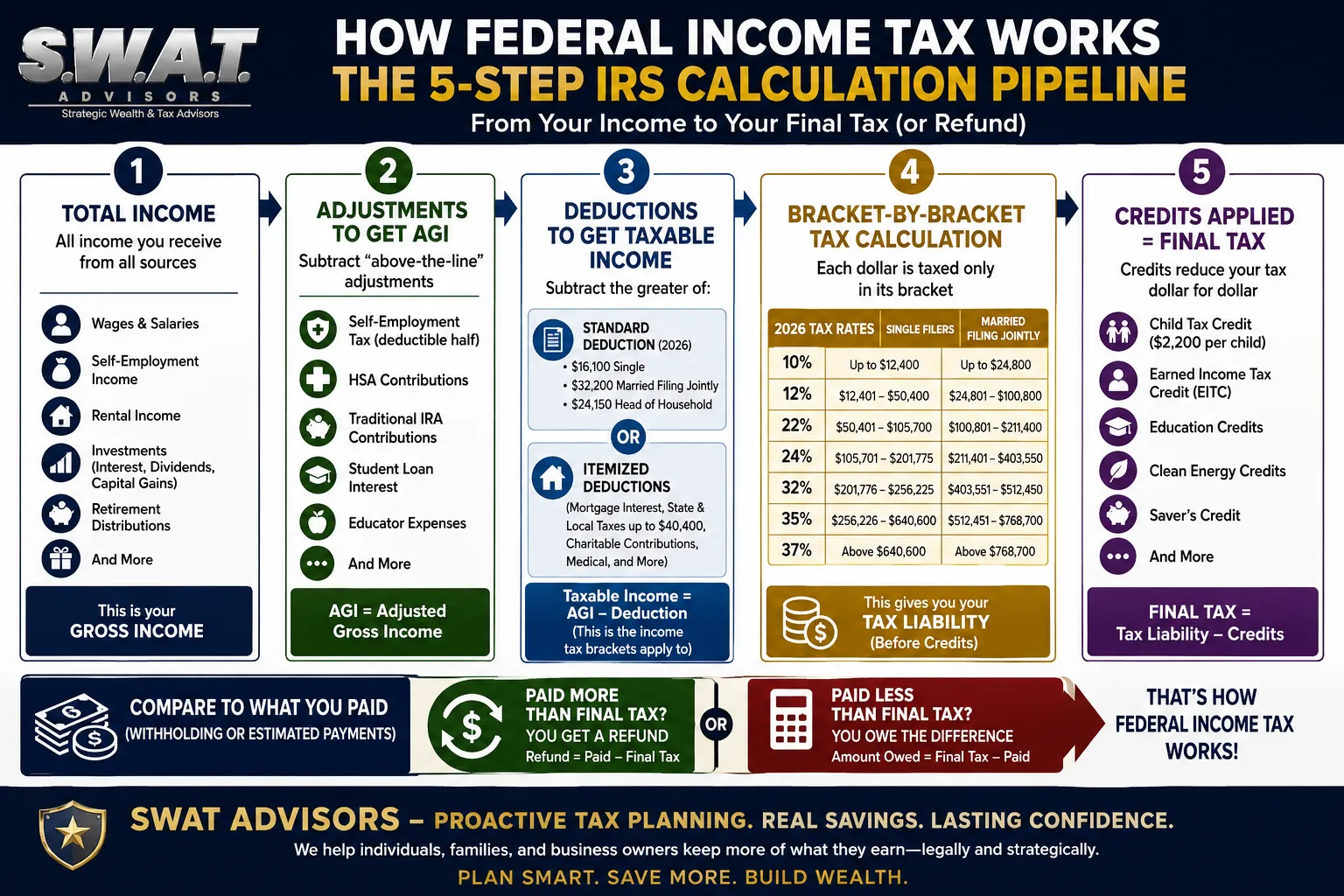
The Complete Income-to-Tax Flow (The IRS Calculation Pipeline)
How the IRS calculates your taxes follows five clear steps: total income, adjustments to get AGI, deductions to get taxable income, bracket-by-bracket tax calculation, and credits applied at the end.
Step 1: What Counts as Income for Federal Tax Purposes?
Gross income is every dollar you receive that the IRS doesn’t specifically exclude. That covers wages, tips, self-employment profit, interest, dividends, rental income, and most retirement withdrawals, per IRS Publication 525. Adjustments then reduce gross income before it becomes AGI, things like educator expenses or student loan interest.
| Often not federally taxable: qualified Roth IRA withdrawals, most life insurance payouts, child support received, and gifts under the annual exclusion. |
Step 2: How the IRS Determines Your Adjusted Gross Income (AGI)
Adjusted gross income, or AGI, is your total income minus specific above-the-line adjustments listed on Schedule 1 of Form 1040. It is the single number that determines eligibility for dozens of deductions and credits.
Common adjustments include the deductible half of self-employment tax, HSA contributions, and traditional IRA contributions. Lowering your AGI often unlocks credits that phase out at higher income levels.
Step 3: How Deductions Reduce Taxable Income (Not Your Tax Bill)
A deduction lowers the income the IRS taxes, not the tax itself. Reducing taxable income with deductions means subtracting either the standard deduction or your itemized total from AGI to land on taxable income.
For 2026, the standard deduction is $16,100 for single filers and $32,200 for married couples filing jointly, per IRS Revenue Procedure 2025-32. A $1,000 deduction saves someone in the 22% bracket about $220, not $1,000.
Step 4: How Progressive Tax Brackets Really Work
A marginal tax rate is the rate applied only to the income that falls inside a specific bracket, not your whole income. Marginal tax rates for 2026 single filers run from 10% on the first $12,400 up to 37% above $640,600, per IRS Revenue Procedure 2025-32.
| 2026 Tax Rate | Single Filers | Married Filing Jointly |
| 10% | Up to $12,400 | Up to $24,800 |
| 12% | $12,401 to $50,400 | $24,801 to $100,800 |
| 22% | $50,401 to $105,700 | $100,801 to $211,400 |
| 24% | $105,701 to $201,775 | $211,401 to $403,550 |
| 32% | $201,776 to $256,225 | $403,551 to $512,450 |
| 35% | $256,226 to $640,600 | $512,451 to $768,700 |
| 37% | Above $640,600 | Above $768,700 |
The table above shows how each dollar of taxable income gets sorted into a bracket and taxed at that bracket’s rate only. Your blended tax rate, also called your effective rate, is your total tax divided by your total taxable income, and it is always lower than your top marginal rate.
Moving into a higher tax bracket usually doesn’t reduce your take-home pay, because only the income above the new threshold gets taxed at the higher rate. A raise that pushes $2,000 into the 24% bracket costs you $480 more in tax, not your entire paycheck at 24%.
Step 5: Tax Credits, the Fastest Legal Way to Reduce Your Tax Bill
A tax credit cuts your tax bill dollar for dollar, which makes it more valuable than a same-size deduction. The Child Tax Credit, EITC, and education credits fall into this category, and some, like the EITC, are refundable even if you owe nothing.
Step 6: Taxable Income
Taxable income is your AGI minus the standard deduction or your itemized total, whichever is larger. It is the exact figure the bracket table above applies to, and it is almost always smaller than the income shown on your W-2 or 1099.
| Taxable Income = Adjusted Gross Income (AGI) − Standard Deduction (or Itemized Deductions, whichever is higher) |
Step 7: Tax Brackets and Tax Liability
Tax liability is the dollar amount the IRS calculates by running your taxable income through the bracket table, layer by layer. This gross figure comes before any credits get applied, so it is not your final bill yet.
| Tax Liability = Taxable Income × Applicable Progressive Tax Rates |
Step 8: Final Tax Owed or Refund
Your final tax owed is the gross liability minus every credit you qualify for. Compare that number to what you already paid through withholding or estimated payments; a shortfall means you pay the difference, and an overpayment means the IRS sends a refund.
Final Tax = Tax Liability − Tax Credits
|
Common Scenarios: How Federal Income Tax Works in Real Life
Federal income tax rules apply differently depending on a taxpayer’s filing status, income sources, deductions, and life circumstances.
Salaried Employee
A W-2 employee has federal tax withheld from every paycheck based on Form W-4 elections. At filing, if withholding exceeds the actual tax owed, the IRS sends a refund; if not, the employee pays the balance by April 15.
Freelancer or Independent Contractor
Freelancers receive gross pay with no withholding, so they owe both income tax and self-employment taxes of 15.3% on net profit. Missing quarterly payments can trigger IRS underpayment penalties even if the full amount gets paid by the deadline.
Retiree
Retirees often mix taxable pension income, partially taxable Social Security, and tax-free Roth withdrawals. Up to 85% of Social Security benefits become taxable once combined income crosses IRS thresholds, per Publication 915.
Investor
Investors pay ordinary rates on interest and short-term gains, but qualified dividends and long-term capital gains get preferential rates of 0%, 15%, or 20%. Timing a sale past the one-year mark can meaningfully cut what’s owed.
Legal Ways to Minimize Federal Income Tax Without Triggering IRS Problems
Cutting your tax bill legally comes down to three levers: shrink taxable income before it hits your return, claim every credit you qualify for, and time your moves before December 31.
Reduce Taxable Income Before It Reaches Your Tax Return
Traditional 401(k) contributions, traditional IRA contributions, HSA deposits, and FSA elections all lower taxable wages before the IRS ever sees them. The 401(k) defers tax until withdrawal, while an HSA can be entirely tax-free if used for medical costs.
- Traditional 401(k): $24,500 limit for 2026, plus $8,000 catch-up at age 50+
- Traditional IRA: $7,500 limit for 2026, deductibility phases out at higher income if covered by a workplace plan
- HSA: reduces AGI dollar for dollar and grows tax-free for medical expenses
- FSA and employer pre-tax benefits: lower wages reported on your W-2 directly
High earners on W-2 income benefit most, since every pre-tax dollar escapes their top marginal rate immediately.
Claim Every Tax Credit You’re Eligible For Before Filing
The Child Tax Credit ($2,200 per child for 2026), the EITC (up to $8,231 for three or more children), education credits, clean energy credits, and the Saver’s Credit all reduce tax owed dollar for dollar. Most carry income phase-outs, so check eligibility every year, not just once.
Choose the Deduction Method That Results in the Lowest Taxable Income
You either take the standard deduction or itemize, never both. Itemizing beats the standard deduction only when mortgage interest, state and local taxes (capped at $40,400 for 2026 under current law), medical costs above 7.5% of AGI, and charitable gifts combined exceed your standard deduction amount.
Adjust Tax Withholding to Avoid Large Refunds or Unexpected Tax Bills
Federal tax withholding is set by your Form W-4, and updating it after a raise, marriage, or new job prevents both a surprise bill and an interest-free loan to the government. A refund is not free money; it is tax you overpaid all year with no interest paid back.
Tax Planning Strategies for Self-Employed Individuals and Freelancers
Estimated tax payments are due quarterly (typically April 15, June 15, September 15, and January 15) to cover income and self-employment tax that no employer withholds. To calculate and pay estimated taxes accurately, self-employed filers should track net profit monthly and set aside 25 to 30% for federal obligations.
Business expense deductions, a SEP-IRA or Solo 401(k), and keeping a separate business bank account all support clean, defensible business tax planning strategies. Separating income tax planning from self-employment tax planning matters because deductions that lower income tax don’t always reduce the 15.3% SECA tax.
Year-End Tax Moves That Can Still Reduce Your Federal Tax Bill
Maxing out retirement contributions, harvesting investment losses against gains, bunching charitable contributions, and prepaying deductible expenses before December 31 all shrink the current year’s bill. Review capital gains and losses together each December; unused losses carry forward if they exceed gains.
How SWAT Advisors Helps You Navigate Federal Income Tax With Confidence
SWAT Advisors focuses on proactive tax planning strategies, not just annual tax prep, for business owners, physicians, dentists, and high-net-worth families across California.
In our practice, we’ve seen clients overpay for years simply because nobody reviewed their withholding, retirement contributions, or entity structure together. A common mistake we see is treating tax planning for high-income individuals as a once-a-year event instead of a quarterly discipline.
- Certified tax planners who build strategies around small business tax deductions, retirement tax planning, and entity structuring
- Support with the IRS Fresh Start Program and resolution of IRS tax notices for clients already behind
- Quarterly reviews so your plan adjusts as income, law, and life circumstances change
Book a consultation with us to see what a proactive strategy could save you this year.
Conclusion
Federal income tax works on total income, AGI, deductions, bracket-based tax, and credits. The U.S. federal income tax system taxes only the income inside each bracket, not your entire paycheck, and the biggest legal savings come from lowering taxable income before it ever reaches your return.
SWAT Advisors identify which deductions, credits, and entity moves apply to your exact income mix, then build a strategy around it instead of reacting after the year ends.
We work with W-2 employees, freelancers, retirees, and business owners who want a real plan, not just a filed return. Contact us to schedule a tax planning consultation and find out what you’re currently leaving on the table.
FAQs
The IRS taxes your income in layers called brackets, taking a bigger percentage only on the portion of income inside each higher bracket, after subtracting deductions and credits.
Each bracket taxes only the income within its range; a single filer earning $60,000 in 2026 pays 10%, then 12%, then 22% on different slices, not 22% on the full amount.
No. Only the income above the new bracket threshold gets taxed at the higher rate; everything below it stays taxed at the lower rates
AGI is gross income minus above-the-line adjustments; taxable income is AGI minus the standard deduction or itemized deductions, and it's the number brackets apply to.
Withholding is an estimate based on your W-4; if it undercounted your actual liability from bonuses, side income, or bracket changes, you owe the difference.
Employers hold back a portion of every paycheck based on your Form W-4 and send it to the IRS, which counts as prepayment toward your annual tax bill.
Federal tax filing deadlines fall on April 15 for most individual filers, with an automatic extension to October 15 available if you file Form 4868 on time.
Yes. Pre-tax retirement contributions, HSA deposits, itemized deductions, and eligible tax credits all legally lower what you owe without triggering IRS scrutiny.
To calculate federal income tax owed, subtract deductions from income to get taxable income, apply the 2026 bracket table, then subtract any credits you qualify for.
IRS Publication 17 and IRS.gov remain the primary sources for current federal tax rules, thresholds, and filing requirements each year.