

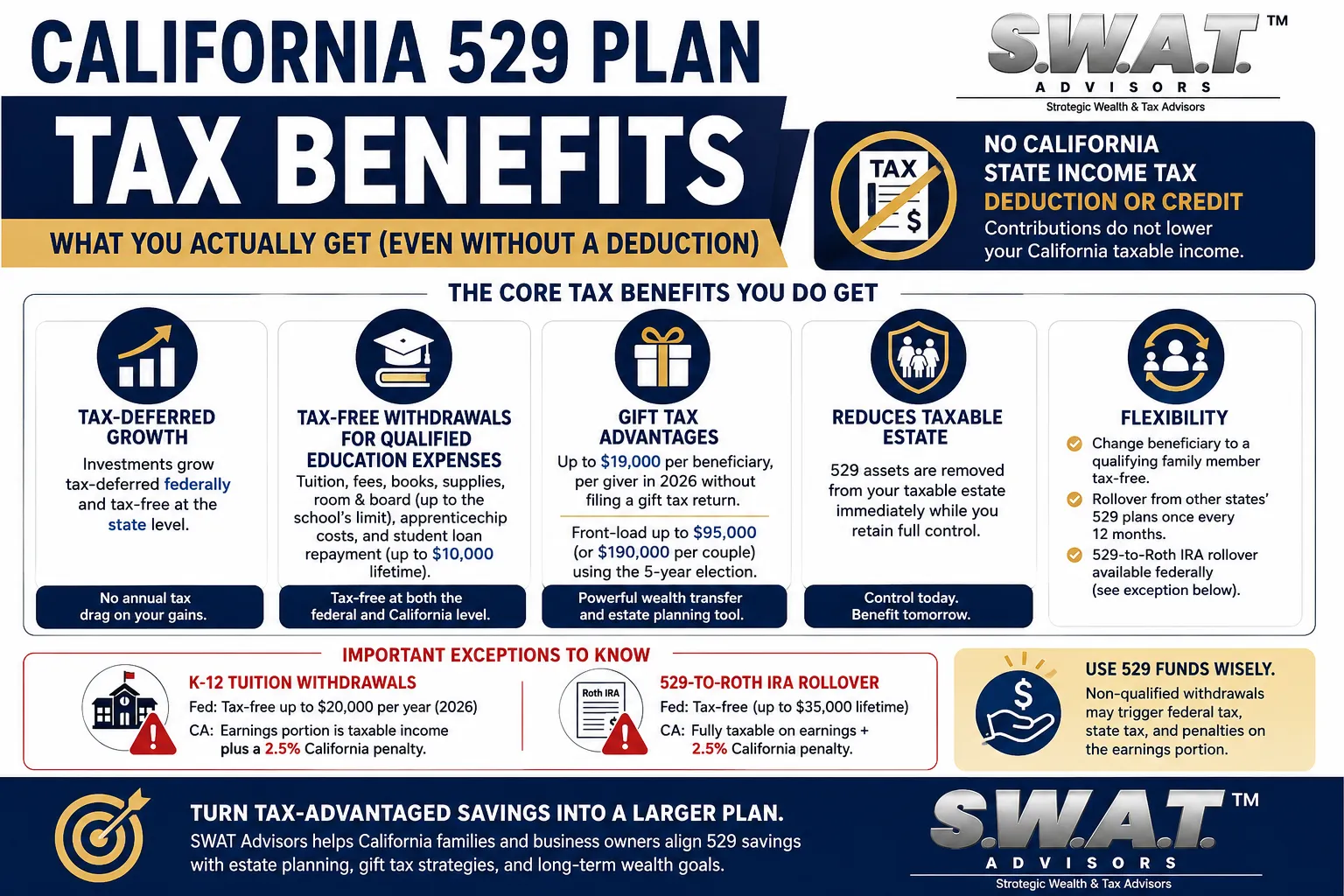
California’s 529 plan, ScholarShare 529, does not provide a state income-tax deduction or credit for contributions. However, investment earnings grow tax-deferred, allowing savings to compound without annual federal or California income tax.
Withdrawals for qualified higher-education expenses are generally free from federal and California income tax. Nonqualified withdrawals may trigger federal and California taxes and additional penalties on the earnings portion, so funds should be used carefully.
Key Takeaways
|
The One Thing California’s 529 Plan Doesn’t Offer
California does not allow a state income tax deduction or credit for contributions made to ScholarShare 529 or any other state’s 529 plan. This puts California in the same category as roughly 20 other states that collect income tax but give no 529 deduction, including states like Hawaii, Kentucky, and North Carolina.
| In our practice, this is the first misunderstanding we clear up with clients who moved to California from a state that did offer a deduction. There is no dollar limit to “hit” because there is no deduction to claim in the first place. Contributing $5,000 or $50,000 to ScholarShare 529 has zero effect on your California taxable income for that year. |
A 2026 legislative attempt to change this, Senate Bill 529, would have created California’s first-ever 529 deduction, up to $10,000 for joint filers and $5,000 for individuals, subject to income caps of $150,000 and $75,000. The bill did not pass and was returned to the Secretary of the Senate under Joint Rule 56 in February 2026.
Tax-Deferred Growth: The Core Benefit of Any California 529
Money in a California 529 grows without triggering federal or state income tax on the annual gains, and that deferral is where the real long-term value sits. Tax-deferred growth means you don’t pay tax each year on dividends, interest, or capital gains realized inside the account, unlike a standard brokerage account where you’d owe tax annually even if you never withdrew a dollar.
The difference between tax-free and tax-deferred growth matters because deferral only postpones a tax bill, while tax-free treatment eliminates it. Growth becomes tax-free only when the withdrawal is qualified. Until then, it is simply deferred, meaning the tax bill is postponed and potentially eliminated entirely if the money is eventually used correctly.
What this looks like in practice:
- A $10,000 contribution invested for 18 years at a 7% average annual return grows to roughly $33,800, all without an annual tax drag reducing the compounding
- In a taxable account, the same growth would be reduced each year by tax on realized gains, interest, and dividends, depending on your bracket
- The deferral applies regardless of your income level; there is no phaseout that removes this benefit for high earners
- California conforms to this federal deferral treatment, so the state does not tax the annual growth either
In our experience advising California families on education funding, the deferral benefit alone often outweighs the missing state deduction within 8 to 10 years, especially for families contributing consistently rather than as a single lump sum.
This deferral is the foundation of every other tax benefit of a 529 plan in California, since qualified withdrawals simply convert deferred growth into permanently tax-free growth.
Tax-Free Withdrawals for Qualified Education Expenses
Withdrawals from a California 529 are completely tax-free at both the federal and state level when used for qualified education expenses. A qualified education expense is a cost the IRS defines under IRC Section 529 and IRS Publication 970, and it includes tuition, mandatory fees, books, supplies, equipment, and computers required for enrollment at an eligible institution.
Room and board also qualifies, but only up to the school’s official cost of attendance figure for students enrolled at least half-time. Going over that figure converts the excess into a non-qualified withdrawal.
Additional categories that qualify tax-free at both the federal and California level:
- Registered apprenticeship program expenses, including fees, books, supplies, and equipment, for programs certified under the National Apprenticeship Act
- Student loan repayment, up to a $10,000 lifetime cap per borrower, applicable to the account beneficiary or their siblings
- Costs at any accredited public, private, or graduate institution nationwide, along with some eligible schools abroad.
The K-12 Tuition Exception You Need to Know About
California does not recognize K-12 tuition as a qualified 529 expense, which means the earnings portion of a K-12 withdrawal is taxable on your California return even though it’s tax-free federally.
- Under the One Big Beautiful Bill Act, the federal K-12 tuition withdrawal cap doubled from $10,000 to $20,000 per year starting in the 2026 tax year.
- California did not adopt that change, which is the clearest exception to the general California 529 plans tax benefit rule that federal and state treatment line up.
Here’s what actually happens when a California resident withdraws 529 funds for K-12 private or religious school tuition:
| Tax Treatment | Federal | California |
| Withdrawal up to $20,000/year for K-12 tuition | Tax-free | Earnings portion is taxable income |
| Additional state penalty on earnings | None | 2.5% California tax added |
| Contribution portion of the withdrawal | Not taxed (already after-tax money) | Not taxed |
The table above shows that only the earnings component of a K-12 withdrawal creates a tax bill in California, but the combination of state income tax plus the 2.5% penalty means the effective cost is higher than most parents expect.
If you’re funding a 529 specifically for private K-12 tuition, run the numbers before assuming the withdrawal is free of consequence just because the IRS treats it that way.
Gift Tax and Estate Planning Benefits of a California 529
Contributions to a California 529 count as gifts to the beneficiary for federal gift tax purposes, and in 2026 you can contribute up to $19,000 per beneficiary, per giver, without filing a gift tax return. A married couple can combine exclusions to contribute $38,000 to a single beneficiary in one year with no reporting requirement at all.
The 529 plan tax strategy for high-income families typically centers on a provision most other savings vehicles don’t offer: the five-year gift tax averaging election under IRC Section 529(c)(2)(B).
- An individual can contribute up to $95,000 to one beneficiary in a single year (5 x $19,000) and elect to treat it as spread evenly across five years for gift tax purposes
- A married couple electing to split gifts can contribute up to $190,000 in one year using the same election
- The election requires filing IRS Form 709 in the year of the contribution, even though no tax is owed
- If the donor dies during the five-year period, the unused portion allocated to future years is pulled back into the taxable estate
- No further annual exclusion gifts can be made to that same beneficiary during the five-year window without additional reporting
For California estate planning considerations, the money is removed from the donor’s taxable estate immediately, even though the donor, as account owner, keeps full control over investment choices, beneficiary changes, and withdrawal timing. A 529 is one of the few tools available for estate planning in California that lets a grandparent retain full authority over an asset that’s already outside their estate for tax purposes.
The 2026 federal lifetime gift and estate tax exemption is at $15 million per individual, or $30 million for a married couple. Front-loading a 529 through the five-year election is one of the more efficient ways for grandparents to move money out of an estate while the funds still serve a specific, useful purpose for a grandchild’s education.
Other Flexible Benefits: Beneficiary Changes, Rollovers, and the 529-to-Roth IRA Option
Flexibility is part of the tax benefits of 529 plan ownership in California, since the account adapts to changed circumstances.
Changing the Beneficiary
You can change the named beneficiary on a California 529 to another qualifying family member without triggering federal or state tax, as long as the new beneficiary is a member of the original beneficiary’s family as defined under IRC Section 529(e)(2). This covers siblings, cousins, parents, and even the account owner in some cases. If a child receives a scholarship, doesn’t attend college, or finishes with funds remaining, the account doesn’t become a tax liability by default; it becomes transferable.
Rolling Over to a Different State’s Plan
ScholarShare 529 allows you to roll funds in from another state’s 529 plan once every 12 months for the same beneficiary without tax consequence for families who opened an account before moving to California, or who want to consolidate multiple accounts into one for simpler tracking and single-step payments to schools.
The 529-to-Roth IRA Rollover
Federal law under SECURE 2.0 allows a 529 account that has been open for at least 15 years to roll funds directly into a Roth IRA for the beneficiary, up to a $35,000 lifetime cap, without federal tax or penalty, as long as the rollover amount doesn’t exceed that year’s Roth IRA contribution limit and is aggregated with any other IRA contributions made that year.
California does not conform to this federal provision. The California Franchise Tax Board treats a 529-to-Roth IRA rollover as a non-qualified withdrawal, which means the earnings portion is included in California taxable income and hit with the same 2.5% additional state tax that applies to other non-qualified distributions, according to the FTB’s instructions for Form 3805P.
What Happens If You Make a Non-Qualified Withdrawal
A non-qualified withdrawal from a California 529 triggers a 10% federal penalty on the earnings portion, ordinary federal income tax on those earnings, plus a 2.5% California state penalty on top of the state income tax owed.
Contributions are never taxed again on withdrawal since they were made with after-tax dollars, so only the growth portion is exposed.
- Federal: 10% penalty tax on earnings, plus the earnings are taxed at the recipient’s ordinary federal income tax rate
- California: state income tax on the earnings, plus an additional 2.5% California penalty tax
- Contributions withdrawn: no tax or penalty at either level, since that money was already taxed before it went in
- Exceptions to the 10% federal penalty (though state income tax may still apply) include the beneficiary receiving a scholarship, attending a U.S. military academy, or becoming disabled
Before pulling money out for a non-qualifying purpose, it’s worth checking whether a beneficiary change or a rollover to a family member’s education expenses avoids the penalty entirely.
Is ScholarShare 529 the Right Choice, or Should You Compare Other States?
ScholarShare 529 makes sense for most California residents because the state’s lack of a deduction means there’s no in-state tax incentive keeping you locked into California’s plan, so the decision comes down to investment options, fees, and account features rather than tax savings.
ScholarShare’s average asset-based fees run well below the national average for 529 plans, and it offers a broad set of investment portfolios from established managers.
You should stick with ScholarShare 529 if:
- You want the lowest-friction option with low fees and no state tax reason to look elsewhere
- You value the ability to pay schools directly and manage everything from one account
- You’re contributing modest to moderate amounts annually and don’t need a specialized investment lineup
You should compare other states’ plans if:
- You currently live in, or plan to move to, a state that offers a meaningful state income tax deduction or credit for its own plan, since California residency isn’t required to open most states’ 529 plans
- You want access to a specific investment manager or fund lineup not offered through ScholarShare
- You’re a grandparent living outside California funding a grandchild’s account and want to capture your own state’s deduction, if one exists
Since California itself offers no tax incentive to stay in-state, the fee structure and investment menu matter more here than in states where residents give up a deduction by leaving.
Building These Benefits Into Your Family’s Tax and Estate Strategy
Step 1: Set a Contribution Level Tied to the Gift Tax Exclusion
Start by deciding whether you’re contributing within the $19,000 annual exclusion per beneficiary or whether a larger, front-loaded contribution using the five-year election makes more sense for your estate goals. Families focused purely on college savings usually stay within the annual exclusion. Families also doing estate planning often look at the five-year election instead.
Step 2: Separate K-12 Funding From College Funding
If part of your goal includes private K-12 tuition, consider whether that money should sit in the 529 at all, given California’s earnings tax and 2.5% penalty on those withdrawals, or whether a separate account without those state-level consequences serves the K-12 goal better while the 529 stays dedicated to post-secondary costs.
Step 3: Decide Who Owns the Account
Account ownership affects both control and, in some cases, financial aid calculations. Parent-owned and grandparent-owned accounts are treated differently under federal financial aid formulas, and this decision should be made alongside a broader financial plan rather than in isolation.
Step 4: Build in a Beneficiary Contingency Plan
Because beneficiary changes to qualifying family members carry no tax consequence, decide in advance who the account could transfer to if the original beneficiary doesn’t use all the funds.
Step 5: Coordinate With Your Broader Estate Plan
If you’re using the five-year gift tax election or making larger contributions as part of moving assets out of your estate, this needs to be documented and coordinated with your Form 709 filings and your overall estate plan.
How SWAT Advisors Helps You Save More of Your Californian Income
Clients often come to us already aware of the general California 529 plan tax benefits but unsure how those benefits fit alongside the rest of their income and estate strategy.
SWAT Advisors builds a 529 plan tax strategy for high-income families into a coordinated plan that accounts for gift tax elections, estate exposure, and the specific California treatment of K-12 withdrawals and Roth rollovers.
Here’s how we help:
- We map out whether the five-year gift tax election fits your estate goals and file the required Form 709 documentation correctly
- We coordinate 529 contributions with your broader estate planning strategy so the account works alongside trusts, insurance, and other wealth transfer tools instead of sitting apart from them
- We flag the specific California tax exposure points, like K-12 withdrawals and 529-to-Roth rollovers, before you make a withdrawal you can’t undo
If you’re a high-net-worth family, a business owner, or a physician trying to make sure education savings and estate planning work together, book a consultation with us.
Conclusion
California’s 529 plan tax benefits come from federal treatment, not a state deduction. Tax-deferred growth, tax-free qualified withdrawals for college and apprenticeships, the $19,000 annual gift tax exclusion, and the five-year superfunding election deliver real, quantifiable savings regardless of California’s missing deduction.
K-12 tuition withdrawals and 529-to-Roth IRA rollovers require deliberate planning rather than assumption, both federally tax-free but taxed by California with an added 2.5% penalty.
SWAT Advisors specialize in coordinating education savings with estate planning, gift tax elections, and California-specific tax exposure that generic advice overlooks. We help California families and business owners turn tax-advantaged accounts like ScholarShare 529 into part of a larger wealth-building plan. Contact us to schedule a tax planning consultation.
FAQs
Yes. Tax-deferred growth, tax-free qualified withdrawals, and the federal gift tax exclusion all apply regardless of California's missing deduction.
The core tax benefits of a 529 plan in California are tax-deferred growth, tax-free qualified withdrawals for college and apprenticeships, and gift tax exclusion eligibility for contributions.
Yes. The account still avoids annual tax drag on growth and removes qualified withdrawals from taxable income at both the federal and state level.
Yes. California treats it as a non-qualified withdrawal, taxing the earnings portion and adding a 2.5% state penalty, even though it's tax-free federally.
Yes, on the earnings portion. California adds a 2.5% penalty on top of state income tax, despite federal tax-free treatment up to $20,000 a year.
Yes. Contributions are removed from your taxable estate immediately, even though you retain full control over the account as owner.
No. Only the contribution portion is tax-free; the earnings portion is taxed by California plus a 2.5% state penalty.
Yes. Grandparents can front-load up to $95,000 per beneficiary (190,000 per couple) using the five-year gift tax election in 2026.
The earnings portion becomes taxable California income with a 2.5% penalty added, unlike the federal treatment, which allows the rollover to be tax-free.







)
&description=&image=https://swatadvisors.com/wp-content/uploads/2026/09/california-529-plan-tax-benefits-1024x683.webp)