
The 401(k) contribution limits for 2026 have increased across every category. The base limit rose, the catch-up limit for workers 50 and older increased, and the combined employer-plus-employee cap also rose. On top of that, SECURE 2.0 introduced two rules that make this year more complex than most: a boosted “super” catch-up for workers aged 60 to 63, and a new requirement that high earners must make catch-up contributions as Roth rather than pre-tax. If you have not reviewed your contribution strategy this year, you may be leaving money on the table. This guide gives you the complete picture so you can act before December 31.
Key Takeaways
|
The 2026 Base 401(k) Contribution Limit
The employee elective deferral limit for 2026 is $24,500, up $1,000 from the 2025 limit of $23,500. This limit applies to traditional 401(k) plans, Roth 401(k) plans, 403(b) plans (most employers), and most governmental 457(b) plans.
If you contribute to both a traditional 401(k) and a Roth 401(k) within the same plan, the $24,500 limit is shared across both. You cannot put $24,500 in the traditional account and another $24,500 in the Roth side. The combined employee contributions across both must stay at or below $24,500.
This limit does not count employer contributions. Your employer’s matching contributions or profit-sharing deposits sit on top of your $24,500 and are subject to a separate combined cap, covered below.
Catch-Up Contributions If You’re 50 or Older
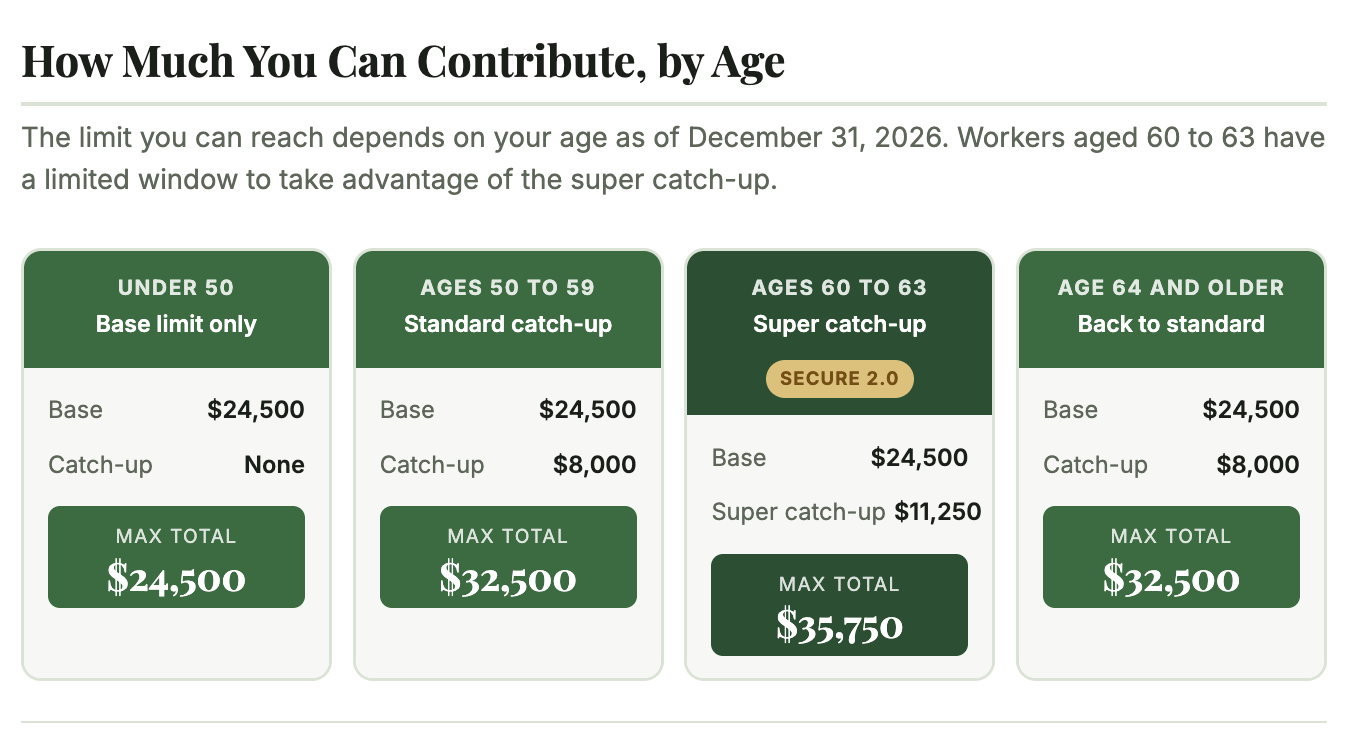
Workers who are age 50 or older by December 31, 2026 can contribute an additional $8,000 on top of the base limit, bringing the total to $32,500. The $8,000 catch-up amount is up $500 from the $7,500 allowed in 2025. You become eligible starting January 1 of the year you turn 50, even if your birthday falls later in the year.
| Plan check: Not all employers automatically allow catch-up contributions. Confirm with your HR or benefits department that your plan accepts them, especially if you are making catch-up contributions for the first time this year. |
The “Super” Catch-Up for Ages 60 to 63
SECURE 2.0 (signed December 2022) created a second, larger catch-up tier for workers in a specific four-year window: ages 60, 61, 62, and 63. This “super” catch-up replaces the standard $8,000 catch-up for this age group.
In 2026, the super catch-up amount is $11,250. Combined with the base limit, workers aged 60 to 63 can contribute up to $35,750 to their 401(k) in 2026.
| Age Group | Base Limit | Catch-Up | Total Limit |
| Under 50 | $24,500 | None | $24,500 |
| 50 to 59 | $24,500 | $8,000 | $32,500 |
| 60 to 63 (super catch-up) | $24,500 | $11,250 | $35,750 |
| 64 and older | $24,500 | $8,000 | $32,500 |
The super catch-up window is short. Once you turn 64, you revert to the standard $8,000 catch-up. Workers currently aged 60 to 63 should treat this window as a one-time opportunity to accelerate retirement planning and savings at a higher limit. After 63, it is gone.
Also Read: Solo 401(k) Setup Deadline & 401(k) Plan Deadlines 2026
New for 2026: High Earners Must Make Catch-Up Contributions as Roth
This is the most consequential change for high-income workers this year. Under SECURE 2.0, starting in 2026, employees who earned more than $150,000 in Social Security wages from the same employer in the prior year (2025) must designate all catch-up contributions as Roth, not pre-tax.
This means the catch-up portion of your contribution goes in after-tax. You do not get an upfront deduction on that $8,000 or $11,250. The money grows tax-free and comes out tax-free in retirement.
What does not change: the base $24,500 can still be contributed pretax (traditional) or as Roth, at your election. The Roth mandate applies only to the catch-up amount.
| Critical plan risk: If your employer’s 401(k) plan does not offer a Roth contribution option, high earners who are subject to this rule may not be able to make any catch-up contributions at all in 2026. Check with your plan administrator now. If your plan lacks a Roth option, your employer may be working on adding one, but until it exists, the catch-up may be unavailable to you entirely. |
For high earners, this change shifts the after-tax math of the catch-up contribution. You lose the immediate deduction, but the long-term tax-free growth on Roth funds is often more valuable, especially for those expecting high income or high tax rates in retirement.
The Combined Employer + Employee Limit
The Section 415(c) limit caps total annual additions to a 401(k) from all sources: your contributions, your employer’s match, and any profit-sharing deposits. For 2026, the limit is:
- $72,000 for workers under 50
- $80,000 for workers 50 and older (including catch-up contributions)
This limit matters most for business owners and highly compensated employees. If you run a solo 401(k), you can contribute both as the employee (up to $24,500) and as the employer (profit-sharing, up to 25% of W-2 wages or net self-employment income), with the combined total capped at $72,000.
Employer contributions generally do not count toward your personal $24,500 employee limit. But they do count toward the $72,000 combined ceiling.
How 401(k) Limits Compare to IRA and HSA Limits for 2026
A 401(k) is not the only tax-advantaged account available to you. IRA and HSA limits also increased in 2026, and you can often use these accounts alongside your 401(k).
| Account | 2026 Limit | Catch-Up | Total (with catch-up) |
| 401(k) / 403(b) | $24,500 | $8,000 (50+) / $11,250 (60-63) | $32,500 / $35,750 |
| Traditional / Roth IRA | $7,500 | $1,100 (age 50+) | $8,600 |
| HSA (self-only) | $4,400 | $1,000 (age 55+) | $5,400 |
| HSA (family) | $8,750 | $1,000 (age 55+) | $9,750 |
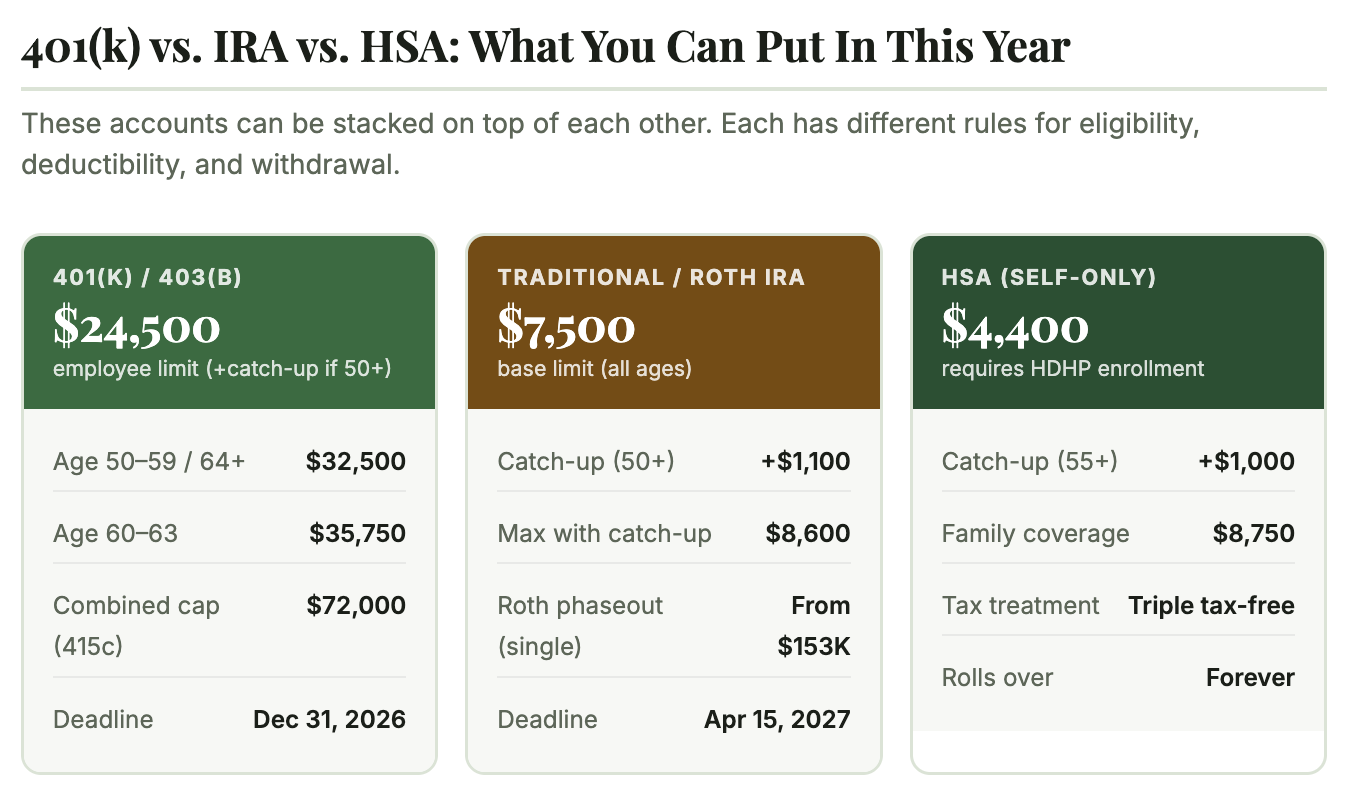
IRA contributions are separate from your 401(k) limit and can be stacked on top of it. However, the deductibility of a Traditional IRA contribution phases out at higher incomes if you or your spouse are covered under a workplace plan. For 2026, the Roth IRA phaseout begins at $153,000 (single) and $242,000 (married filing jointly).
An HSA is particularly powerful because contributions are triple tax-advantaged: deductible going in, tax-free growth, and tax-free withdrawals for qualified medical expenses. If you have a high-deductible health plan, maxing your HSA before your 401(k) beyond the employer match is often the right sequence.
Also Read: Estimated Tax Payments Schedule 2025 and 2026: Every IRS Quarterly Due Date
How to Decide How Much to Contribute Before Year-End
Year-end is the only deadline that matters for 401(k) contributions. Unlike an IRA (where you have until April 15 of the following year), your 401(k) elections must be processed through payroll. If your last paycheck of 2026 does not include the final contribution, you cannot go back and add it.
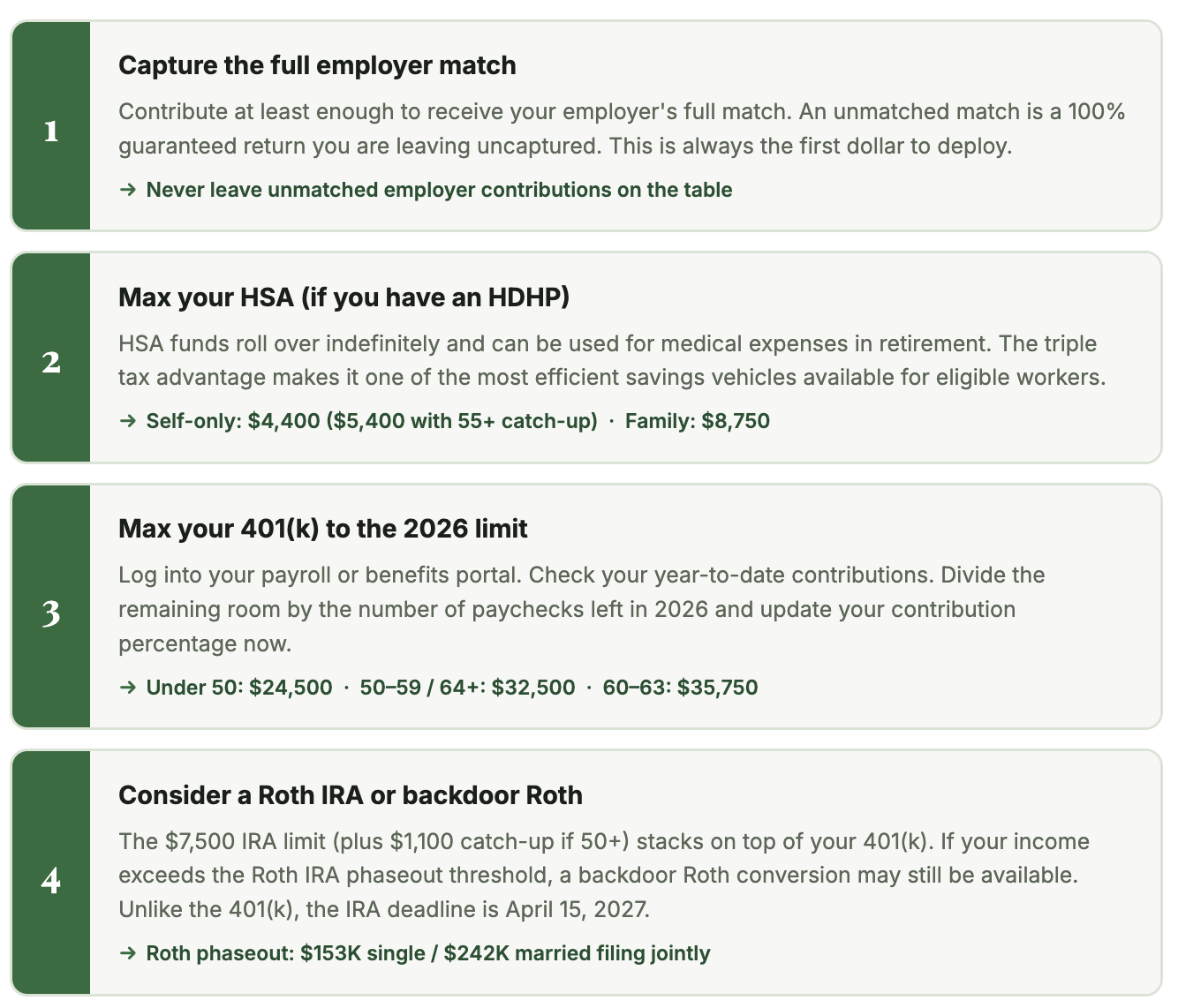
A practical contribution sequence for most workers:
- Contribute enough to get your full employer match. This is the highest guaranteed return available anywhere. Never leave unmatched money uncaptured.
- Max your HSA if you have a qualifying high-deductible health plan. HSA funds roll over forever and can be used for medical expenses in retirement.
- Max your 401(k) up to the 2026 limit. Bump up your contribution percentage now so the remaining paychecks hit the target.
- Consider a Roth IRA or backdoor Roth if your income allows. The $7,500 IRA limit stacks on top of your 401(k).
Log in to your payroll or benefits portal and check your year-to-date 401(k) contributions. Divide the remaining room by the number of paychecks left in 2026 to calculate the adjustment you need to make now.
For California residents, both state and federal tax rules allow pretax 401(k) contributions to reduce your taxable income in the same way. Coordinating your contributions with other California-specific deductions is part of an effective year-end plan.
How SWAT Advisors Can Help You Maximize Retirement Contributions Tax-Efficiently
Hitting the annual contribution limits is straightforward. Deciding how to allocate those contributions (pretax vs. Roth, 401(k) vs. IRA vs. HSA), when to convert existing balances, and how this year’s contributions affect your overall tax picture is more complex.
SWAT Advisors helps clients with:
- Calculating the optimal split between traditional and Roth contributions based on projected lifetime tax rates.
- Modeling the super catch-up window for clients aged 60 to 63 and the long-term impact of maximizing it.
- Advising high earners on the new Roth catch-up mandate and its effect on after-tax retirement income.
- Coordinating 401(k) contributions with Roth conversion strategies, IRA funding, and estate planning goals.
- Reviewing solo 401(k) and SEP-IRA options for business owners and self-employed professionals.
Common 401(k) Contribution Mistakes to Avoid
Even experienced investors make avoidable errors with their 401(k) contributions.
Here are the ones SWAT Advisors sees most often.
- Not adjusting contributions after a raise: Many people set a percentage contribution early in their career and never revisit it. A fixed percentage may still fall short of the annual limit at a higher salary. Check the dollar amount, not just the percentage.
- Missing the 60-to-63 super catch-up window: This four-year window is easy to overlook if no one has flagged it for you. Workers in this age range who aren’t contributing the full $35,750 are leaving a permanent opportunity behind.
- Assuming your plan is ready for the Roth catch-up mandate: Not all plans were immediately updated to accommodate the new rule. High earners should confirm their plan offers a Roth option before assuming it will accept their catch-up contribution.
- Waiting until December to adjust elections: If you realize in late December that you are behind, there may not be enough paychecks left in the year to close the gap. Mid-year reviews prevent this.
- Stopping contributions once you hit a round number: Some people stop at $20,000 or $22,000 because it feels like enough. The actual 2026 limit is $24,500. The difference, compounded over 20 years, is meaningful.
- Overlooking the employer match vesting schedule: Some employers require you to stay for two to five years before their contributions are fully yours. Know the schedule before you decide on a job.
Conclusion
2026’s 401(k) limits offer more room than in most years, but you have until December 31, 2026, instead of April 15, 2026, to use them. The new super catch-up for workers aged 60 to 63 is a four-year opportunity that doesn’t come back once you age out. For high earners, the Roth catch-up rule is already in place, and plans not updated in time may block contributions without the worker even knowing it. All of this is easy to find once you know what to look for, but if you miss it, you’ll be behind for a long time. The right time to review your contribution strategy for 2026 is now, while you still have enough paychecks left to act.
The 2026 limits are higher, but the window closes December 31, not April 15. Call SWAT Advisors today and make sure every dollar is working before the year ends.
FAQs
The 401(k) limit for 2026 is $24,500 for employee elective deferrals. This is up $1,000 from the 2025 limit of $23,500.
Workers who are 50 or older can contribute an extra $8,000 in catch-up contributions in 2026, for a total of $32,500.
The super catch-up is a higher catch-up limit introduced by SECURE 2.0 for workers aged 60, 61, 62, and 63. In 2026, these workers can contribute $11,250 above the base limit, for a total of $35,750.
Yes, if your prior-year wages from the same employer exceeded $150,000. Workers who meet this threshold must designate all catch-up contributions (not the base $24,500, just the catch-up amount) as Roth starting in 2026.
The Section 415(c) combined limit for 2026 is $72,000 for workers under 50, or up to $80,000 for workers 50 and older when catch-up contributions are included.
If you are under 50, the max 401(k) contribution for 2026 is $24,500. If you are 50 to 59 or 64 and older, the max is $32,500. If you are between ages 60 and 63, the max is $35,750.
The standard catch-up contribution limit for 2026 is $8,000 for workers aged 50 and older. Workers aged 60 to 63 have a higher limit of $11,250 under the SECURE 2.0 super catch-up provision.
Yes. Starting in 2026, employees who earned more than $150,000 in prior-year wages from the same employer must contribute catch-up amounts as Roth rather than pretax. SECURE 2.0 mandated this rule.