
Capital gains tax vs income tax comes down to what kind of money you made. Income tax hits wages, salaries, and business profit. Capital gains tax hits the profit you make from selling something you own, like stock or a rental home.
The two use different rules, different rates, and sometimes different IRS forms entirely. This guide breaks down what separates income tax from capital gains tax, and shows exactly how the 2026 brackets compare.
Key Takeaways
|
What Is Income Tax?
Income tax is the tax the federal government, and most states, charge on money you earn from work, a business, or investments like interest and dividends.
- It gets collected through payroll withholding or estimated payments.
- The IRS uses seven income tax brackets for 2026: 10%, 12%, 22%, 24%, 32%, 35%, and 37%.
- Each bracket only taxes the income that falls inside it.
- Your whole paycheck doesn’t get taxed at your top rate.
For example, a single filer earning $80,000 in 2026 doesn’t pay 22% on all $80,000. The first $12,400 is taxed at 10%. The next portion is taxed at 12%, and so on, up through the 22% bracket.
What Is Capital Gains Tax?
Capital gains tax is the tax you owe when you sell stock, real estate, a business, or even collectibles for more than you paid for it.
- The IRS calls this profit a capital gain.
- If you own the asset for one year or less, it’s a short-term gain.
- Hold it longer than a year, and it becomes a long-term gain, which qualifies for lower rates.
- Not every sale creates a taxable gain.
- Sell an asset for less than you paid, and that’s a capital loss. Losses can offset gains elsewhere on your return.
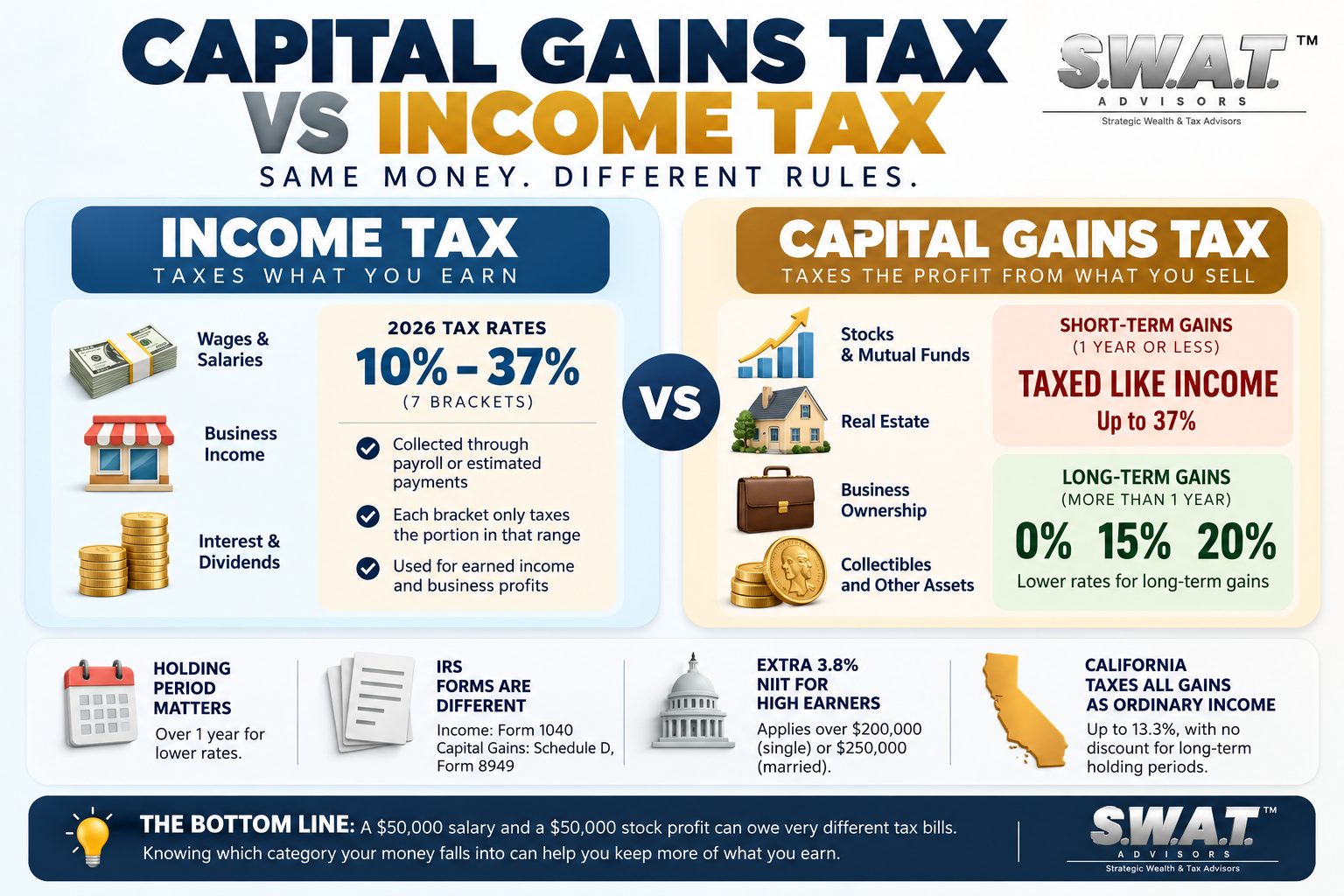
Capital Gains Tax vs Income Tax: Key Differences
Capital gains tax vs income tax are calculated differently, taxed at different rates, and reported on different IRS forms.
The table below breaks down the core differences side by side. This table shows why the label on your money matters more than the dollar amount alone. A $50,000 salary and a $50,000 stock profit can owe very different tax bills.
| Feature | Income Tax | Capital Gains Tax |
| What it taxes | Wages, salaries, business income | Profit from selling an asset |
| 2026 rates | 10% to 37% | 0%, 15%, or 20% long-term; ordinary rates short-term |
| Holding period matters? | No | Yes, over one year for long-term rates |
| Reported on | Form 1040, Schedule 1 | Schedule D, Form 8949 |
| State treatment | Taxed everywhere | Some states, like California, tax it as ordinary income |
Short-Term Capital Gains Are Taxed Like Income
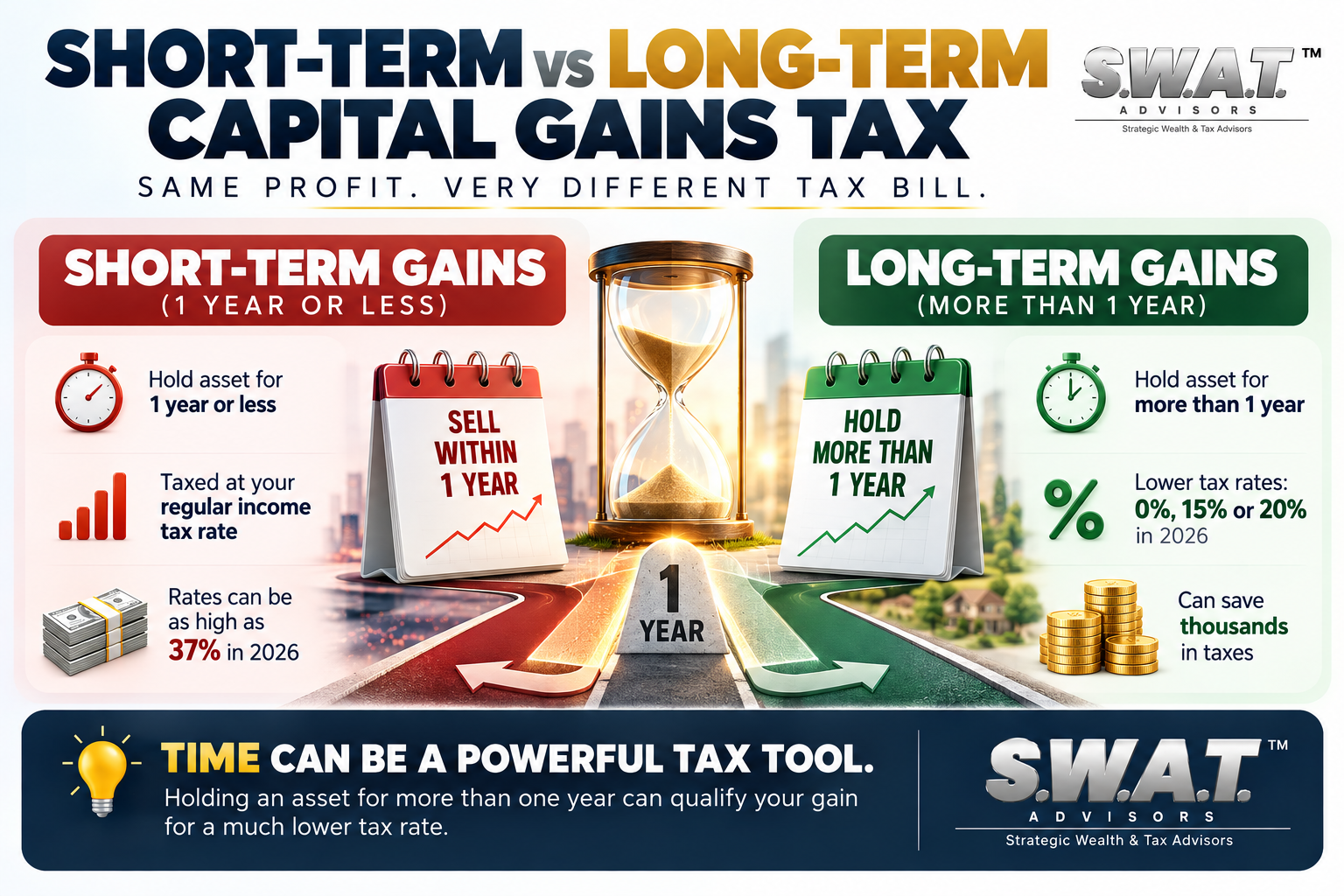
Short-term capital gains are when you buy a stock in March and sell it in October for a profit, and that gain gets added to your other income. It’s taxed at your regular bracket, up to 37%.
Day traders and active investors face this rule constantly. There’s no reward for speed here. The tax code rewards patience instead.
Long-Term Capital Gains Get Their Own Lower Rates
The long-term capital gains tax rate is well below income tax brackets. Hold an asset for more than one year, and your profit qualifies for 0%, 15%, or 20% federal rates instead of your ordinary bracket.
- For 2026, single filers pay 0% on long-term gains up to $49,450 of taxable income.
- The 15% rate covers income from there up to $545,500. Above that, the rate is 20%.
- Married couples filing jointly get 0% up to $98,900, 15% up to $613,700, and 20% beyond.
High earners also need to watch the Net Investment Income Tax. This 3.8% surtax applies once modified adjusted gross income passes $200,000 for single filers or $250,000 for married couples filing jointly. It stacks on top of your regular capital gains rate.
2026 Income Tax Brackets vs Capital Gains Tax Brackets (Side-by-Side)
The table below lines up the 2026 income tax brackets against the 2026 capital gains tax brackets for single filers.
| 2026 Income Tax (Single) | Rate | 2026 Long-Term Capital Gains (Single) | Rate |
| $0 – $12,400 | 10% | $0 – $49,450 | 0% |
| $12,401 – $50,400 | 12% | ||
| $50,401 – $105,700 | 22% | $49,451 – $545,500 | 15% |
| $105,701 – $201,775 | 24% | ||
| $201,776 – $256,225 | 32% | ||
| $256,226 – $640,600 | 35% | Over $545,500 | 20% |
| Over $640,600 | 37% |
A single filer earning $200,000 in wages sits in the 32% income tax bracket. That same person selling stock held for two years pays only 15% on the profit, as long as taxable income stays under $545,500.
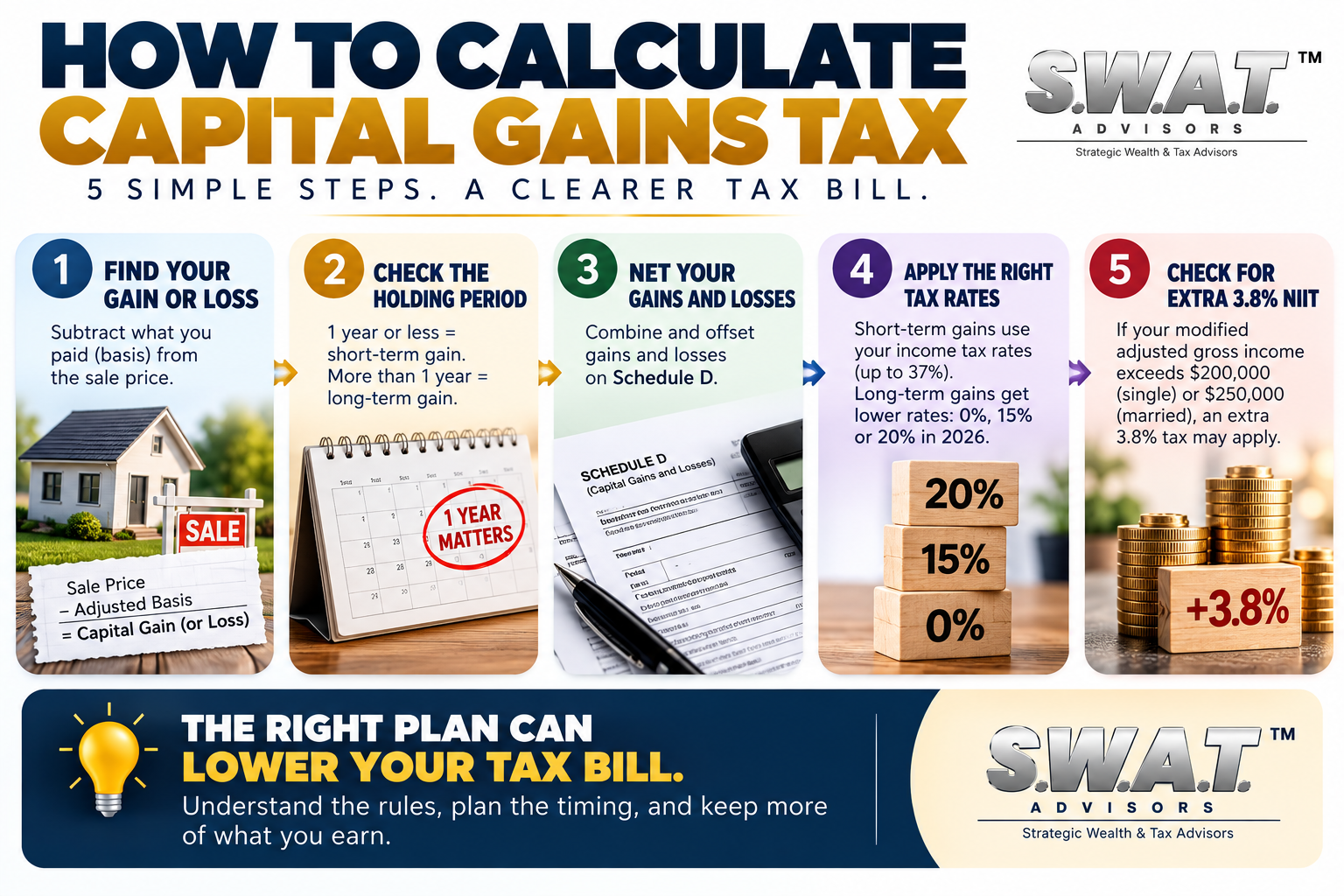
How to Calculate the Tax Difference Without Mixing Up the Rates
Most tax mistakes happen because people multiply the sale price by a tax rate. That’s wrong. The starting point is always the gain. Here’s a five-step framework that keeps ordinary income, short-term gains, and long-term gains separate.
Step 1: Determine Whether the Transaction Created a Gain or Loss
Subtract your adjusted basis, meaning what you paid plus improvements, from the sale proceeds. A positive number is a gain. A negative number is a loss, and losses can offset other gains.
Step 2: Determine Whether the Gain Is Short-Term or Long-Term
Check the IRS holding-period rule. If you own the asset for one year or less, it’s short-term. Longer than a year, it’s long-term and eligible for lower rates.
Step 3: Net Applicable Capital Gains and Losses
Schedule D is where short-term and long-term amounts get combined and netted against losses. This step sets your final taxable gain for each category.
Step 4: Determine the Applicable Federal Tax Treatment
Keep three capital gains buckets separate: ordinary income, short-term capital gains, and long-term capital gains. Each bucket uses its own rate table.
Step 5: Check Whether NIIT May Apply
Compare your modified adjusted gross income to the $200,000 single filer threshold or $250,000 for married filing jointly. Cross it, and the 3.8% surtax applies to your investment income.
| Important: don’t calculate capital gains tax by multiplying the sale price by a tax rate. The starting point is the gain, not the gross proceeds. |
Strategies to Manage Both Taxes Together
Managing income tax and capital gains tax together means timing sales, tracking basis, and using the tax code’s built-in breaks.
- Reduce capital gains tax by holding assets past the one-year mark whenever possible, so gains qualify for the lower long-term rate instead of your income tax bracket.
- Check the current capital gains tax rate for your income level before selling a large position of capital gains tax on stocks. A big sale can push you into the 20% bracket or trigger NIIT.
- Capital gains distributions from mutual funds get taxed even if you never sold a share yourself. Review fund statements every December.
- Capital gains tax on a home sale often disappears entirely. The IRS excludes up to $250,000 of gain, or $500,000 for married couples, on a primary residence. Capital gains tax on a vacation home doesn’t get that exclusion.
- Capital gains tax on inherited property is usually lower than people expect. The asset’s basis “steps up” to its value on the date of death, wiping out gains from before you owned it.
- California capital gains tax brackets don’t distinguish between short-term and long-term gains at all. The state taxes both as ordinary income, up to 13.3%. Capital gains on California real estate should always be modeled against both federal and state rates.
How SWAT Advisors Can Help You Plan Your Property Sale
Selling investment property, a vacation home, or land in California often creates one of the largest single tax events of a lifetime. SWAT Advisors helps clients model both the federal capital gains tax and California’s state-level tax before the sale closes, not after the check clears.
Our team has worked with more than 20,000 clients on tax planning. Our goal is to separate ordinary income from capital gains before a sale closes, to reduce capital gains tax exposure.
We work through:
- Timing the sale to stay under NIIT thresholds where possible
- Structuring installment sales or 1031 exchanges for capital gains on California real estate
- Comparing the capital gains tax on a home sale exclusion against the capital gains tax on a vacation home rules, since only one qualifies for the $250,000 or $500,000 exclusion
- Reviewing basis records so capital gains tax on inherited property reflects the full stepped-up value
If a property sale is on your calendar this year, book a consultation with SWAT Advisors before you sign anything. A short planning call now can prevent a much larger tax bill in April.
Conclusion
Capital gains tax vs income tax decisions come down to timing and asset type, not the size of your paycheck. Income tax applies to earned income across seven marginal brackets, topping out at 37% in 2026. Capital gains tax applies to profit from selling an asset, with short-term gains taxed at those same rates and long-term gains taxed at 0%, 15%, or 20%. California taxes all gains as ordinary income up to 13.3%. Knowing which category your money falls into, before you sell, decides how much profit you actually keep.
SWAT Advisors models your specific holding period, filing status, and state exposure against current tax law. Then we build a timeline for selling assets in the order that lowers your total bill.
A well-timed sale can mean the difference between paying 37% and paying 15% on the same dollar. Contact us today to schedule a consultation with SWAT Advisors and put a plan in place before your next transaction.
FAQs
No. Capital gains tax and income tax are calculated differently. Short-term gains use income tax brackets, but long-term gains use separate 0%, 15%, or 20% rates.
The tax code rewards holding assets over a year instead of trading them. Long-term capital gains rates top out at 20%, well below the 37% top income tax bracket.
Yes. Capital gains add to your taxable income and can push your ordinary income into a higher bracket, even though the gain itself gets taxed separately.
The current capital gains tax rate for 2026 is 0%, 15%, or 20% for long-term gains, based on taxable income. Short-term capital gains are taxed at your regular income tax rate, up to 37%.
Yes. A large short-term gain gets added to your ordinary income and can move you into a higher income tax bracket for that year.
No. Capital gains tax on stocks follows the short-term or long-term holding rule. Capital gains distributions from mutual funds get taxed as gains in the year they're paid, even without a sale on your part.
No. California capital gains tax brackets don't exist separately. The state taxes all gains as ordinary income, up to 13.3%, regardless of the long-term capital gains tax rate you pay federally.