
A blended tax rate is the average rate you actually pay across all your income, once every tax bracket is combined into one number. A blended tax rate is the amount that goes to taxes out of every dollar you earn.
Your paycheck stub shows a marginal rate, but your marginal rate never shows you what you actually paid; a blended rate does. It shapes decisions on raises, retirement withdrawals, home sales, and business income.
Key Takeaways
|
What Is a Blended Tax Rate?
The blended tax rate meaning is the effective, average rate you pay after combining every tax bracket your income reaches. It is the rate on all your dollars combined.
Federal income tax works in layers where the IRS taxes your first dollars at 10%, then moves you into higher brackets as income rises. Your blended rate averages all those layers into one figure. It is also called your effective tax rate.
Components of a Blended Tax Rate
A full blended tax rate combines federal, state, and local taxes. Each layer stacks separately, and each has its own brackets.
Federal Blended Tax Rate
The federal blended rate averages the seven IRS brackets that apply to your taxable income. For 2026, those brackets run 10%, 12%, 22%, 24%, 32%, 35%, and 37%, per IRS Revenue Procedure 2025-32. A taxpayer near the 24% bracket typically pays a federal blended rate in the high teens.
State Taxes
California taxes income through nine brackets ranging from 1% to 12.3%, according to the California Franchise Tax Board. Income above $1 million pays an added 1% surtax under the Behavioral Health Services Tax. California does not conform to every federal deduction, so state taxable income often differs from federal taxable income.
Local Tax Rate
Most California cities and counties do not charge a separate local income tax. Local tax exposure usually comes through sales tax and property tax instead, both of which sit outside your blended income tax rate calculation.
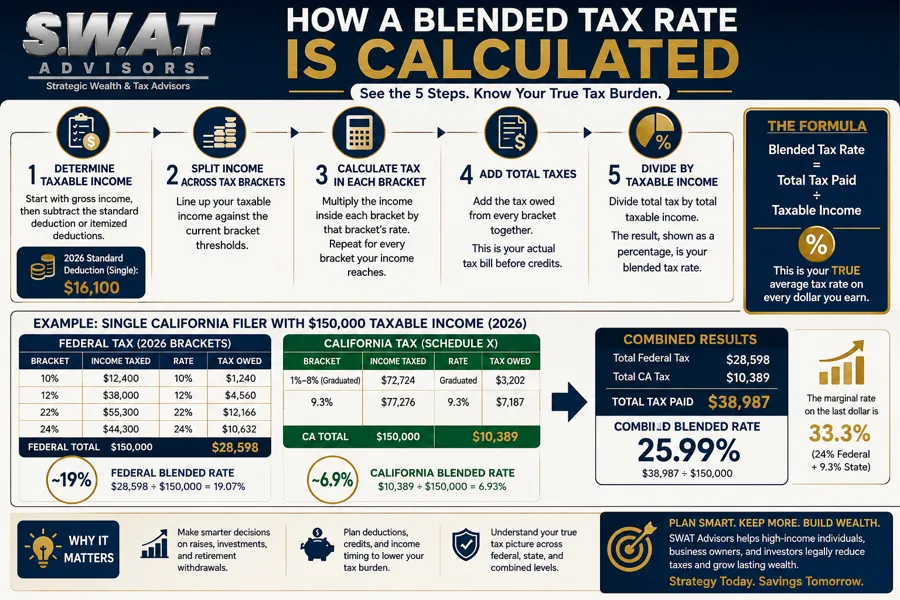
How a Blended Tax Rate Is Calculated Step-by-Step With Example
A blended tax rate is calculated by applying the progressive tax system, where different portions of your taxable income are taxed at different rates instead of one flat percentage. Once the tax owed in each bracket is added together, dividing the total tax by your taxable income gives you your blended tax rate.
The step-by-step example below demonstrates exactly how this calculation works and why it differs from your marginal tax rate.
Step 1: Determine Taxable Income
Start with gross income, then subtract the standard deduction or itemized deductions. For 2026, the federal standard deduction is $16,100 for single filers, per the IRS.
Step 2: Split Income Across Tax Brackets
Line up your taxable income against the current bracket thresholds. Each bracket only taxes the income that falls inside it, not your full income.
Step 3: Calculate Tax In Each Bracket
Multiply the income inside each bracket by that bracket’s rate. Repeat for every bracket your income reaches.
Step 4: Add Total Taxes
Add the tax owed from every bracket together. This total is your actual tax bill before credits.
Step 5: Divide By Taxable Income
Divide total tax by total taxable income. The result, shown as a percentage, is your blended rate.
Example: A single California filer has $150,000 in federal taxable income in 2026.
| Bracket | Income Taxed | Rate | Tax Owed |
| 10% | $12,400 | 10% | $1,240 |
| 12% | $38,000 | 12% | $4,560 |
| 22% | $55,300 | 22% | $12,166 |
| 24% | $44,300 | 24% | $10,632 |
| Federal Total | $150,000 | $28,598 |
The table below shows what happens once California’s brackets stack on top, using the state’s current published Schedule X for single filers.
| Bracket | Income Taxed | Rate | Tax Owed |
| 1%–8% | $72,724 | Graduated | $3,202 |
| 9.3% | $77,276 | 9.3% | $7,187 |
| CA Total | $150,000 | $10,389 |
Combined tax owed equals $38,987. Divide that by $150,000, and the combined blended rate lands at 25.99%, even though the marginal rate on the last dollar is 33.3% (24% federal plus 9.3% state).
| Blended Tax Rate = Total Tax Paid ÷ Taxable Income |
You can run this same math using a blended tax rate calculator, but understanding the five steps first helps you catch calculator errors and spot planning opportunities a tool alone will not flag.
Blended Tax Rate vs Marginal Tax Rate
The blended tax rate meaning differs sharply from the marginal rate meaning. Your marginal rate applies only to your next dollar earned. Your blended rate applies to every dollar you already earned.
The table below compares how each rate functions in real financial decisions.
| Factor | Blended Rate | Marginal Rate |
| Definition | Average tax rate across all income | Tax rate on your next dollar earned |
| Used for | Overall tax burden, budgeting | Decision-making on additional income |
| Planning | Long-term wealth and cash flow planning | Short-term choices like bonuses or side income |
| Salary negotiations | Shows true take-home impact | Shows tax cost of the raise itself |
| Investment decisions | Confirms overall tax efficiency | Confirms tax cost of new investment income |
| Tax forecasting | Predicts total annual liability | Predicts liability on incremental income |
When Should You Use Blended Rate Or Marginal Rate?
Use your blended rate to forecast your total annual tax bill and to compare your real tax burden year over year. Use your marginal rate when deciding whether one more dollar of income, a bonus, a freelance gig, or a Roth conversion, is worth the tax cost. Financial advisors lean on marginal rate for one-time decisions and blended rate for big-picture planning.
Impact of Blended Tax Rates on Personal Income
Your blended tax rate directly affects how much of your income you keep after taxes. It reflects the combined effect of progressive tax rates, deductions, credits, and income sources.
Tax Burden on Different Income Levels
Blended rates rise slowly, then increase faster as income grows. A single filer earning $40,000 in taxable income carries a federal blended rate near 11%. A filer at $150,000 sits near 19%. A filer at $500,000 climbs toward 29%, based on 2026 bracket math. Middle-income earners often overestimate their true burden because they confuse their marginal bracket with their blended rate.
Deductions and Credits
Deductions reduce taxable income before brackets apply, which lowers your blended rate at the base. Credits cut your final tax bill dollar for dollar, which lowers your blended rate directly. A $2,000 child tax credit, for example, reduces total tax owed by exactly $2,000, shrinking the blended rate more efficiently than a $2,000 deduction would for most filers.
Where Your Blended Tax Rate Actually Matters
Using a blended tax rate instead of your marginal rate can lead to more accurate estimates for additional income, withdrawals, investments, and business earnings. The following scenarios show where knowing your blended tax rate can improve tax planning and reduce unexpected liabilities.
Accepting a Raise
A raise only pushes new income into a higher bracket. It never raises the rate on income you already earned. Your blended rate rises only slightly, even when your marginal bracket jumps.
Retirement Withdrawals
Withdrawals from a traditional IRA or 401(k) stack on top of other income and get taxed at your marginal rate first. Spreading withdrawals across multiple years keeps your blended rate lower than pulling a lump sum in one year.
Investment Decisions
Capital gains and dividends layer on top of ordinary income, which can push your blended rate higher through both a higher bracket and, above $200,000 for single filers, the 3.8% Net Investment Income Tax under IRS Topic 559.
Self-Employed Income
Self-employment tax adds 15.3% on top of income tax, which raises the blended rate for freelancers and consultants well above what a W-2 employee pays at the same income level.
Business Owners
Owners who pay themselves through a pass-through entity often need a separate blended rate calculation for the Qualified Business Income deduction, since that 20% deduction under Section 199A directly reduces taxable income before brackets apply.
Factors That Can Change Your Blended Tax Rate
Your blended tax rate changes as your income, deductions, credits, filing status, and tax laws change over time. Even if your tax bracket stays the same, shifts in taxable income or available tax benefits can increase or decrease your overall effective tax burden.
Here are several forces that shift a blended rate every year.
- Inflation adjustments to brackets and the standard deduction, published annually by the IRS
- A change in filing status, such as marriage or divorce
- One-time income spikes from bonuses, stock sales, or property sales
- New tax credits or the expiration of existing ones
- A move between states with different tax structures
- Business income that fluctuates year to year
Blended Tax Rate Isn’t Always a Fixed Number
The blended tax rate shifts depending on which income and which jurisdiction you are measuring. Financial planners often track several blended rates for the same client at once.
- Federal blended rate: Covers only IRS tax owed against federal taxable income.
- State blended rate: Covers only California tax owed against state taxable income.
- Combined blended rate: Adds federal and state tax together over total taxable income.
- Investment income blended rate: Isolates capital gains, dividends, and interest, which may carry different rates than wage income.
- Business blended rate: Reflects pass-through income after the QBI deduction and self-employment tax.
Practical Ways to Lower Your Blended Tax Rate
Lowering your blended tax rate is more about combining strategies that reduce taxable income, maximize credits, and improve the timing of income and deductions. Because the blended rate reflects your average tax burden, even small planning adjustments can produce meaningful long-term tax savings.
The following strategies can help improve tax efficiency while staying aligned with IRS rules and your overall financial goals.
Increase Pre-Tax Retirement Contributions
The 2026 401(k) limit is $24,500, with an $8,000 catch-up for savers 50 and older, per the IRS. Every pre-tax dollar contributed lowers taxable income directly, which is one of the most reliable retirement tax planning strategies available to W-2 employees.
Make the Most of Tax Credits Before Deductions
Credits cut your bill directly, while deductions only shrink taxable income. Claim every credit you qualify for first, then layer deductions on top.
Time Income and Major Deductions Strategically
Pushing a bonus into January or bunching charitable gifts into one year can keep income out of a higher bracket in any single tax year.
Optimize Investment Income
Holding an asset over one year shifts it from short-term to long-term treatment. The long-term capital gains cap at 20% federally, while short-term gains are taxed as ordinary income. Homeowners can also exclude up to $250,000 of capital gains on a home sale ($500,000 for joint filers) under IRC Section 121, one of the clearest ways to avoid capital gains tax in California on a primary residence.
Reduce Taxable Income Through Employer Benefits
Health Savings Account contributions, dependent care FSAs, and commuter benefits all lower gross income before tax brackets apply.
Review Your Filing Status and Eligible Tax Elections
Filing status changes the bracket thresholds themselves. Reviewing California tax planning credits and deductions each year, including the state’s dependent and renter’s credits, catches savings many filers miss.
Work With Annual Tax Projections Instead of Last Year’s Rate
Brackets, credits, and deduction amounts shift every year. A projection built on last year’s blended rate almost always misses new opportunities.
How SWAT Advisors Can Help You Optimize Your Blended Tax Rate
Calculating a blended rate and turning that number into real savings takes a coordinated strategy across income timing, entity structure, and investment planning, which is where SWAT Advisors built its practice. We have delivered over $100 million in documented client tax savings across two decades of high-net-worth tax planning in California.
- We build custom retirement tax planning strategies that sequence 401(k), IRA, and executive retirement contributions to pull your blended rate down year after year.
- We handle tax planning for business owners in California, structuring entities and timing income to legally reduce business tax liability.
- We map out capital gains timing and help clients avoid capital gains tax in California through exclusions, installment sales, and 1031 exchanges.
- We specialize in tax planning for high-income individuals, physicians, dentists, and real estate investors who need more than a single blended rate calculation to plan effectively.
We build a strategy around your full financial picture, then review it every quarter as your income and the tax code both change. Contact SWAT Advisors to book a strategy session and see your actual blended rate reduction, in writing, before you commit to anything.
Conclusion
Your blended tax rate shows you the true share of income you hand over each year. Calculating it means adding total tax owed across every bracket and dividing by taxable income. For California taxpayers, that gap widens further once state brackets, the Behavioral Health Services surtax, and the Net Investment Income Tax stack on top of federal layers. Retirement contribution timing, capital gains holding periods, entity structure, and filing status all move this number in measurable ways.
SWAT Advisors turns that yearly review into a documented strategy. Our firm’s certified planners specialize in the exact levers that move a blended rate: retirement sequencing, capital gains timing, entity structure, and California-specific credits.
If you paid over $100,000 in taxes last year and have never calculated your own blended rate, contact SWAT Advisors to get a clear picture of where your tax dollars are going and what can change.
FAQs
Add the tax owed from every bracket your income touches, then divide that total by your taxable income. This is the full blended tax rate in practice.
Yes, blended tax rate and effective tax rate describe the same calculation: total tax divided by total taxable income.
Your blended rate averages every bracket you touched; your marginal rate only reflects the bracket on your last dollar earned.
Because only your top dollars get taxed at your top bracket. Earlier dollars are taxed at lower rates, pulling the average down.
Yes. Deductions, credits, and exactly where income falls within the bracket all change the final blended rate, even at identical marginal brackets.
No. A raise only taxes the new income at the higher bracket; your blended rate rises only slightly, not across your whole paycheck.
Yes. California's nine brackets, up to 12.3% plus a 1% surtax over $1 million, add directly to your combined blended rate.
Investors should use the marginal rate for single trades and the blended rate for annual portfolio and capital gains on a home sale.
Credits cut tax owed dollar for dollar; deductions only reduce taxable income before brackets apply, making credits more powerful per dollar.