
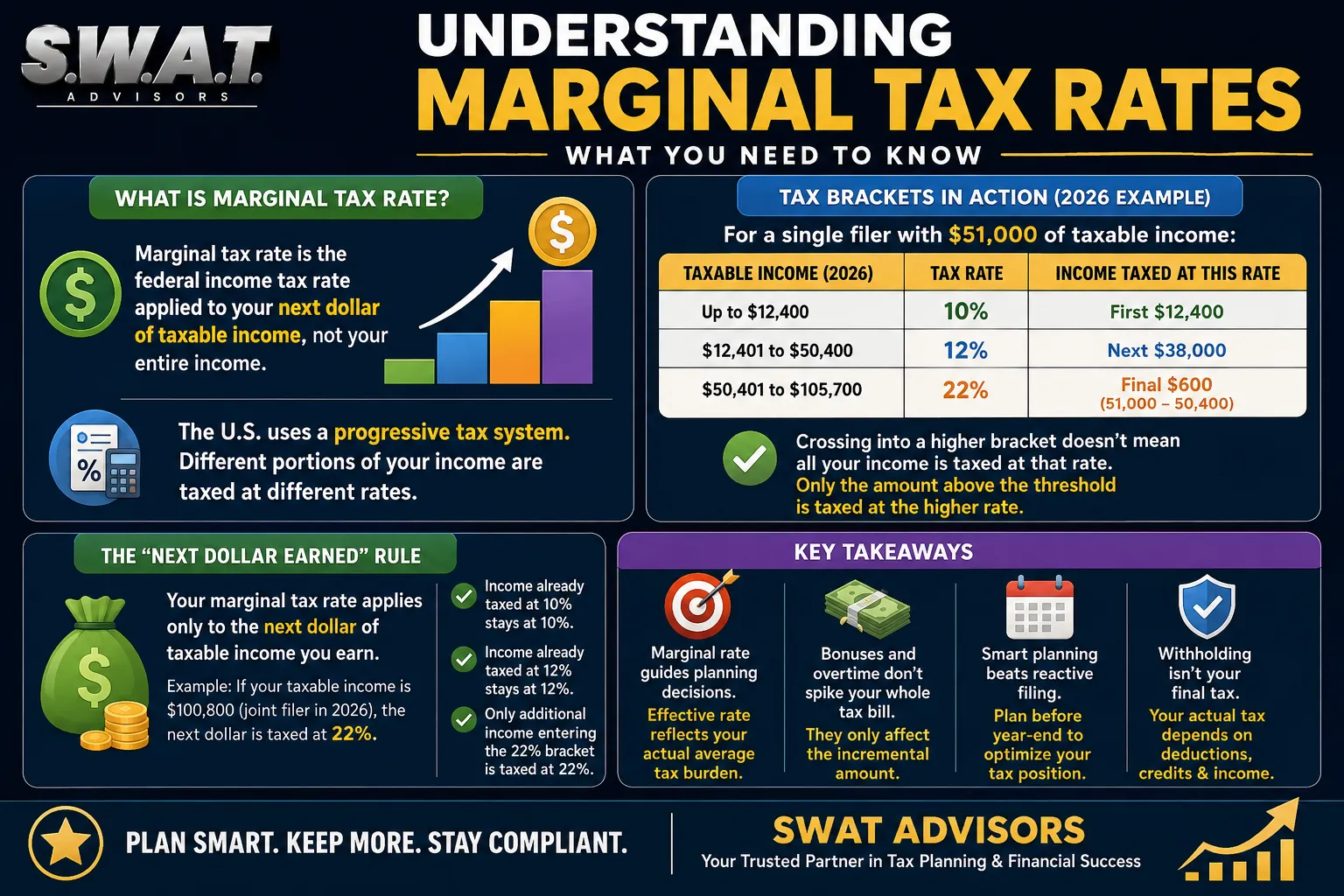
The marginal tax rate determines the federal income tax applied to your next dollar of taxable income, not your entire income. The IRS uses a progressive tax system where each portion of taxable income is taxed separately.
This guide explains how marginal tax rates work, how they differ from effective tax rates, why tax brackets matter, and how you can use them for smarter tax planning.
Key Takeaways
|
What Is Marginal Tax Rate?
A marginal tax rate is the federal income tax rate applied to your next dollar of taxable income. According to the IRS, federal income tax uses graduated tax rates, meaning different portions of your taxable income are taxed at different percentages rather than one single rate.
Marginal Tax Rate Example
Taxable income is the amount of income remaining after subtracting eligible deductions from your adjusted gross income. Your marginal tax rate is the tax rate that applies to the next additional dollar of taxable income.
For example, suppose a taxpayer earns enough taxable income that part of it falls into the 22% federal bracket. That does not mean every dollar is taxed at 22%.
Instead:
- The first portion is taxed at the lowest rate.
- The next portion moves into the next bracket.
- Only the final portion reaches 22%.
How Do Marginal Tax Rates Actually Work in a Progressive Tax System?
A progressive federal income tax system taxes different portions of taxable income at different rates. Your federal marginal tax rates increase only as additional taxable income enters higher brackets.
How Income Is Divided Across Multiple Tax Brackets
Instead of applying one percentage to all income, the IRS divides taxable income into several layers. Each layer has its own federal income tax rate.
The process follows this order:
- Income first fills the lowest tax bracket.
- After reaching that bracket’s limit, additional income moves into the next bracket.
- Every higher bracket taxes only the income inside its own range.
- Previously taxed income never changes tax rates.
This is why two taxpayers earning different incomes may share several lower tax brackets before one enters a higher bracket.
Why Each Portion of Income Is Taxed Differently
Each federal income tax bracket has its own taxable income range established by law. As taxable income increases, only the income exceeding each threshold becomes subject to the next rate. This graduated structure creates a blended tax result rather than applying one percentage across all taxable income. Your tax return combines several tax rates into one total federal income tax calculation, even though your marginal tax rate applies only to your highest taxable dollar.
What Happens When Your Income Crosses Into a Higher Tax Bracket?
Crossing into a higher tax bracket does not cause all of your income to be taxed at the new rate. Only the portion of your taxable income that exceeds the new bracket’s threshold is taxed at the higher marginal tax rate.
Federal tax brackets are separate layers rather than one tax rate applied to your entire income. For example, assume a single taxpayer has a taxable income of $51,000 in 2026.
According to the IRS, the 2026 tax brackets for a single filer begin as follows:
| Taxable Income (2026) | Federal Tax Rate |
| Up to $12,400 | 10% |
| $12,401 to $50,400 | 12% |
| $50,401 to $105,700 | 22% |
The table above shows that crossing into the 22% bracket does not change the income tax already taxed at 10% or 12%.
- The first $12,400 remains taxed at 10%.
- The next $38,000 remains taxed at 12%.
- Only the final $600 receives the 22% tax rate.
The taxpayer does not pay 22% on the full $51,000. Every additional dollar moves through the tax brackets one layer at a time instead of changing the tax rate on previous income.
How the “Next Dollar Earned” Rule Works
The “next dollar earned” rule means your marginal tax rate applies only to the next dollar of taxable income you earn after reaching your current tax bracket. It does not apply to income already taxed in lower brackets.
| Example: Suppose your taxable income is $100,800, and you file a joint federal tax return in 2026. According to the IRS, the next dollar above $100,800 enters the 22% federal tax bracket. Now assume you earn an additional $5,000 bonus. Only that additional income enters the higher bracket. It does not cause your previous $100,800 of taxable income to be recalculated.
Your tax calculation works like this:
|
In our practice, we often meet taxpayers who delay bonuses near year-end because they believe the entire payment will be taxed at their highest bracket. Once they understand the “next dollar earned” rule, they realize the higher rate applies only to the portion above the bracket threshold, not the entire bonus.
How Are a Marginal Tax Rate vs Effective Tax Rate Different?
Your marginal tax rate helps with future tax planning, while your effective tax rate measures the average percentage of tax you actually pay.
Which Tax Rate Determines Your Tax Planning Decisions?
Your marginal tax rate is usually the most important number for tax planning because it measures the tax savings or tax cost of your next financial decision.
For example, your marginal rate affects decisions such as:
- Making a Traditional IRA contribution.
- Contributing more to a workplace retirement plan.
- Selling appreciated investments.
- Accelerating income into the current year.
- Deferring income until the following tax year.
- Evaluating the tax benefit of charitable donations.
If your next taxable dollar falls into the 24% bracket, every deductible dollar may reduce federal income tax by up to 24 cents, subject to IRS rules and deduction limitations.
Which Tax Rate Represents Your Average Tax Burden?
An effective tax rate is your total federal income tax divided by your taxable income. It represents your average federal income tax burden after all graduated tax brackets have been applied. Because lower portions of taxable income receive lower tax rates, the effective tax rate is almost always lower than the highest marginal tax rate.
For example:
- Highest marginal tax rate: 24%
- Effective federal income tax rate: 15%
Both figures can be correct because only a portion of taxable income reaches the 24% bracket. You should always verify results using the IRS Tax Withholding Estimator or official IRS tax worksheets.
How Is Taxable Income Calculated Before Marginal Tax Rates Are Applied?
Your marginal tax rate is applied only after the IRS calculates your taxable income. Before the IRS applies federal marginal tax rates, it determines how much of your income is actually taxable.
The calculation follows this order:
| Gross Income → Adjusted Gross Income (AGI) → Taxable Income → Federal Tax Brackets → Tax Credits → Final Tax Liability |
Gross Income vs. Adjusted Gross Income (AGI)
Gross income is all taxable income you receive during the year before eligible adjustments. It may include wages, salaries, self-employment income, taxable interest, dividends, capital gains, rental income, retirement distributions, and other taxable income.
Adjusted Gross Income (AGI) is your gross income minus eligible “adjustments to income,” also called above-the-line deductions. The IRS uses AGI as a key starting point for calculating taxable income and determining eligibility for many deductions and credits.
The table below shows why AGI is one of the most important numbers on a tax return. It affects not only your taxable income but also eligibility for several deductions, credits, and income-based tax benefits.
| Calculation Step | What Happens |
| Gross Income | Add all taxable income sources. |
| Minus Adjustments | Subtract eligible above-the-line deductions. |
| Adjusted Gross Income (AGI) | IRS calculates your AGI. |
| Minus Standard or Itemized Deduction | Determine your taxable income. |
| Taxable Income | Federal tax brackets are applied. |
When Tax Credits Are Applied
Tax credits do not reduce your taxable income or your marginal tax rate. They are applied after the IRS calculates your tax using the federal tax brackets.
The simplified order is:
- Calculate Gross Income.
- Determine Adjusted Gross Income (AGI).
- Calculate Taxable Income.
- Apply the federal tax brackets.
- Calculate total federal income tax.
- Apply eligible tax credits.
- Determine your final tax liability or refund.
This sequence explains why tax credits and deductions produce different tax results even though both reduce your overall tax bill.
Which Types of Income Can Change Your Marginal Tax Rate?
Nearly every form of taxable income can affect your marginal tax rate because the IRS combines most taxable income when determining your taxable income. However, different income types follow different tax rules, making some more likely to increase your federal tax bracket than others.
Salary and Wage Income
Salary and wages are the most common sources of taxable income. Employers report these earnings on Form W-2, and they generally make up the largest portion of gross income.
Every additional dollar of taxable wages can increase your marginal tax rate for a salary increase if your taxable income crosses into the next federal tax bracket. However, receiving a raise does not mean all previous earnings move into the higher bracket. Only the income exceeding the bracket threshold receives the higher tax rate.
Self-Employment and Freelance Income
Self-employment income is taxable business income earned by individuals who work independently instead of receiving wages as employees. Additional business profit increases your taxable income, which may increase your marginal tax rate for side income if your total taxable income enters a higher federal bracket.
Self-employed individuals should also remember that income taxes and self-employment taxes are separate calculations. A higher marginal tax rate affects federal income tax, while self-employment tax follows different IRS rules.
Investment Income and Capital Gains
Investment income includes taxable interest, dividends, and capital gains from selling investments. Capital gains are profits from selling capital assets such as stocks, mutual funds, or investment real estate.
Rental Income and Business Income
Rental income and business income generally increase gross income unless offset by allowable business expenses and deductions. Net rental profit, rather than gross rent collected, usually affects taxable income.
If you own rental properties or operate pass-through businesses, you should monitor income throughout the year because unexpected profits may increase their marginal tax rate before year-end.
Retirement Distributions and Pension Income
Many retirement distributions are taxable, although the tax treatment depends on the type of account and distribution.
Examples may include:
- Traditional IRA distributions.
- Traditional 401(k) withdrawals.
- Pension payments.
- Taxable annuity income.
Taxable retirement distributions generally increase taxable income, which may affect your marginal tax rate, Medicare-related income thresholds, and eligibility for certain tax benefits.
How Can You Calculate Your Marginal Tax Rate Step by Step?
You can calculate your marginal tax rate by identifying your taxable income, finding the matching federal tax bracket for your filing status, and determining the tax rate that applies to your next dollar of taxable income.
Identify Your Taxable Income
Your taxable income is the amount remaining after the IRS subtracts eligible deductions from your Adjusted Gross Income (AGI). It is the only income amount used to determine your federal income tax bracket.
Use this simple sequence:
- Add all taxable income to calculate gross income.
- Subtract eligible adjustments to determine Adjusted Gross Income (AGI).
- Claim either the Standard Deduction or Itemized Deductions.
- The remaining amount becomes taxable income.
Locate the Correct Federal Tax Bracket
After calculating taxable income, compare it with the IRS tax rate schedule for your filing status. For tax year 2026, the federal income tax rates remain:
- 10%
- 12%
- 22%
- 24%
- 32%
- 35%
- 37%
The percentage itself does not change each year, but the taxable income ranges usually do because of annual inflation adjustments.
Determine the Tax Rate on Your Next Dollar Earned
Your marginal tax rate is the federal tax rate that applies to your next dollar of taxable income. It does not represent the average tax paid on your entire income. For example, suppose your taxable income places you in the 24% federal bracket.
If you receive:
- A year-end bonus
- A salary increase
- Additional consulting income
- Taxable investment income
The additional taxable income generally enters your current bracket first. If it exceeds that bracket’s upper limit, only the excess moves into the next bracket.
Verify Your Calculation Using Official IRS Resources
The IRS provides several official tools that help you verify your federal tax calculations. Recommended resources include:
- IRS Federal Income Tax Rate Schedules
- IRS Publication 17
- IRS Tax Withholding Estimator
- Form 1040 Instructions
- IRS Interactive Tax Assistant, when applicable
What Financial Decisions Depend Most on Your Marginal Tax Rate?
Many important financial decisions depend on your marginal tax rate because it determines the tax cost or tax savings of your next financial move.
Should You Contribute to a Traditional or Roth Retirement Account?
The choice between a traditional retirement account and a Roth retirement account often depends on whether your current marginal tax rate is expected to be higher or lower than your future retirement tax rate.
In general:
- Traditional contributions may provide an immediate tax deduction if IRS eligibility requirements are met.
- Roth contributions generally do not provide an immediate deduction, but qualified future withdrawals may be tax-free under IRS rules.
Taxpayers currently in higher federal marginal tax rates often evaluate whether immediate deductions provide greater long-term value than future tax-free withdrawals. The decision depends on expected retirement income, future tax law, age, and overall retirement tax planning goals.
When Does Tax-Loss Harvesting Save More Money?
Tax-loss harvesting is the practice of selling investments with unrealized losses to offset eligible capital gains or, within IRS limits, certain ordinary income. IRS Publication 550 explains the federal rules governing investment gains and losses.
This strategy generally creates the greatest tax benefit when you are already in relatively higher marginal tax rates, because each deductible loss offsets income taxed at those higher rates.
Should You Accelerate or Defer Income?
The decision to accelerate income into the current year or defer it until the following year depends largely on whether your future marginal tax rate is expected to increase or decrease.
Examples include:
- Delaying year-end consulting invoices.
- Deferring self-employment income when appropriate.
- Accelerating deductible business expenses.
- Timing retirement account withdrawals.
- Scheduling asset sales strategically.
If you expect to move into a lower tax bracket next year, deferring taxable income may reduce overall federal income tax. Conversely, if higher tax rates are expected in a future year, accelerating income may sometimes produce better long-term tax results.
When Is Charitable Giving More Tax-Efficient?
Charitable contributions generally produce the greatest federal tax benefit when you itemize deductions instead of claiming the standard deduction.
Tax efficiency may increase when:
- Itemized deductions exceed the standard deduction.
- Donations occur during years with higher taxable income.
- Appreciated investments are donated instead of cash, where IRS rules allow.
- Multiple years of planned charitable gifts are grouped into one tax year when appropriate.
The value of any charitable deduction depends on the taxpayer’s filing status, income, deduction limitations, and applicable IRS rules.
How Do Marginal Tax Rates Apply to Bonuses, Overtime, and Side Income?
Bonuses, overtime, and additional income can increase your taxable income, but they do not automatically change the tax rate applied to your entire income.
Are Bonuses Taxed Differently or Simply Withheld Differently?
Bonuses are generally withheld differently, not necessarily taxed differently.
Employers may calculate federal withholding on supplemental wages using IRS-approved withholding methods. Because withholding is only a prepayment of estimated federal income tax, the amount withheld from a bonus may differ from the actual tax calculated on your federal return.
Your final tax depends on:
- Total taxable income.
- Filing status.
- Eligible deductions.
- Tax credits.
- Applicable marginal tax rate.
A larger withholding amount does not necessarily mean you ultimately owe more federal income tax.
Does Overtime Push All Income Into a Higher Tax Bracket?
No. Overtime never causes all of your income to move into a higher tax bracket. Overtime wages simply increase your taxable income. If additional earnings exceed the current bracket threshold, only that portion receives the higher marginal tax rate.
How Freelance Income Changes Your Overall Tax Picture
Freelance income generally increases gross income and, after allowable business deductions, increases taxable income.
Additional freelance profit may:
- Increase your marginal tax rate for side income.
- Increase estimated tax payment requirements.
- Affect retirement contribution opportunities.
- Influence eligibility for certain deductions and credits.
Because self-employment income also involves separate self-employment tax calculations, freelancers should evaluate both income tax and self-employment tax together when planning for year-end obligations.
Why Is Payroll Withholding Different From Your Actual Marginal Tax Rate?
Payroll withholding is an estimate of your expected federal income tax, while your marginal tax rate is the percentage applied to your next taxable dollar after your complete tax return is calculated. The two numbers often differ because payroll systems cannot account for every deduction, credit, investment transaction, or additional income source during the year.
- Your employer calculates withholding one paycheck at a time.
- A bonus may temporarily increase withholding without increasing your final effective tax burden.
- Side income usually has no payroll withholding, which may require quarterly estimated tax payments.
- Retirement contributions made through payroll often reduce taxable wages before withholding is calculated.
- Updating Form W-4 after major life events, such as marriage, divorce, or a new job, helps keep withholding closer to your actual tax liability.
- The IRS Tax Withholding Estimator can identify under-withholding before year-end, allowing corrections before penalties become a concern.
How Can You Legally Reduce Taxes Without Misunderstanding Marginal Tax Rates?
Reducing taxes legally starts with lowering your taxable income through IRS-approved strategies, not by avoiding additional income.
Increase Tax-Deferred Retirement Contributions
Contributing to eligible tax-deferred retirement accounts is one of the most effective ways to lower taxable income while building long-term wealth. Depending on IRS eligibility rules, contributions to employer-sponsored retirement plans or Traditional IRAs may reduce the income subject to your current marginal tax rate.
Every deductible retirement contribution reduces income that would otherwise be taxed at your highest current federal rate.
Potential benefits include:
- Lower current-year taxable income.
- Immediate federal income tax savings when contributions are deductible.
- Greater long-term retirement savings.
- Improved retirement tax planning flexibility.
- Better opportunities for future income management.
Always review annual IRS retirement contribution limits before making year-end contributions because contribution limits change periodically through IRS inflation adjustments.
Maximize Eligible Above-the-Line Deductions
Above-the-line deductions are deductions the IRS allows before calculating Adjusted Gross Income (AGI). Because they reduce AGI, they may also improve eligibility for additional deductions, credits, and other income-based tax benefits.
Depending on your circumstances, eligible adjustments may include:
- Deductible retirement contributions.
- Health Savings Account (HSA) contributions.
- Certain self-employed retirement plan contributions.
- Self-employed health insurance deductions, when applicable.
- Other IRS-approved adjustments reported on Form 1040.
Instead of focusing only on deductions that reduce taxes today, you should evaluate how lowering AGI may improve your complete tax picture.
Time Income and Deductions Strategically
The timing of income and deductions can affect your marginal tax rate, particularly when your taxable income falls close to the top of a federal tax bracket.
Depending on your financial situation and IRS rules, you may evaluate strategies such as:
- Delaying certain self-employment income until the following tax year.
- Accelerating deductible business expenses before year-end.
- Timing charitable contributions.
- Planning investment sales carefully.
- Coordinating retirement account withdrawals.
Review Tax Planning Opportunities Before Year-End
The best tax planning usually happens before December 31. Once the calendar year closes, many planning opportunities disappear because the IRS generally determines federal income tax using transactions completed during that tax year.
A year-end review may identify opportunities to:
- Increase retirement contributions.
- Adjust estimated tax payments.
- Harvest investment losses when appropriate.
- Review business income and expenses.
- Compare the standard deduction with itemized deductions.
- Evaluate charitable giving strategies.
Regular year-end tax planning also allows you to respond to changes in income, investments, or business performance before filing your federal return.
Know When Lowering Taxable Income Is Not the Best Financial Decision
Lowering taxable income is not always the right financial decision. A strategy that reduces taxes today may create higher taxes, reduced flexibility, or missed financial opportunities later.
For example, aggressively reducing taxable income could:
- Limit future retirement income flexibility.
- Reduce available cash for business growth.
- Delay income into years with higher future tax rates.
- Affect loan qualification or financing applications.
- Reduce eligibility for certain financial objectives.
The objective is maximizing after-tax wealth over many years through thoughtful planning.
How SWAT Advisors Helps You Plan Around Marginal Tax Rates
SWAT Advisors focuses on proactive tax planning rather than simply preparing tax returns. Our team develops customized tax strategies that integrate tax planning with retirement planning, business planning, estate planning, and long-term wealth preservation.
How we help you plan around your marginal tax rate:
- Build customized tax strategies based on your current and projected tax brackets.
- Identify legal opportunities to reduce taxable income before year-end.
- Coordinate retirement, estate, and investment planning with your tax strategy.
- Evaluate business structures to improve long-term tax efficiency.
- Help business owners, physicians, dentists, real estate investors, and high-net-worth families reduce unnecessary tax exposure.
- Review federal, state, and local tax planning opportunities as tax laws change.
- Provide ongoing planning instead of focusing only on annual tax filing.
If you want a personalized strategy based on your income, investments, retirement goals, or business, schedule a tax planning consultation.
Conclusion
Understanding your marginal tax rate is essential because it explains how federal income tax actually works and supports better financial decisions throughout the year. Your highest tax bracket never applies to all of your income. Instead, the IRS taxes each portion of taxable income using a progressive system, making it possible to earn more without losing take-home pay.
At SWAT Advisors, we work throughout the year to identify opportunities that support your financial goals while remaining fully compliant with current tax laws.
Contact us today to schedule a private consultation and let us build a tax strategy that helps you keep more of what you earn while planning confidently for the future.
FAQs
No. Only the portion of your taxable income within your highest marginal tax rate bracket receives that rate.
Your marginal rate applies to your next taxable dollar, while your effective rate is your average federal income tax rate.
Federal tax brackets divide taxable income into ranges. Each range has its own tax rate, and only income within that range receives that rate.
A raise increases after-tax income because only the additional income entering a higher bracket receives the higher marginal tax rate.
Calculate your taxable income, identify your filing status, then compare your taxable income with the current IRS federal tax bracket schedule.
Not always. Long-term capital gains generally follow separate capital gains tax brackets, while short-term gains are usually taxed as ordinary income.
The most authoritative sources are the IRS Federal Income Tax Rates and Brackets, IRS Publication 17, Form 1040 Instructions, IRS Publication 505, and related IRS publications.