
Selling a business can trigger federal capital gains tax, state tax, depreciation recapture, and the 3.8% net investment income tax all in the same year. However, strategies to avoid tax on the sale of a business exist, and most of them have to be set up months or years before you sign a letter of intent.
This guide walks through what determines your tax bill, which planning windows actually work, and which strategy fits your specific situation.
Key Takeaways
|
What Determines How Much Tax You Pay When Selling a Business?
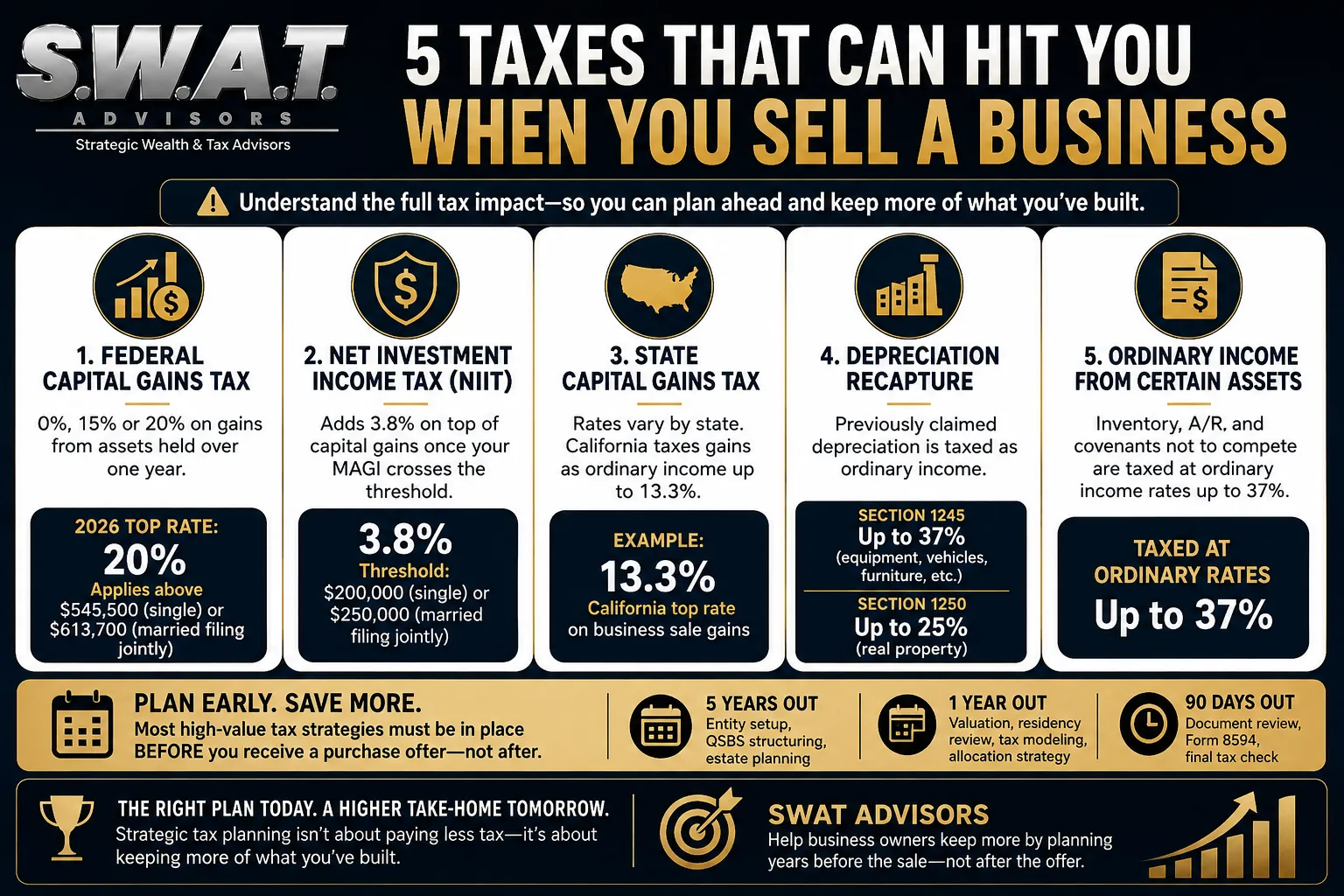
Five separate tax layers can apply to a single business sale, and each one is calculated differently. Understanding which ones apply to your deal is the first step toward any plan to reduce tax when selling a business.
Federal Capital Gains Tax
Federal capital gains tax on a business sale is 0%, 15%, or 20% for assets held longer than one year, based on your taxable income for the year of sale. For 2026, the IRS sets the 20% bracket at taxable income above $545,500 for single filers and $613,700 for married couples filing jointly, according to Revenue Procedure 2025-32.
Gain on assets held one year or less is taxed as ordinary income, at rates up to 37%. This is why timing the closing date around a full 12-month holding period on newer assets can change your bracket entirely.
Net Investment Income Tax (NIIT)
The net investment income tax adds 3.8% on top of capital gains tax once your modified adjusted gross income crosses $200,000 for single filers or $250,000 for joint filers, under Internal Revenue Code Section 1411. The IRS charges NIIT on whichever is smaller: your net investment income, or the amount your MAGI exceeds the threshold.
A seller actively working in the business at the time of sale may qualify for a material participation exception on the gain, but this depends on facts the IRS scrutinizes closely, so document your role well before closing.
State Capital Gains Tax
States tax business sale gains on top of federal tax, and rates vary sharply. California taxes capital gains as ordinary income at rates up to 13.3%, with no separate lower rate for long-term gains. Some states, including Texas, Florida, and Nevada, impose no state income tax at all. If you plan to relocate before closing, timing and residency rules matter more than most sellers expect, since states apply their own sourcing rules to gain from a business with in-state operations.
Depreciation Recapture
Depreciation recapture is the portion of your gain equal to depreciation you already deducted, and the IRS taxes it as ordinary income rather than capital gain. Under IRC Section 1245, recapture on equipment, vehicles, and furniture is taxed at ordinary rates up to 37%.
Under Section 1250, recapture on real property is capped at 25%. IRS Publication 544 confirms Section 1245 recapture must be reported in full in the year of sale, even if you structure the rest of the deal as an installment sale.
Ordinary Income from Certain Assets
Not every dollar from a business sale qualifies for capital gains treatment. Inventory, accounts receivable, and certain covenants not to compete generate ordinary income, taxed at your regular bracket.
This is one reason purchase price allocation on Form 8594 has such a large effect on your final bill: shifting value toward goodwill or equipment lowers your ordinary income exposure, while shifting it toward inventory or a non-compete raises it.
Which Tax-Saving Strategies Must Be Implemented Before You Receive a Purchase Offer?
Most of the strategies that meaningfully reduce tax when selling a business stop being available the moment you sign a letter of intent (LOI). QSBS qualification, entity restructuring, and gifting shares to family members all require lead time the IRS will not waive retroactively.
- Before an LOI: Entity conversion, QSBS structuring, gifting or trust funding, and residency changes are all still open.
- After an LOI: Most of the above close off, because the IRS treats a signed LOI as evidence a sale was already anticipated, which can unwind gifting and trust strategies under step-transaction doctrine.
- At closing: Only deal-structure choices remain, such as installment terms, purchase price allocation, and rollover equity.
Planning windows generally break down as five years out for entity and QSBS setup, three years out for gifting and trust funding, one year out for residency and valuation work, and the 90 days before closing for document review.
Is It Better to Sell Business Assets or Business Stock for Lower Taxes?
Whether an asset sale or stock sale is better depends on your entity type and the mix of assets involved, and the two structures can produce a materially different tax bill on the same deal.
When an Asset Sale Creates a Higher Tax Bill
Asset sales usually cost C corporation owners more, because the gain is taxed twice: once at the corporate level when the company sells the assets, and again when the corporation distributes proceeds to shareholders. Asset sales also trigger depreciation recapture immediately, and buyers typically prefer this structure because it lets them step up the basis of purchased assets and avoid inheriting unknown liabilities.
When a Stock Sale Is More Tax Efficient
Stock sales are usually better for sellers of C corporations, since gain is taxed once, at the shareholder level, generally at capital gains rates. Stock sales also preserve QSBS eligibility, since the Section 1202 exclusion only applies to stock, not to a sale of business assets. Buyers tend to resist stock deals because they inherit the company’s liabilities and lose the step-up in asset basis.
How Purchase Price Allocation Changes Your Final Tax Bill
In an asset sale, the buyer and seller must jointly complete Form 8594 to allocate the purchase price across seven IRS-defined asset classes, covering cash, securities, accounts receivable, inventory, equipment, intangibles, and goodwill. The allocation directly determines how much of your gain is capital gain versus ordinary income, and it must match what the buyer reports, or both returns risk an IRS mismatch flag. Negotiating this allocation inside the purchase agreement gives you leverage the IRS respects.
The table below shows how the same $2 million sale can land in different tax categories depending on the deal structure.
| Deal Structure | Typical Tax Treatment | Who Usually Prefers It |
| Stock sale, C corp | Capital gains at shareholder level | Seller |
| Asset sale, C corp | Corporate tax plus shareholder tax on distribution | Buyer |
| Asset sale, S corp or LLC | Pass-through capital gain, ordinary income on some assets | Buyer, seller pays less than C corp |
| Stock sale with QSBS | Up to $15 million gain excluded federally | Seller of qualifying C corp stock |
Which Pre-Sale Tax Planning Strategies Can Legally Reduce Taxes the Most?
The strategies below are the core of most advanced tax planning strategies used by sellers of profitable, closely held businesses. Each has strict eligibility rules, and combining more than one requires coordination between your CPA, tax attorney, and deal team.
Qualify for the Qualified Small Business Stock (QSBS) Exclusion
The QSBS exclusion under IRC Section 1202 lets eligible sellers exclude a large share of federal capital gains tax on the sale of qualifying C corporation stock. For stock issued after July 4, 2025, the exclusion caps at the greater of $15 million or 10 times your adjusted basis, and the $15 million figure is indexed for inflation starting in 2027, per Grant Thornton’s summary of the One Big Beautiful Bill Act.
- Eligibility: Only domestic C corporations qualify. The corporation’s gross assets must have been $75 million or less at issuance for stock issued after July 4, 2025 (previously $50 million).
- Five-year holding period: Stock issued after July 4, 2025 uses a tiered schedule: 50% exclusion at three years held, 75% at four years, and 100% at five years or more. Stock issued before that date still requires a full five-year hold for any exclusion.
- $10 million or $15 million exclusion: Stock issued on or before July 4, 2025 remains capped at the prior $10 million or 10x basis limit, even if sold after that date.
- Section 1045 rollover: If you sell QSBS before the five-year mark, Section 1045 lets you roll the gain into new QSBS within 60 days and keep your original holding period intact.
California, Alabama, Mississippi, and Pennsylvania do not conform to Section 1202, so residents of those states owe full state tax on gain the IRS excludes federally, per California Revenue and Taxation Code Section 18152.
Structure the Sale as an Installment Sale
An installment sale under IRC Section 453 lets you spread capital gains tax over the years you actually receive payment, rather than paying it all in the year of closing. You report the sale on Form 6252 in the year of sale and every year after that a payment arrives.
Depreciation recapture under Section 1245 must still be recognized in full in the year of sale, regardless of payment timing. Installment obligations with a sales price over $5 million held at year-end can trigger an interest charge under Section 453A, so this strategy works best for mid-size deals rather than large ones.
Transfer Appreciated Shares to a Charitable Remainder Trust Before the Sale
A charitable remainder trust (CRT) lets you contribute appreciated business shares before a sale, have the trust sell them tax-free, and receive an income stream for a set term or for life. Because the CRT itself is tax-exempt under IRC Section 664, it pays no capital gains tax when it sells the shares.
You still pay income tax on distributions you receive from the trust over time, so this defers and spreads the tax rather than eliminating it, and it requires an irrevocable transfer completed before any binding sale agreement exists.
Sell Through an Employee Stock Ownership Plan (ESOP)
Selling stock to an ESOP lets qualifying C corporation shareholders defer capital gains tax under IRC Section 1042 by reinvesting proceeds into qualified replacement property (QRP) within the required window.
To qualify, you must have held the stock at least three years, the ESOP must own at least 30% of the company immediately after the sale, and you and your immediate family cannot participate in ESOP allocations tied to the sold shares. If you hold the QRP until death, the deferred gain can be eliminated through a step-up in basis under Section 1014.
Gift Business Interests Before the Sale Instead of Cash After Closing
Gifting shares of the business to family members or a trust before a sale, rather than gifting cash from sale proceeds afterward, shifts future appreciation and some of the gain to recipients who may be in a lower tax bracket. This only works if the gift happens before any binding sale agreement exists, since the IRS applies the step-transaction doctrine to unwind gifts made in anticipation of an already-arranged sale.
Use Opportunity Zone Investments Only When They Support Your Investment Goals
Reinvesting capital gains into a Qualified Opportunity Fund (QOF) within 180 days of a sale can defer tax on the original gain and eliminate tax on the QOF investment’s own appreciation if held ten years or more.
How Does Your Business Entity Affect the Taxes Owed on the Sale?
Your entity type at the time of sale determines whether you face one layer of tax or two, and choosing the right business entity years before an exit is one of the highest-leverage moves available to a seller. C corporations risk double taxation on asset sales but unlock QSBS and ESOP deferral options unavailable to others structures. S corporations and partnerships generally pass gain through to owners once, avoiding corporate-level tax, but they cannot issue QSBS.
LLCs taxed as partnerships offer the most flexibility in structuring the sale itself, including partial asset sales and profits-interest arrangements, but every member’s tax outcome depends on their individual basis and allocation, which makes the exit far more complex to model than a straightforward stock sale.
What Should You Do 3–5 Years, 12 Months, and 90 Days Before Selling a Business?
Selling a business is a multi-year process, so the earlier you prepare, the more opportunities you have to strengthen financial performance, reduce buyer risks, and increase your company’s valuation.
Here’s what you should focus on at each stage to maximize your exit value and ensure a smoother transaction.
Three to Five Years Before Selling
This is the window to convert entity type if a C corporation structure would unlock QSBS or ESOP benefits, begin building a five-year QSBS holding clock, review your estate plan for ownership transition planning, and clean up financial records so a future buyer’s due diligence team finds no surprises.
Twelve to Twenty-Four Months Before Selling
Get a formal business valuation, model your after-tax proceeds under both an asset sale and a stock sale, review your state residency if you are considering a move before closing, and start drafting the purchase price allocation approach you will negotiate into the sale agreement.
Ninety Days Before Closing
Have your CPA review the final deal structure against your tax model, have a tax attorney review trust, gifting, or QSBS documentation for defensibility, and prepare Form 8594 in coordination with the buyer’s accountant, and review every closing document for consistency with the tax positions you plan to take on your return.
Which Tax Strategy Is Most Effective for Your Type of Business Sale?
The right approach depends on your entity, your goals, and how you are structuring the deal itself, more than on any single “best” strategy that applies to every seller.
The table below matches common seller situations to the strategy most likely to apply, but most sellers qualify for more than one. A certified exit planning advisor can model combinations, such as pairing an installment sale with a partial QSBS exclusion, to find the sequence that keeps the most money in your hands after tax.
| Situation | Strategy Worth Evaluating |
| Selling a qualified C corporation | QSBS exclusion under Section 1202 |
| Providing seller financing | Installment sale under Section 453 |
| Planning charitable giving | Charitable remainder trust |
| Selling to employees | ESOP with Section 1042 rollover |
| Passing wealth to family | Gifting and trust-based strategic business exit plan |
| Operating in multiple states | State residency and sourcing review |
| Selling an asset-heavy business | Purchase price allocation optimization |
Which IRS Forms and Records Should You Keep to Support Your Tax Position After the Sale?
The IRS can examine a business sale years after closing, and the documents below are what substantiate the tax position you took on your return.
- Form 8594: Confirms the agreed purchase price allocation across the seven asset classes; mismatches between buyer and seller filings are a known audit trigger.
- Purchase agreement: Establishes the legal terms the IRS will compare against your reported allocation and payment structure.
- Allocation schedules: Support how you divided value between goodwill, equipment, inventory, and other categories.
- Valuation reports: Independent third-party valuations back up both your allocation and any gifting or trust funding done before the sale.
- Basis calculations: Document your adjusted basis in stock or assets, which determines your taxable gain.
- Trust documents: Prove a CRT or gifting trust was properly funded and irrevocable before any binding sale agreement existed.
- Installment agreements: Support the gross profit percentage and payment schedule reported on Form 6252 each year.
- Board approvals: Show corporate authorization for the sale, relevant for C corporations facing IRS scrutiny on related-party terms.
How SWAT Advisors Can Help Business Owners Minimize Taxes Before and During a Business Sale
Most business owners only think about tax on a sale after a buyer has already made an offer, and by then, the highest-value business sale tax planning strategies are already off the table. SWAT Advisors builds the plan years earlier, when QSBS structuring, entity conversion, and trust funding are still legally available.
- Conducting a pre-sale tax readiness assessment to identify planning opportunities before a transaction begins.
- Evaluating whether an asset sale or stock sale is likely to be more tax-efficient based on your business structure and goals.
- Coordinating with CPAs, tax attorneys, estate planning attorneys, and M&A advisors so tax strategy and deal terms move together, not in separate silos.
- Reviewing purchase price allocation and deal terms to help reduce unnecessary tax exposure at closing.
- Assessing eligibility for QSBS, installment sales, ESOPs, charitable planning, and buy-sell agreement structures where they fit your situation.
- Modeling after-tax proceeds under different deal structures, so you understand your real take-home number.
- Helping owners prepare documentation and financial records that hold up under IRS scrutiny and speed up buyer due diligence.
- Building a multi-year exit strategy consultant roadmap for owners who are not ready to sell yet but want every future option open.
As exit planning services go, most firms show up after the letter of intent is signed. We start the conversation years before that, because the strategies that save the most money require years to put in place. If you own a business and expect to sell within the next one to five years, the plan you build today determines how much of the sale price you actually keep.
Get in touch with us to schedule a discovery call and find out which of these strategies apply to your business before your next offer arrives.
Conclusion
Strategies to avoid tax on the sale of a business work only when they are built into your ownership structure well ahead of a buyer’s offer, since QSBS eligibility, ESOP rollovers, and trust funding all depend on timing the IRS will not retroactively approve.
The single highest-leverage decision is entity structure: a C corporation opens QSBS and Section 1042 pathways closed to S corporations and partnerships, while asset-versus-stock structuring and purchase price allocation determine whether your gain is taxed once or twice.
SWAT Advisors has spent more than 20 years helping California business owners build tax plans around a sale long before a buyer shows up, combining certified tax planning with minimizing taxes through succession planning and exit strategy. Our team coordinates directly with your CPA, attorney, and M&A advisor, so every part of the deal, from entity choice to Form 8594 allocation, works toward the same after-tax outcome.
If you are even considering a sale in the next few years, contact SWAT Advisors to find out exactly where your tax exposure sits today and what can still be done about it.
FAQs
Yes, through IRS-sanctioned provisions like Section 1202 QSBS exclusion, Section 453 installment sales, and ESOP rollovers under Section 1042, all of which reduce or defer tax legally.
For qualifying C corporations, a stock sale using the QSBS exclusion typically saves the most, excluding up to $15 million in federal capital gains for stock issued after July 4, 2025.
Stock sales usually favor C corporation sellers by avoiding double taxation; buyers typically prefer asset sales for the basis step-up and reduced liability exposure.
Combine entity planning, QSBS qualification, installment sale structuring, and purchase price allocation negotiated directly into the purchase agreement before closing.
It is an IRC Section 1202 provision excluding up to $15 million (stock issued after July 4, 2025) or $10 million (earlier stock) of federal capital gains on qualifying C corporation stock held five years or more.
It spreads the tax bill over the years you receive payment, but depreciation recapture must still be reported in full in the year of sale under IRS rules.
LLC gain generally passes through to members once, taxed at capital gains or ordinary rates depending on the asset type, without a separate corporate-level tax.
Depreciation you previously deducted is taxed as ordinary income, up to 37% under Section 1245, even when the rest of your gain qualifies for lower capital gains rates.
Reinvesting capital gains into a Qualified Opportunity Fund within 180 days can defer the original gain and eliminate tax on the QOF's own appreciation after a ten-year hold.
Three to five years before a sale, since QSBS qualification, entity conversion, and gifting strategies all require lead time that the IRS will not apply retroactively.