
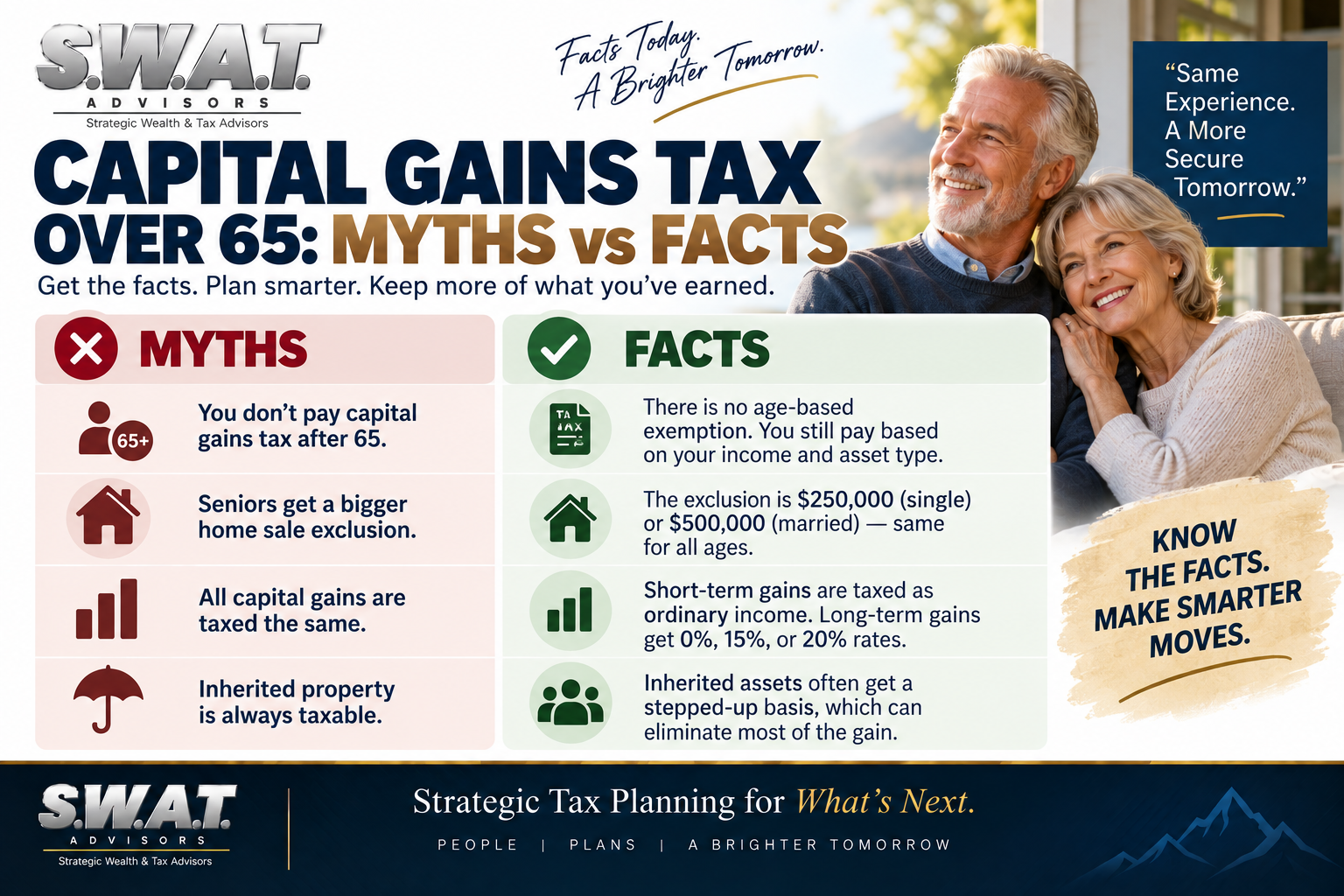
Turning 65 does not erase your capital gains tax bill. Federal law taxes gains on stocks, real estate, and other assets the same way at 65 as it does at 45, based on your income and how long you held the asset.
For retirees, lower taxable income after leaving the workforce, IRA withdrawal timing, and rules like the home-sale exclusion open real paths to reduce capital gains tax over 65, sometimes down to zero.
This article covers what actually changes at 65, the 0% capital gains bracket, six legal strategies for how to avoid capital gains tax over 65, the home-sale exclusion, a pending bill that would raise that exclusion to $1 million, and the mistakes that cost retirees the most money.
Key Takeaways
|
Is There a Capital Gains Tax Exemption for People Over 65?
No. There is no general federal exemption from capital gains tax based on age alone.
Seniors can still owe tax on:
- Stocks and mutual funds
- Investment property and rental real estate
- Business interests
- Collectibles, artwork, and other capital assets
What actually determines the bill is:
- Short-term versus long-term holding period
- Taxable income for the year of sale
- Filing status
- Adjusted basis in the asset
- The type of asset sold
What Actually Changes at Age 65?
Age 65 triggers a handful of separate tax provisions, but none of them exempt capital gains. IRS Publication 554, Tax Guide for Seniors, outlines an additional standard deduction for taxpayers 65 and older and a higher filing threshold, both of which reduce taxable income and can indirectly help a retiree qualify for the 0% capital gains rate.
- Up to 85% of Social Security benefits can become taxable once combined income crosses set thresholds, and Medicare Part B and Part D premiums rise under the Income-Related Monthly Adjustment Amount when modified adjusted gross income exceeds set limits from two years prior.
- A large capital gain in one year can pull both levers even though the gain itself is taxed under ordinary capital gains rules.
Do Seniors Pay Capital Gains Tax at the Same Rate as Everyone Else?
Yes. The federal long-term capital gains rate structure, 0%, 15%, or 20%, applies identically regardless of age. Short-term gains, on assets held one year or less, are taxed as ordinary income at rates up to 37% for anyone. Retirees frequently pay less in practice only because retirement income tends to be lower than working-years income, which is an income effect.
The 0% Capital Gains Bracket: A Retiree’s Biggest Advantage
The 0% long-term capital gains rate is the single biggest lever available for reducing taxable income exposure to capital gains in retirement. It is open to any filer whose taxable income, including the gain itself, falls under the threshold for their filing status.
The table below sets out the 2026 federal long-term capital gains brackets, confirmed under IRS Revenue Procedure 2025-32 and reflecting adjustments made under the One Big Beautiful Bill Act. Rates and thresholds apply to qualifying long-term gains and qualified dividends; short-term gains are taxed as ordinary income under separate brackets.
| Rate | Single | Married Filing Jointly | Head of Household | Married Filing Separately |
| 0% | $0 – $49,450 | $0 – $98,900 | $0 – $66,200 | $0 – $49,450 |
| 15% | $49,451 – $545,500 | $98,901 – $613,700 | $66,201 – $579,600 | $49,451 – $306,850 |
| 20% | Over $545,500 | Over $613,700 | Over $579,600 | Over $306,850 |
A single retiree with $49,450 or less in total taxable income for 2026 owes nothing federally on qualifying long-term gains realized that year. A married couple filing jointly gets nearly double that room, up to $98,900.
Why Taxable Income, Not Age, Determines the 0% Rate
Your eligibility for the 0% rate depends entirely on total taxable income for the year, including the gain you are about to realize. The gain itself gets added into taxable income first, and that combined figure decides which bracket applies.
Someone with $30,000 of pension and Social Security income might assume a $25,000 stock sale is safe because $30,000 alone sits well under the $49,450 single-filer threshold. It does, until the $25,000 gain is added on top, pushing total taxable income to $55,000, past the threshold, and moving part of that gain into the 15% bracket.
The “Capital-Gain Stacking” Concept Retirees Need to Understand
Long-term capital gains stack on top of ordinary taxable income when the IRS determines which rate bracket applies to the gain.
| Example: Take a retiree with $38,000 in combined Social Security and IRA withdrawals (already reflected in taxable income after applicable deductions) who sells stock for a $20,000 long-term gain, filing single in 2026. The $49,450 threshold for the 0% rate leaves $11,450 of room before that first dollar of gain hits the 15% bracket.
Of the $20,000 gain, $11,450 is taxed at 0%, and the remaining $8,550 is taxed at 15%, producing roughly $1,283 in federal tax on that sale. The ordinary income does not move; the gain splits across two rates depending on where it lands. |
Having a capital gain does not automatically mean the entire amount is taxed at 15% or 20%. A retiree with low enough taxable income can put some or all of a qualifying long-term gain into the 0% federal bracket, and partial 0% treatment on a partially stacked gain is common.

How to Avoid Capital Gains Tax Over 65: 6 Legal Strategies
These six approaches are the primary, IRS-recognized ways to avoid capital gains tax over 65.
1. Use the 0% Long-Term Capital Gains Tax Rate When Your Taxable Income Is Low
Sell in a year when total taxable income, gain included, stays under your filing status’s 0% threshold. Retirees who delay Social Security, limit IRA withdrawals, or time a sale for a lower-income year can capture part or all of a gain at 0%.
2. Sell Your Primary Residence Using the $250,000 or $500,000 Home-Sale Exclusion
Qualifying homeowners can exclude up to $250,000 of gain on the sale of a primary residence, or $500,000 for married couples filing jointly, if ownership and use tests are met.
- This exclusion is not limited to seniors; anyone who owned and lived in the home as a primary residence for at least two of the five years before the sale can generally qualify.
- For many retirees downsizing after decades in one home, this is the largest single tax reduction available on capital gains tax on a home sale.
3. Offset Investment Gains With Capital Losses and Unused Loss Carryforwards
Realized capital losses offset realized capital gains dollar for dollar, and up to $3,000 of net capital loss beyond that ($1,500 if married filing separately) deducts against ordinary income each year. Losses beyond that annual limit carry forward indefinitely to future tax years.
4. Recalculate Your Cost Basis Before Selling an Appreciated Asset
Taxable gain equals the amount realized minus adjusted basis, and adjusted basis is often higher than taxpayers assume. IRS Publication 551 allows purchase price, acquisition costs like broker commissions and title fees, and capital improvements to be added to basis.
5. Check the Stepped-Up Basis Before Selling Inherited Stocks or Property
Inherited capital assets generally receive a basis equal to fair market value on the date of the original owner’s death rather than what the deceased originally paid. This step-up can eliminate most or all of the taxable gain built up during the decedent’s lifetime, and inherited assets are treated as long-term regardless of how briefly the heir holds them.
6. Donate Highly Appreciated Investments Instead of Selling Them First
Donating appreciated stock or fund shares directly to a qualified charity lets the donor avoid capital gains tax on the appreciation entirely while generally deducting the full fair market value, subject to IRS Publication 526’s adjusted gross income limits for the year.
Selling Your Home After 65: The Section 121 Exclusion
The Section 121 exclusion works the same way after 65 as it does at any other age: no age requirement exists in the statute.
- To qualify, a seller must have owned and used the home as a primary residence for at least two of the five years before the sale, and cannot have claimed the exclusion on another home sale within the past two years.
- Vacation homes and rental properties do not qualify for Section 121 in the same way; capital gains tax on a vacation home that was never a primary residence is generally taxed in full, subject to depreciation recapture rules if it was ever rented out.
 Proposed $1 Million Home Sale Exclusion for Seniors 65+
A bill introduced in the House in June 2026, the Nest Egg Protection Act (H.R. 9064), sponsored by Rep. Nicole Malliotakis, would temporarily raise the home-sale exclusion to $1 million for qualifying sellers age 65 and older. As of September 2026, the bill remains in committee and is not law.
| Provision | Current Law (Section 121) | Proposed Under H.R. 9064 |
| Exclusion amount | $250,000 single / $500,000 MFJ | $1,000,000, same for single and joint filers |
| Age requirement | None | 65 or older |
| Ownership requirement | 2 of the last 5 years | At least 25 years |
| Applicable years | Current and future, indefinitely | Tax years 2027 through 2030, if enacted |
The table above shows the gap between what current law allows and what this proposal would change. The proposal adds a strict 25-year ownership requirement that current law does not have, and it applies only through 2030 even if passed.
Mistakes Retirees Make When Selling Appreciated Assets
- Selling everything in one calendar year. Realizing a large gain and a large IRA withdrawal in the same tax year often pushes both into higher brackets simultaneously, when spreading the sale across two years could have kept more of the gain in lower brackets.
- Ignoring the NIIT threshold. The 3.8% Net Investment Income Tax applies once modified adjusted gross income exceeds $200,000 (single) or $250,000 (married filing jointly); a gain that looks manageable at the federal capital gains rate can still trigger this additional surtax.
- Forgetting that a gain can spike Medicare premiums two years later. IRMAA surcharges on Medicare Part B and Part D are based on MAGI from two years prior, so a large 2026 sale can raise premiums in 2028, a delay many retirees do not anticipate.
- Assuming a vacation home qualifies for the Section 121 exclusion. It does not, unless it was converted into and used as a primary residence for the required period before the sale.
- Selling inherited property using the original owner’s purchase price. Skipping the stepped-up basis calculation means paying tax on a decade of appreciation that legally is not taxable to the heir.
- Not checking capital loss carryforwards from prior years before selling. Unused losses sitting on a prior return can offset a current-year gain, but only if someone remembers to apply them.
How SWAT Advisors Can Help You Reduce Capital Gains Tax in Retirement
Reducing capital gains tax over 65 takes a plan built around your specific income, assets, and timeline. SWAT Advisors has spent over 20 years building advanced tax planning strategies for business owners, physicians, real estate investors, and retirees across California.
Here is how we help with retirement tax planning strategies around capital gains specifically:
- We map out when to sell appreciated stock, property, or business interests against your other income, so more of the gain lands in the 0% or 15% bracket instead of the 20% bracket or the NIIT surtax range.
- We coordinate capital-gain timing with Social Security claiming, IRA distributions, and Medicare IRMAA thresholds, since these interact in ways a standalone capital gains calculation misses.
- We review basis documentation on inherited and long-held property before a sale, catching stepped-up basis and overlooked improvement costs that shrink the taxable gain.
- We structure charitable giving of appreciated assets and coordinate with estate planning, so gains are minimized now and your legacy is protected later.
If you are weighing a sale and want a clear, personalized breakdown of tax planning for retirement and legally reducing your tax burden before you act, book a Tax Planning Discovery Call with SWAT Advisors today.
Conclusion
Age alone never determines a capital gains tax over 65; taxable income, holding period, filing status, and basis do. The 0% bracket, the $250,000/$500,000 home-sale exclusion, capital-loss offsets, basis corrections, stepped-up basis on inherited assets, and charitable donation of appreciated securities remain the legally available tools for reducing what you owe.
A pending bill could raise the home-sale exclusion to $1 million for long-term senior homeowners starting in 2027, but current law still caps it at $250,000 or $500,000 today.
SWAT Advisors turns these rules into an individualized plan. With over 20 years of California-based tax planning experience and more than $100 million in documented client tax savings, the firm builds strategies around your specific basis records, income sources, and timeline instead of applying the same playbook to every retiree.
If a sale, an inheritance, or a home downsize is on your horizon, contact SWAT Advisors to find out exactly where your gain falls in the bracket structure before you owe a dollar more than the law requires.
FAQs
No. Federal capital gains tax applies at 65 exactly as it does at any other age, based on income, filing status, and holding period, not birth year.
Sell in years when taxable income (gain included) stays under your 0% bracket threshold, use the home-sale exclusion, offset gains with losses, and confirm stepped-up basis on inherited assets.
The same 0%, 15%, or 20% federal rates that apply to every filer, based on 2026 income thresholds of $49,450 single and $98,900 married filing jointly for the 0% bracket.
No, not currently. The $250,000/$500,000 Section 121 exclusion applies at any age; a pending bill (H.R. 9064) would add a senior-specific $1 million exclusion only if passed.
Yes, potentially. A large home-sale gain above the exclusion can raise combined income enough to make more of your Social Security benefit taxable that year.