
Yes, hiring your spouse or child can lower your family’s tax bill, but only when the family member does real work and you pay a reasonable, well-documented wage for it. The business pays deductible compensation, which becomes the family member’s income.
Depending on your entity type, certain family payroll tax rules can reduce or eliminate Social Security, Medicare, and unemployment tax on those wages. The family member may also gain access to retirement savings or other employee benefits.
Your business structure changes the outcome completely. The IRS treats sole proprietorships and parent-parent partnerships very differently from corporations and other partnerships, according to Publication 15, the Employer’s Tax Guide.
Key Takeaways
|
What Family Employee Tax Planning Actually Means
Family employee tax planning involves structuring how you pay a spouse, child, or parent for real work in your business so the household keeps more money after taxes. It is the same payroll rulebook every employer follows, applied with attention to a handful of family-specific exceptions.
- The strategy works because the IRS carves out relief for certain relationships and entity types.
- A sole proprietor who hires a 15-year-old to handle social media and filing pays no FICA on those wages.
- A corporation that hires the same child under the same job description pays full FICA.
This is where family payroll tax planning earns its name when you apply it correctly to a relationship the IRS already recognizes.
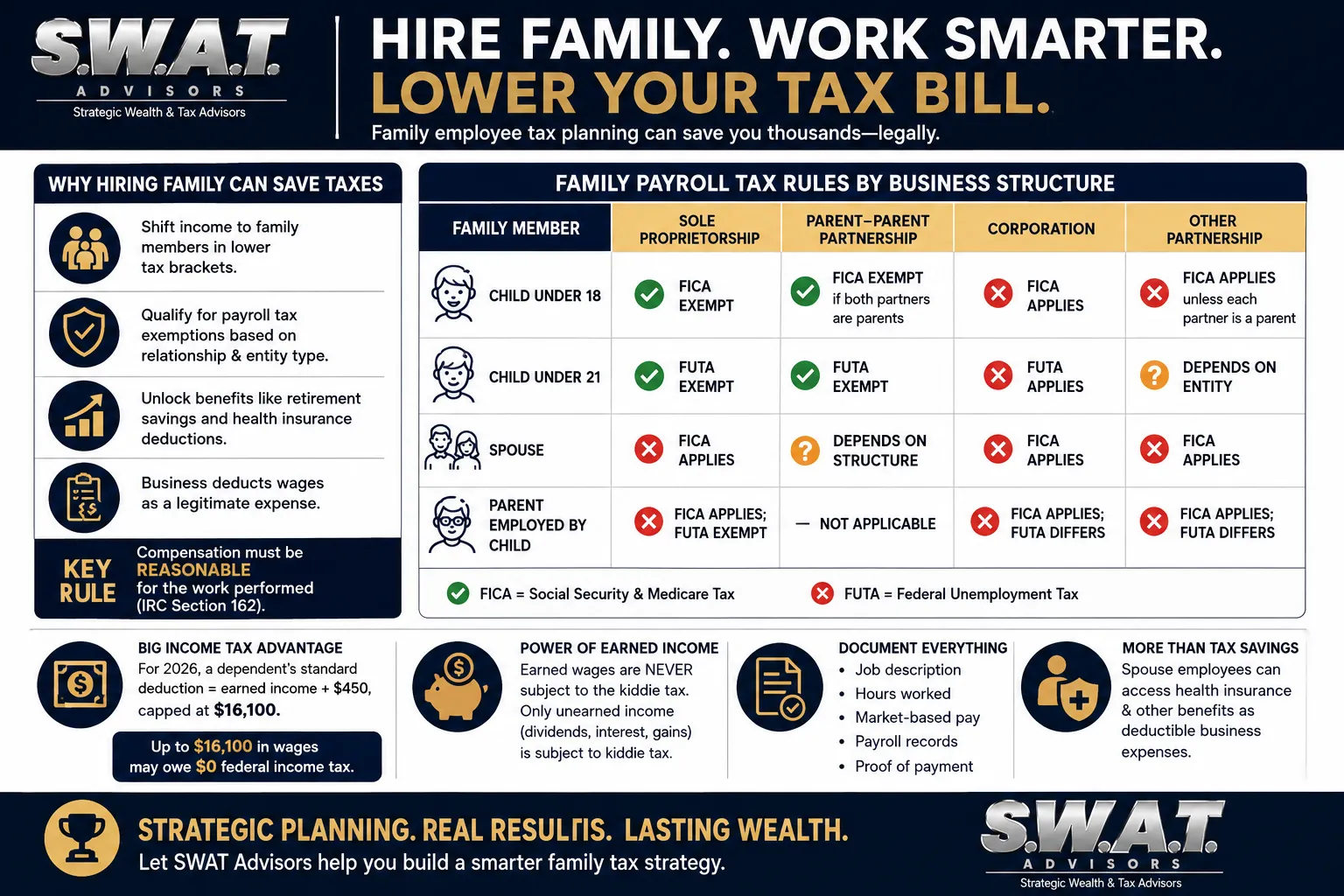 Which Family Members Can You Hire, and Why Does the Business Structure Matter More?
Your entity type decides whether family employment tax breaks apply at all, sometimes more than the relationship itself does. A child working for a corporation gets no FICA break, while the same child working for a sole proprietor gets a full exemption.
The table below breaks down how each family business payroll tax rules exception shifts by entity.
| Family Employee | Sole Proprietorship | Parent-Parent Partnership | Corporation | Other Partnership |
| Child under 18 | FICA exempt | FICA is exempt if both partners are parents. | FICA applies. | FICA applies unless each partner is a parent. |
| Child under 21 | FUTA exempt | FUTA exempt | FUTA applies. | Depends on entity |
| Spouse | FICA applies. | Depends on structure | FICA applies. | FICA applies. |
| Parent employed by child | FICA applies; FUTA is exempt. | Not applicable | FICA applies; FUTA differs. | FICA applies; FUTA differs. |
Confirm your entity classification with your accountant before you calculate any savings. Publication 15 contains the controlling federal employment-tax distinctions, and a wrong assumption about entity type is the single most common mistake in hiring family members for tax strategy planning.
Hiring Your Child: The Biggest Family Employee Tax Opportunity
Hiring your child can shift business income into a lower tax bracket while cutting payroll tax, but only if the business qualifies and the work is genuine.
- Under a sole proprietorship or a partnership where both partners are the child’s parents, wages paid to a child under 18 are exempt from Social Security and Medicare tax.
- Wages to a child under 21 are exempt from FUTA. Income tax withholding still applies regardless of the child’s age, though the child’s own standard deduction usually erases the bill.
For 2026, a dependent’s standard deduction equals earned income plus $450, capped at $16,100. A child earning $16,100 in real wages from the family business can owe $0 in federal income tax, while the business still deducts the full wage as a business expense.
Corporations and most partnerships do not get the FICA break. If your S-Corp or LLC taxed as a corporation employs your child, expect standard payroll tax treatment.
Earned Wages vs. the Kiddie Tax
The kiddie tax never applies to a child’s earned wages. It applies only to unearned income, such as dividends, interest, and capital gains, above $2,700 for 2026. A child who earns a paycheck for real bookkeeping or marketing work reports that income as earned wages, taxed under the child’s own bracket and standard deduction.
Hiring Your Spouse: What Changes and What Doesn’t
Hiring your spouse changes your FUTA exposure but not your FICA obligation. Wages paid to a spouse working in the business are subject to income tax withholding and full Social Security and Medicare tax, but exempt from FUTA.
If you and your spouse jointly run the business and share profits and losses, you may already be partners for tax purposes, whether or not you filed a formal partnership agreement. Married couples who operate an unincorporated business together can instead elect qualified joint venture status, filing two Schedule C forms instead of a partnership return.
Hiring a Parent: A Different Set of Rules
Wages paid to a parent employed by their adult child are subject to income tax withholding and full FICA tax, but exempt from FUTA. This differs from both the child and spouse categories, and it applies whether the parent works in an office, a storefront, or a home-based operation the adult child owns.
The Health Insurance and Fringe Benefit Angle
A spouse genuinely employed in the business can receive employer-paid health insurance and other fringe benefits as a deductible business expense rather than a personal expense. This is one of the more overlooked pieces of hiring family members tax strategy work, particularly for sole proprietors who currently pay premiums out of pocket with no deduction.
Structuring a spouse as a bona fide employee, with real duties and documented hours, can convert non-deductible family health costs into a deductible payroll benefit. The arrangement must reflect an actual employment relationship.
Reasonable Compensation: The Rule That Protects (or Breaks) the Strategy
Reasonable compensation is what a similar business would pay an unrelated person for the same work under the same circumstances, which is drawn from IRC Section 162 and decides whether the IRS accepts or challenges every dollar you deduct for a family employee’s wages.
Compensation that is inflated relative to the job invites an audit. Compensation that is artificially low, especially for a working owner-spouse in an S corporation, invites a different kind of scrutiny. In our practice at SWAT Advisors, we’ve seen family payroll deductions disallowed not because the family relationship was a problem, but because the business never documented what the job actually involved.
How Should You Decide How Much to Pay a Family Employee Without Creating a Tax Red Flag?
Set the wage using market rates and actual hours worked, never a target deduction amount. There is no IRS-published dollar figure that automatically qualifies as safe or automatically tax-free. The wage has to trace back to a real job, done for a real number of hours, at a rate similar to what businesses would pay.
Use Market Value and Actual Hours, Not the Family’s Desired Tax Deduction
Document six things before the first paycheck goes out: a written job description, the hourly rate or salary basis, actual hours logged, deliverables completed, comparable market rates for the role, and a consistent payment schedule. This record is what separates a defensible family employee tax planning arrangement from one that collapses under audit.
Why “Paying the Maximum Tax-Free Amount” Is the Wrong Way to Set Family Wages
There is no universal child-wage number that is automatically exempt from tax. The deduction depends entirely on whether the compensation is reasonable and tied to services actually performed. A family that pays a 12-year-old $16,100 for two hours of filing a month is not executing tax strategy. It is inviting an IRS challenge.
What Payroll Paperwork Is Required When You Put Your Spouse or Child on Payroll?
You need the same paperwork trail required for any employee, family or not. That includes:
- An Employer Identification Number, where the entity requires one
- A completed Form W-4 from the employee
- Ongoing payroll records
- A Form W-2 issued at year-end
- Timely employment-tax deposits
- Federal employment-tax returns, such as Form 941
- Any applicable state payroll registration and filings
- Time sheets showing hours actually worked
- A written job description
- Proof of payment, such as canceled checks or direct-deposit records
- Supporting documentation describing the work performed
The IRS specifically directs employees to complete Form W-4 for federal income tax withholding, and points employers to Publication 15 for full employment-tax requirements.
What Is the Most Practical Family-Employee Tax Strategy for a Small Business Owner?
The right strategy depends on the family member’s age, the employee relationship, and your business structure.
If You Have a Young Child and a Sole Proprietorship
Confirm the work is genuinely age-appropriate, set a reasonable wage, keep contemporaneous time records, run it through payroll, and weigh the FICA and FUTA exemptions against the earned-income and retirement benefits your child gains, including eligibility to fund a Roth IRA with earned wages.
If Your Child Is 18-20
Recalculate the numbers. The FICA exception generally ends at 18, so Social Security and Medicare tax now apply. The FUTA exception continues until age 21, so that piece of the savings survives a few more years.
If Your Child Is 21 or Older
Treat your child like any other employee for federal employment-tax purposes. None of the age-based FICA or FUTA exceptions apply once your child turns 21, regardless of entity type.
If Your Spouse Is the Proposed Employee
Compare a genuine employee relationship against a qualified joint venture or partnership structure. Each path carries different payroll-tax consequences and a different effect on your spouse’s Social Security earnings record.
The IRS is explicit that the way spouses choose to operate a business changes the tax outcome, so this decision deserves its own conversation with an advisor before you set up payroll.
How Do You Calculate Whether Hiring a Family Member Will Actually Save Money?
Run the numbers before you run payroll. The core formula looks like this:
| Potential tax benefit = business tax reduction from deductible compensation + employment-tax savings + benefit value, minus employee income and payroll taxes – compliance costs. |
Compare three scenarios side by side: no family employee, child as employee, and spouse as employee.
For each, calculate business taxable income, employee taxable income, Social Security and Medicare exposure, FUTA exposure, income-tax withholding, retirement contribution opportunity, and total family federal tax. This is the step that actually tells you whether the deduction beats the added payroll complexity.
How SWAT Advisors Can Help in Setting Up Family Employee Tax Planning the Right Way
SWAT Advisors has spent more than 20 years building family wealth planning strategies for business owners, physicians, dentists, and real estate professionals who want every legal deduction working in their favor. Our firm has contributed to over $100 million in documented client tax savings.
We can help you:
- Confirm whether your entity structure qualifies for the FICA and FUTA exceptions covered in this article
- Set defensible, market-based wages for a spouse or child employee
- Build the payroll paperwork trail that survives an IRS review
- Coordinate retirement planning for tax savings, including Roth IRA contributions funded by a child’s earned wages
- Model the full family tax outcome before you commit to a strategy
Our family tax office service handles exactly this kind of planning, and our advanced tax planning team can layer family payroll strategy into your broader tax picture. Book a consultation with us to find out what a properly structured family employee tax planning plan looks like for your business.
Conclusion
Family employee tax planning works when compensation reflects real work, matches market rates, and fits the rules your specific business structure allows. A sole proprietor hiring a minor child can eliminate FICA and FUTA on those wages. A spouse on payroll skips FUTA but still owes full FICA. A corporation gets none of the child-specific breaks a sole proprietorship does.
SWAT Advisors starts every engagement with a discovery call, runs a full tax-saving assessment, and builds quarterly reviews into the relationship so your family business payroll tax rules strategy stays current as your business and the tax code both change. Contact us today to see what your family could save.
FAQs
Yes, if your business is a sole proprietorship or a parent-parent partnership. Wages to a child under 18 skip FICA, and wages to a child under 21 skip FUTA.
No. The kiddie tax applies only to unearned income like dividends and interest, never to wages earned for actual work performed.
No. Corporations owe full FICA and FUTA on a child's wages regardless of the parent's ownership stake.
There is no fixed safe number. Pay the market rate for the actual job and actual hours worked, and document both.
Yes. A spouse added to payroll may become eligible for the business's retirement plan, which can open new contribution room for the household.