
Cross-border tax planning helps people who live, work, invest, or own property in Canada and the United States reduce double taxation while meeting both countries’ reporting rules. A U.S. citizen living in Canada can still face U.S. tax reporting because the United States generally taxes citizens on worldwide income.
The Canada-US tax treaty can reduce double taxation, but the right result depends on citizenship, residency, income type, account ownership, treaty rules, and foreign tax credits.
This guide explains the key Canada-US cross-border tax planning rules, including residency, treaty tiebreakers, foreign tax credits, FBAR, FATCA, retirement accounts, and estate planning.
Key Takeaways
|
Why Cross-Border Tax Planning Is More Than Just Filing Two Returns
Cross-border tax planning is more than preparing a Canadian return and a U.S. return because the same income, account, or asset can create tax and reporting duties in both countries.
The most important points are:
- Worldwide income: U.S. citizens generally report worldwide income to the IRS, even while living permanently in Canada.
- Canadian residency: Canada generally taxes residents on worldwide income.
- Treaty relief: The treaty can allocate taxing rights and provide relief from double taxation.
- Foreign tax credits: The IRS and CRA both provide credit systems for qualifying foreign taxes.
- Information reporting: Tax can be zero while reporting remains mandatory.
- Timing: Selling investments, changing residency, or moving money can change the tax result.
- Deadlines don’t align: Canadian returns are due April 30; U.S. returns for citizens abroad get an automatic extension to June 15, but FBAR is due April 15 with an automatic extension to October 15.
In our practice, one issue we see repeatedly is treating compliance and planning as separate tasks. Good cross-border tax planning strategies review both together before a transaction happens.
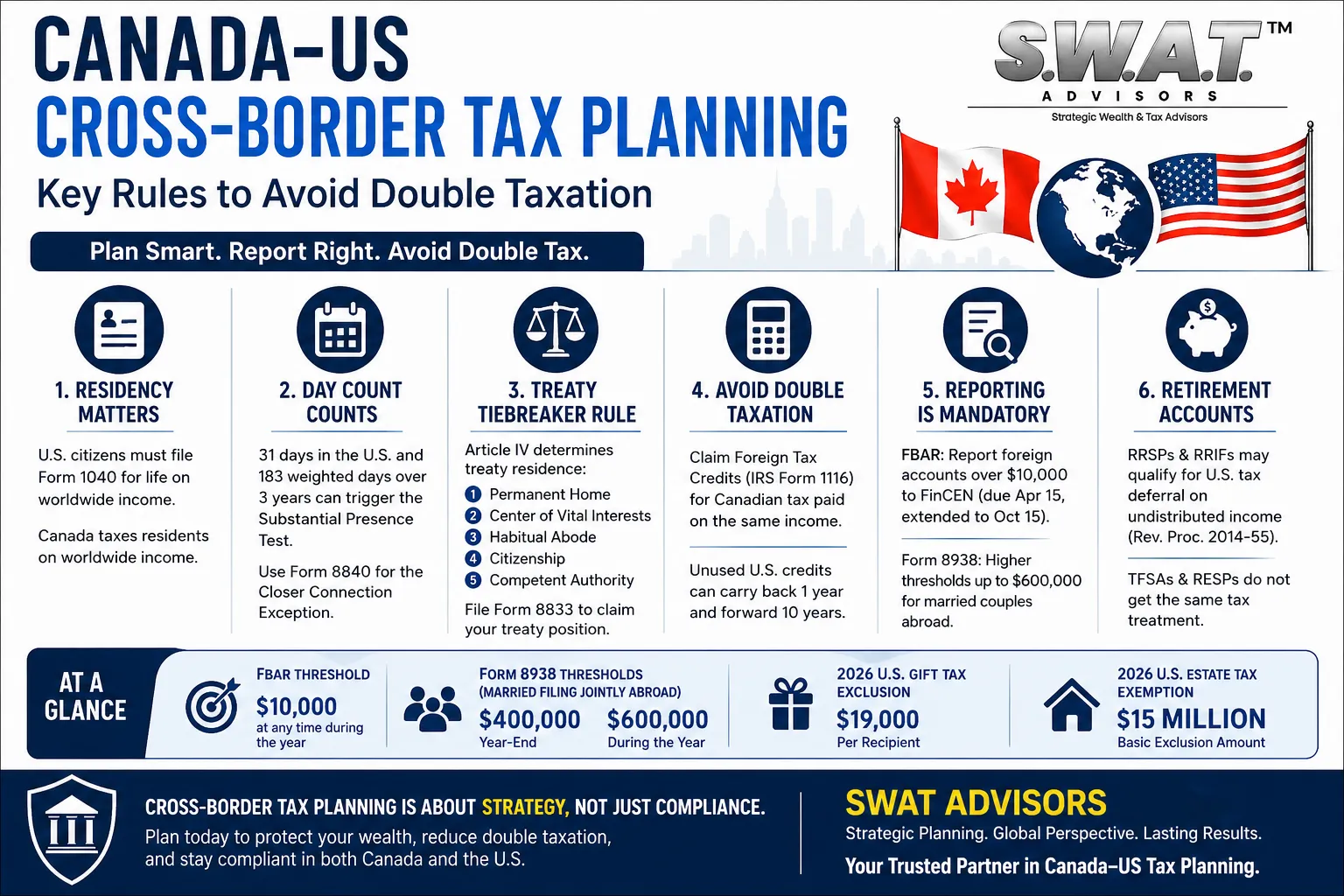
Citizenship-Based vs. Residency-Based Taxation: The Root of the Problem
Citizenship-based taxation is a system that can tax a person based on citizenship, while residency-based taxation generally taxes people based on where they live for tax purposes.
The table below breaks down how each system treats a person differently depending on citizenship and residency status.
| Situation | U.S. Filing Obligation | Canadian Filing Obligation |
| U.S. citizen living in Canada | Files Form 1040 on worldwide income for life | Files T1 as a resident on worldwide income |
| Canadian citizen living in the U.S. | No U.S. filing unless resident or income-sourced | Non-resident return only on Canadian-source income |
| Dual citizen residing in Canada | Files Form 1040 regardless of residency | Files T1 as a Canadian resident |
| Green card holder who moved back to Canada | Still files 1040 unless the green card is formally abandoned | Files T1 as a resident |
The table shows why a person can have obligations in both countries while using treaty and credit rules to limit double taxation. The treaty does not automatically cancel either country’s filing system.
The Canada-US Tax Treaty and Its Tiebreaker Rules
The Canada-US tax treaty can determine treaty residence when domestic rules make an individual resident of both countries. Article IV applies a set order of tests rather than simply counting the number of days spent in each country.
A tax treaty tiebreaker is a set of rules that assigns treaty residence when domestic tax laws treat a person as resident in both countries. Article IV generally looks at:
- Permanent home: If a permanent home exists in only one country, that country comes first.
- Center of vital interests: If homes exist in both countries, personal and economic ties become important.
- Habitual abode: If vital interests cannot be determined, habitual living patterns matter.
- Citizenship: If habitual abode exists in both countries, citizenship becomes relevant.
- Competent authority: If the person is a citizen of both countries, the two authorities can settle the issue by mutual agreement.
A dual-resident taxpayer who resolves as a Canadian resident under the tiebreaker must file Form 8833, Treaty-Based Return Position Disclosure, with their U.S. return to formally claim that status. Skipping this form can trigger a $1,000 penalty for individuals under IRC section 6712. U.S. citizens who win the tiebreaker as Canadian residents still file Form 1040 every year; the treaty resolves double taxation, not the citizenship-based filing obligation itself.
The Substantial Presence Test and Form 8840 for Snowbirds
The substantial presence test is a U.S. day-count rule that can make a noncitizen a U.S. tax resident. It generally requires at least 31 days in the current year and 183 weighted days across three years.
The calculation counts:
- 100% of current-year U.S. days.
- 1/3 of prior-year U.S. days.
- 1/6 of second-prior-year U.S. days.
Form 8840, the Closer Connection Exception Statement, is the IRS statement used to claim the closer connection exception to the substantial presence test. A qualifying person generally needs fewer than 183 actual U.S. days in the current year, a foreign tax home, and a closer connection to the foreign country.
For Canadian snowbirds, tracking every U.S. day is essential. Do not rely on the simple 183-day rule because the weighted formula can produce a different result. Green card holders and applicants cannot use this exception under any circumstances.
Avoiding Double Taxation: Foreign Tax Credits and Treaty Elections
The primary tool for avoiding double taxation is the Foreign Tax Credit, claimed on IRS Form 1116, which lets U.S. taxpayers offset U.S. tax liability dollar for dollar with income tax already paid to Canada on the same income. Canadian residents use an equivalent foreign tax credit mechanism on their T1 return to offset Canadian tax with U.S. tax paid.
Effective cross-border tax planning strategies for avoiding double taxation include:
- Match the income: Identify which income generated the foreign tax.
- Check the treaty: Determine which country has the right to tax that income.
- Calculate the credit: The IRS limits the credit based on foreign-source taxable income.
- Use Form 1116: Most individuals claiming the U.S. foreign tax credit use Form 1116.
- Track unused credits: Certain unused U.S. credits can carry back one year and forward ten years.
- Check Canadian relief: CRA generally limits the Canadian credit to the lower of eligible foreign tax paid and Canadian tax otherwise payable on the related foreign income.
The treaty also contains specific double-tax relief rules for U.S. citizens resident in Canada. Article XXIV can change how U.S. and Canadian taxes interact for certain income.
Reporting Obligations You Can’t Afford to Miss: FBAR and FATCA
Cross-border reporting can remain mandatory even when no additional tax is due. Two major U.S. reporting systems are FBAR and FATCA Form 8938.
FBAR filing requirements apply when the aggregate value of reportable foreign financial accounts exceeds $10,000 at any time during the calendar year. The FBAR is filed electronically with FinCEN using Form 8938, not with the IRS.
Thresholds for Form 8938 depend on filing status and residence. For taxpayers living abroad, the thresholds can reach $200,000 at year-end and $300,000 during the year for unmarried taxpayers, or $400,000 and $600,000 for qualifying joint filers.
For calendar-year FBARs, April 15 is the normal due date, with an automatic extension to October 15.
Why TFSAs and RESPs Create Unexpected US Reporting Headaches
A TFSA is a Canadian tax-free savings account, but U.S. reporting can still apply to the account. IRS guidance specifically identifies Canadian TFSAs and RRSPs as foreign financial accounts for FBAR purposes.
RESP treatment can require separate U.S. analysis because Canadian account rules do not automatically control U.S. tax treatment. IRS systems also specifically recognize RESP and TFSA structures in foreign trust reporting procedures.
RRSPs, RRIFs, and Retirement Accounts Across the Border
RRSPs and RRIFs receive important treaty protection, but the protection does not mean every U.S. reporting rule disappears. IRS Publication 597 recognizes RRSPs and RRIFs as Canadian retirement arrangements and explains the treaty-based deferral rules.
A foreign retirement account is an account established outside the United States that may receive different tax treatment under U.S. law or a treaty. For eligible individuals, Revenue Procedure 2014-55 permits deferral of U.S. tax on undistributed income in qualifying Canadian retirement plans.
| Suppose a U.S. citizen living in Canada owns a Canadian RRSP worth $500,000. The RRSP grows by $25,000 without a distribution. The treaty rules can allow eligible taxpayers to defer U.S. tax on that undistributed growth, but FBAR and Form 8938 obligations may still apply. |
Do not assume the same treatment applies to a TFSA, RESP, or every Canadian investment account. Each structure needs a separate U.S. and Canadian review.
Cross-Border Estate and Gift Tax Planning
Estate planning becomes more important when a person owns U.S. property, is a U.S. citizen, or has assets in both countries. The treaty contains specific estate tax rules under Article XXIX B.
For 2026, the U.S. federal estate tax basic exclusion is $15 million. The 2026 annual gift tax exclusion is $19,000 per recipient.
A Canadian resident who is not a U.S. citizen can still face U.S. estate tax on U.S.-situated assets. Article XXIX B can provide a treaty-based unified credit and, in qualifying cases, limit U.S. estate tax when the worldwide estate does not exceed $1.2 million.
A Canadian resident owns U.S. real estate, U.S. shares, and Canadian investments. The estate review should measure U.S.-situated property, worldwide assets, citizenship, treaty credits, and Canadian tax effects before death.
Common Cross-Border Tax Planning Mistakes
The mistakes we see most often are the gaps that don’t show up until an account grows, a person retires, or someone dies holding assets in the wrong jurisdiction.
- Filing Form 8891 or Form 3520 out of habit. These are no longer required for RRSPs and RRIFs, and filing unnecessary forms sometimes creates reporting inconsistencies the IRS flags automatically.
- Assuming TFSA growth is tax-free in the U.S. It isn’t. Every dollar of TFSA income is taxable on the U.S. return the year it’s earned, treaty or no treaty.
- Forgetting Form 8833 after winning the tiebreaker test. The residency outcome under Article IV means nothing to the IRS without the disclosure form attached.
- Not tracking the Canadian departure tax against the eventual U.S. sale. The deemed disposition gain from emigration and the later actual U.S. gain on the same asset can create a mismatch in timing that erases the foreign tax credit if not planned for in advance.
- Treating the FBAR threshold and the Form 8938 threshold as the same number. They aren’t close. FBAR triggers at $10,000; Form 8938 for a married couple abroad doesn’t trigger until $400,000.
How SWAT Advisors Can Help Save More in Cross-Border Taxes
SWAT Advisors can help coordinate tax planning, reporting, retirement planning, estate planning, and international tax matters around the same financial facts. Our services include individual, corporate, and partnership tax planning, estate and trust planning, retirement planning, international tax matters, and tax consulting.
We can help you with:
- Reviewing Canadian and U.S. residency exposure.
- Coordinating treaty and foreign tax credit positions.
- Reviewing RRSP, RRIF, TFSA, RESP, and other foreign accounts.
- Checking FBAR and FATCA reporting exposure.
- Planning U.S. and Canadian investment transactions.
- Reviewing cross-border estate and gift tax exposure.
- Coordinating tax planning with retirement and estate goals.
- Building a documented Canada-US cross-border tax planning process before major financial decisions.
We focus on the tax rules that apply to your actual income, accounts, assets, and residency. For a detailed review of your situation, schedule a private tax planning consultation with us.
Conclusion
Canada and the United States can both have legitimate tax and reporting claims, but the treaty and foreign tax credit rules can reduce overlapping tax. Residency, citizenship, account type, income source, and timing determine the result.
The strongest cross-border tax plan reviews residency, treaty residence, foreign credits, account reporting, retirement structures, and estate exposure before money moves or assets change hands.
For people with meaningful ties to both countries, Canada-US cross-border tax planning should be treated as an ongoing financial process. Contact us for a coordinated review that can prevent duplicate tax, missed forms, and costly planning errors while keeping decisions aligned with long-term goals.
FAQs
Yes. U.S. citizens generally must report worldwide income to the IRS even while permanently living in Canada.
Yes. Domestic rules can make you resident in both countries, then treaty tiebreaker rules determine treaty residence.
FBAR reports foreign accounts above $10,000, while Form 8938 reports specified foreign assets above separate thresholds. You may need both.
Not necessarily on undistributed growth. Eligible taxpayers can generally elect treaty-based U.S. deferral for qualifying RRSP and RRIF income.
Not automatically. A TFSA can create U.S. reporting and tax issues, so review its treatment before opening or funding one.
Yes, they may. U.S. citizenship can create U.S. worldwide-income reporting while Canadian residency creates Canadian worldwide-income reporting.
It generally tests permanent home, center of vital interests, habitual abode, and citizenship in that order. Dual citizens may require competent-authority agreement.
FBAR goes to FinCEN, while Form 8938 attaches to the federal income tax return. The filing thresholds and asset definitions also differ.
Generally, qualifying undistributed RRSP income can receive treaty-based U.S. tax deferral. Reporting duties can still apply.
Yes. Each country's domestic rules can apply first, with the treaty resolving dual residence for treaty purposes.