
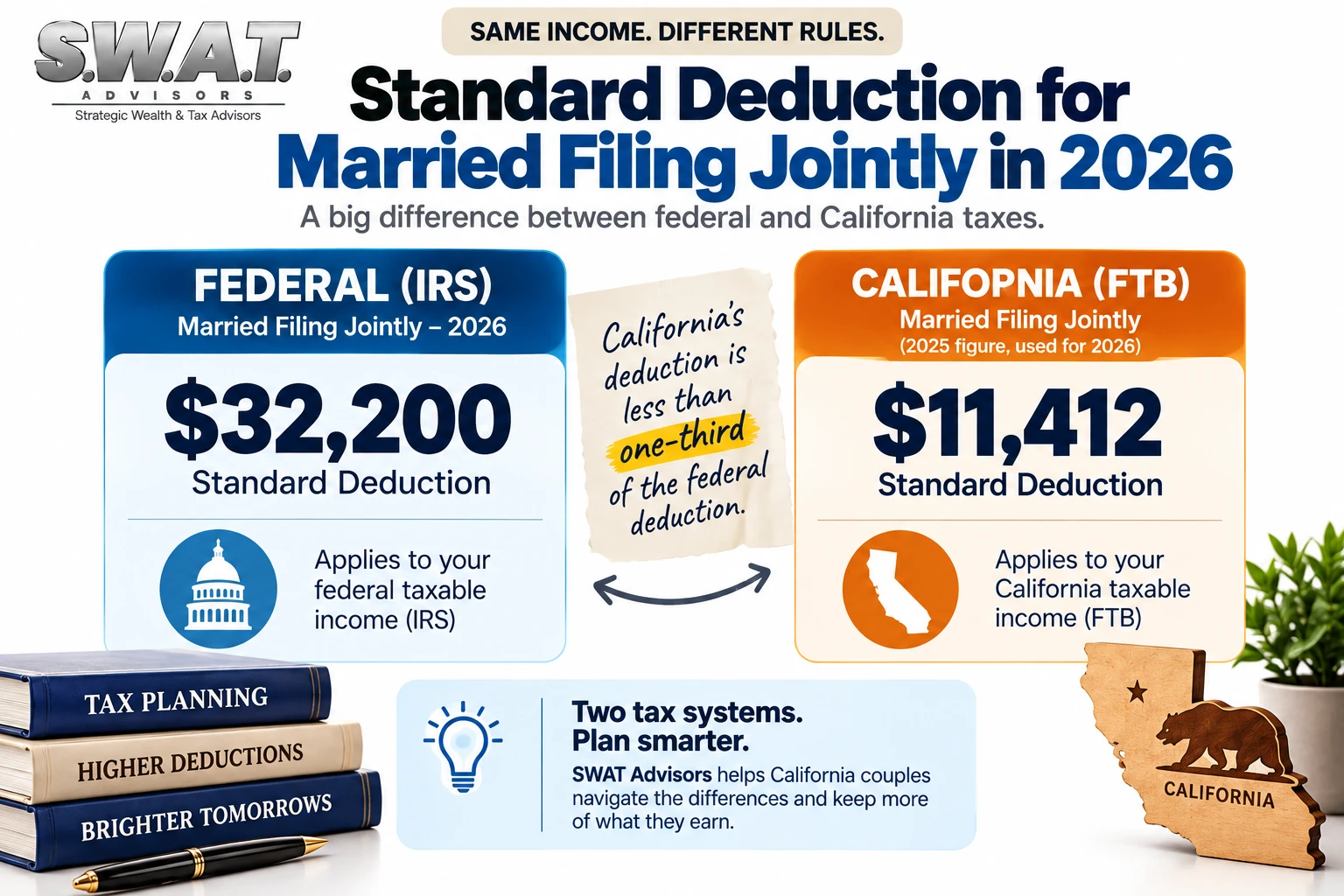
A married couple filing jointly in California in 2026 deals with two separate tax systems that don’t move in sync. The IRS set new federal brackets and a $32,200 standard deduction under Revenue Procedure 2025-32. California, meanwhile, still hasn’t finalized its own 2026 numbers as of this writing, so state filers are working from the last confirmed FTB figures.
This guide breaks down the confirmed 2026 federal numbers, the most recent California figures, where the two systems diverge, and when filing separately in California actually beats filing jointly.
Key facts:
|
California’s Married Filing Jointly Tax Brackets for 2026
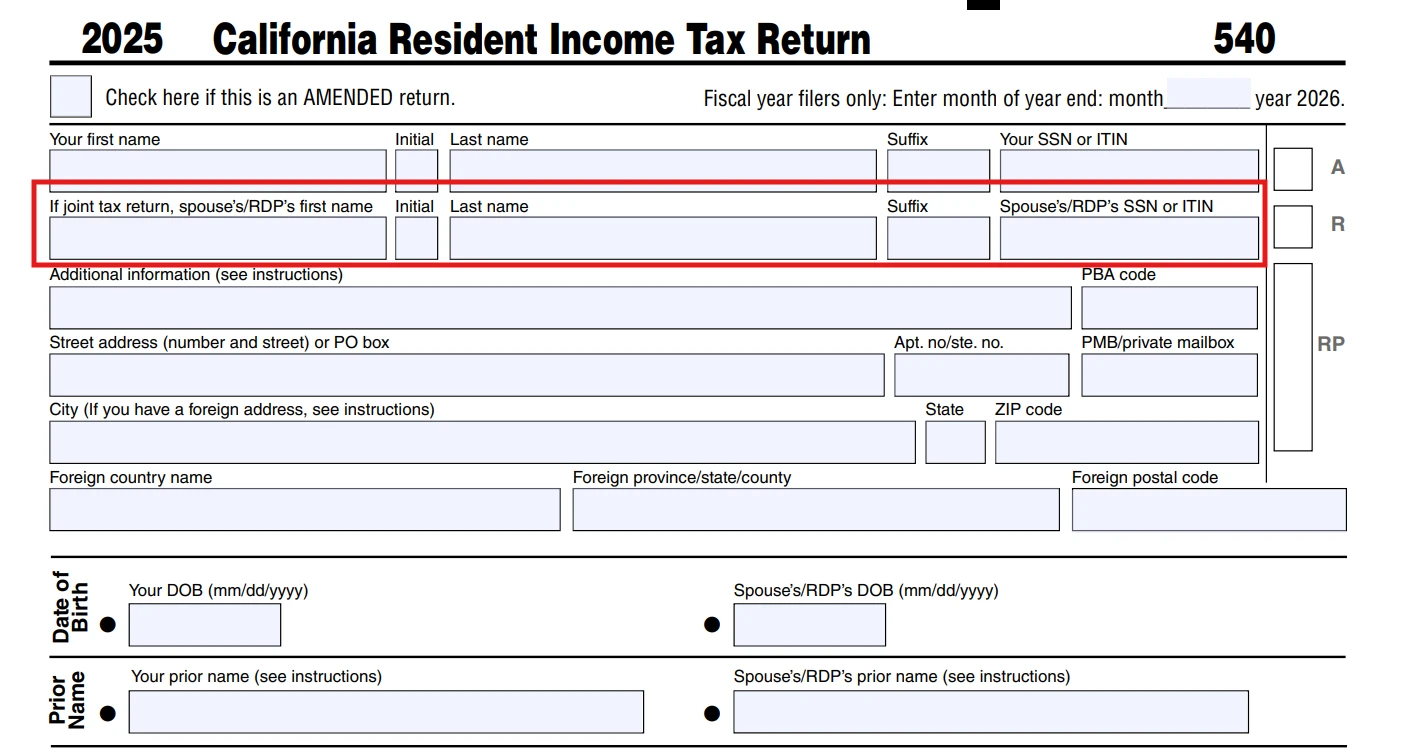
California has not released a finalized Schedule Y for tax year 2026. The Franchise Tax Board typically publishes its indexed brackets in the fall for the year just ending, so the 2026 figures a couple will use on their 2026 Form 540 (filed in spring 2027) usually don’t surface until late 2026.
What exists right now is the confirmed 2025 Schedule Y, published by the FTB in October 2025. We’re using those numbers here as historical and contextual reference only.
Two things stay true regardless of which year’s brackets apply.
- First, California runs its own nine-bracket system that has nothing to do with the seven federal brackets.
- Second, both spouses’ income lands on one joint return, and the state tax is calculated on one combined taxable-income figure.
When a California Couple Qualifies To File Jointly
A couple qualifies for California tax brackets 2026 married filing jointly treatment when they’re legally married (or registered domestic partners under California law) as of December 31 of the tax year, and both spouses agree to combine their income on one return.
- California generally follows the federal filing status you claim on your federal return, so if you filed a joint 1040, you’ll typically file a joint 540 too.
- Registered domestic partners are the exception. Because the federal government doesn’t recognize RDP status for tax purposes, an RDP couple files as single or head of household federally but must file jointly or separately as RDPs on their California return.
Filing jointly also changes how a couple can reduce taxable income with deductions, since itemized deductions and above-the-line adjustments now apply against one combined AGI instead of two individual ones. Once you’re on a joint return, here’s what actually happens to the numbers:
- Both spouses’ W-2, 1099, and self-employment income get reported on a single Form 540.
- The state applies its marginal tax rates to one combined taxable-income number, not to each spouse’s income separately.
- A two-earner household with, say, $90,000 and $60,000 in wages doesn’t get taxed as two $75,000 incomes. It gets taxed as one $150,000 taxable-income calculation running through Schedule Y.
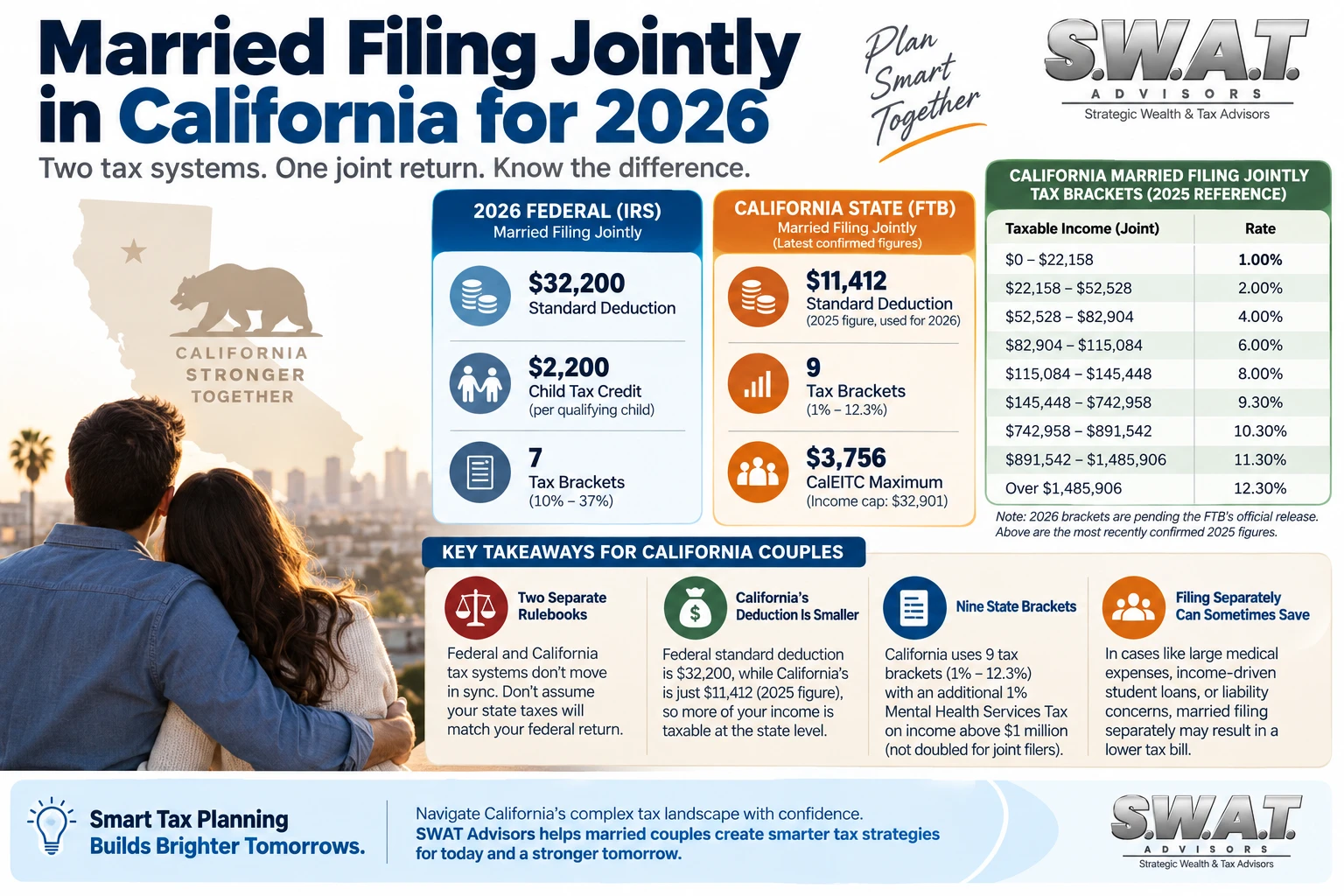
The Federal-California Nonconformity Gap for Joint Filers
California doesn’t automatically adopt every federal tax change. This is called nonconformity.
| Example: the federal standard deduction for MFJ jumped to $32,200 for 2026. California’s confirmed standard deduction for joint filers, at $11,412, is less than a third of that. A couple who assumes their state taxable income will track their federal taxable income closely is going to be surprised by how much more income the state actually taxes. |
Other areas where the two systems split:
- California doesn’t tax Social Security benefits at all, while the federal government can tax up to 85% of them depending on income.
- California doesn’t conform to the federal qualified business income deduction.
- HSA contributions are deductible federally but not for California purposes, so joint filers with an HSA add that amount back on their state return.
- Municipal bond interest treatment differs depending on whether the bonds are California-issued or out-of-state.
It means the couple is running two separate calculations from two separate rulebooks, and treating one as a stand-in for the other produces bad estimates. In our practice, this is the single most common reason a couple’s projected state refund misses by a wide margin.
What Are the 2026 California Tax Brackets for Married Filing Jointly?
California’s brackets for joint filers run through Schedule Y on Form 540, and as of now, the confirmed California tax brackets 2026 married filing jointly reference point is still the 2025 schedule, since the FTB hasn’t released finalized 2026 numbers.
Nine rates apply, from 1% up to 12.3%, with an additional 1% Mental Health Services Tax on income above $1 million (a threshold that does not double for joint filers).
The table below shows the most recently confirmed FTB Schedule Y figures. The table below lists the 2025 tax-year brackets that joint filers use as their current reference until the FTB confirms 2026 amounts.
| Taxable Income (Joint) | Rate |
| $0 – $22,158 | 1.00% |
| $22,158 – $52,528 | 2.00% |
| $52,528 – $82,904 | 4.00% |
| $82,904 – $115,084 | 6.00% |
| $115,084 – $145,448 | 8.00% |
| $145,448 – $742,958 | 9.30% |
| $742,958 – $891,542 | 10.30% |
| $891,542 – $1,485,906 | 11.30% |
| Over $1,485,906 | 12.30% |
What California’s Most Recently Published Schedule Y Tells Us, And What It Doesn’t
It tells us the shape of the system: nine brackets, doubled thresholds for joint filers compared to single filers, and a top marginal rate of 12.3% before the millionaire’s surtax. What it doesn’t tell us is the exact 2026 dollar thresholds, since California adjusts these for inflation every year and hasn’t published that adjustment for 2026 yet.
- Inflation adjustments in recent years have pushed each threshold up by roughly 2% to 4% annually, so the real 2026 brackets will likely sit somewhat higher than the 2025 figures shown above.
- Anyone who needs an exact number for tax planning purposes should confirm directly against the FTB’s published 2026 tax rate schedule once it’s released.
Married Filing Jointly vs. Married Filing Separately in California: When Separate Actually Saves Money?
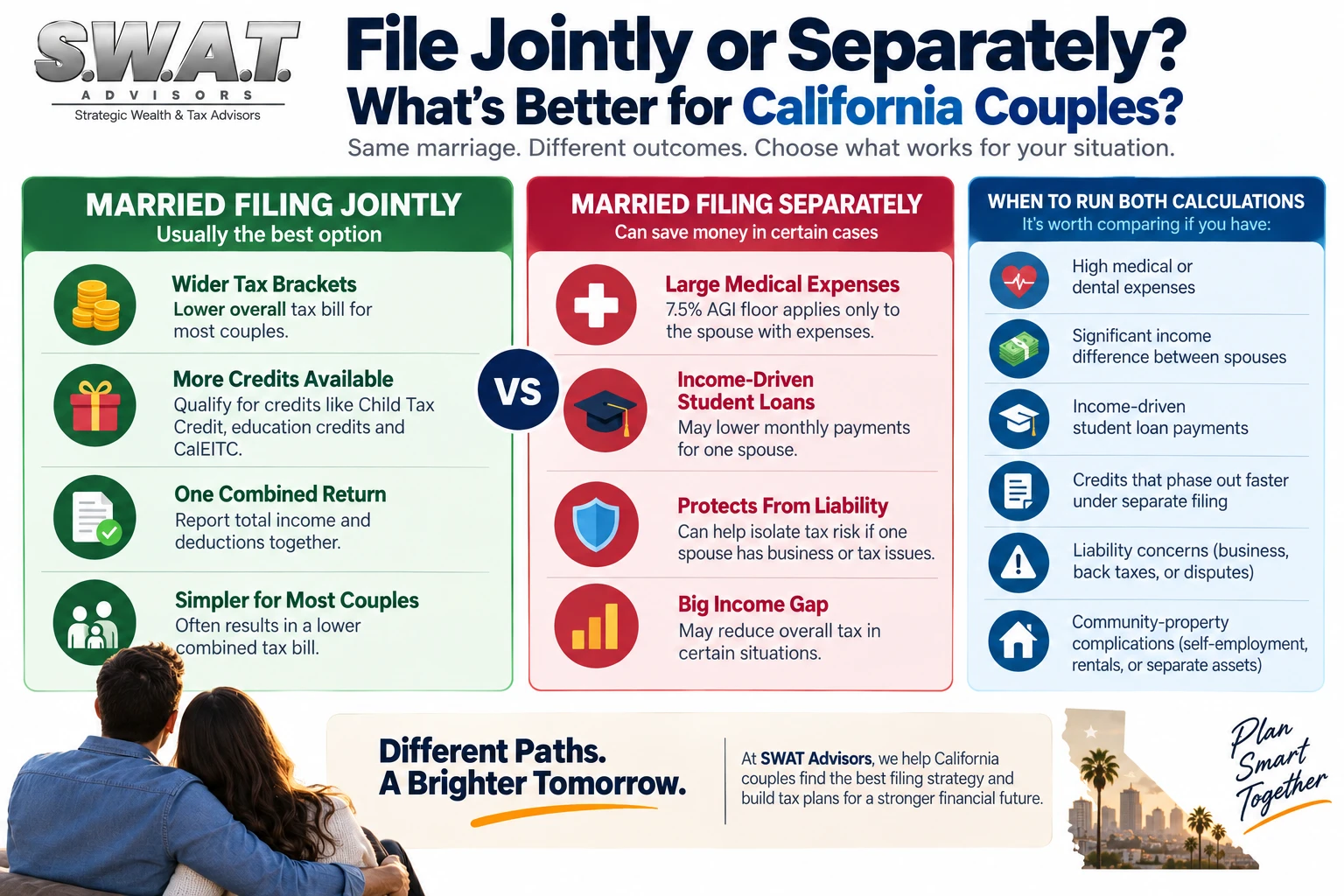
Filing jointly usually produces a lower combined tax bill because the federal MFJ brackets are twice as wide as the single brackets at every level, and it opens the door to credits that married filing separately California filers can’t claim at all.
A few scenarios where separate filing narrows the gap or wins outright:
- One spouse has large unreimbursed medical expenses. The 7.5% AGI floor on medical deductions applies to combined income when filing jointly, which can wipe out the deduction. Filed separately, that floor applies only to the spouse with the medical bills, against their own lower income.
- One spouse is on an income-driven student loan repayment plan. Filing separately can lower that spouse’s calculated payment, even though it usually costs some tax credits.
- A couple wants to isolate liability. If one spouse has a business dispute, unreported income risk, or a messy self-employment situation, the other spouse may prefer separate returns to avoid joint-and-several liability for the whole tax bill.
- California is a community-property state, which complicates separate filing further. Each spouse generally must report half of the combined community income regardless of who earned it.
In a community-property state, filing separately doesn’t let you protect “your” income from your spouse’s tax situation the way people assume. It just changes how the same total income gets split across two returns.
When Should A California Couple Compare Married Filing Jointly With Married Filing Separately?
A married filing separately California comparison only takes a few minutes once you have both spouses’ income figures side by side, and it’s worth running whenever any of the following apply:
- Large medical or dental deductions concentrated in one spouse’s name
- A significant income gap between spouses (roughly 3-to-1 or wider)
- Student-loan payments tied to income-driven repayment
- Eligibility for credits that phase out faster or disappear entirely under MFS, like the Child and Dependent Care Credit and most education credits
- Concerns about liability for a spouse’s tax reporting, back taxes, or an ongoing IRS or FTB dispute
- Community-property complications from self-employment income, rental property held separately, or assets acquired before the marriage
Most couples run both calculations once, at the start of the relationship, and never check again. A raise, a new business, or a life change can flip the math within a year or two.
Credit Thresholds That Change When You File Jointly
Filing jointly changes the income limits, phaseout ranges, and sometimes the eligibility rules for nearly every major credit a household can claim.
- Child Tax Credit: The federal maximum for 2026 is $2,200 per qualifying child, per IRS guidance. This phases out starting at $400,000 of modified AGI for joint filers, a threshold that stays fixed rather than adjusting for inflation.
- Child and Dependent Care Credit: California’s version, claimed on FTB Form 3506, is a percentage of the federal credit and applies only to care provided inside California. It’s capped for households with federal AGI above $100,000.
- California Earned Income Tax Credit (CalEITC): For 2025, the maximum credit is $3,756, available to households with earned income up to $32,901. A married couple filing jointly must have lived in California for more than half the year and cannot use the MFS filing status at all to claim it.
- Young Child Tax Credit (YCTC): Available to CalEITC-eligible households with a child under six. The 2025 maximum is $1,189 per qualifying child, and unlike CalEITC, a taxpayer doesn’t need any earned income at all to qualify, only eligibility for CalEITC itself.
- California dependent exemption credit: Set at $475 per dependent for the 2025 tax year, phasing out once AGI passes roughly $252,203 for single filers or double that for joint filers.
- Education credits: The federal American Opportunity and Lifetime Learning credits phase out at higher MAGI thresholds for joint filers than for single filers, but California doesn’t offer a parallel state-level education credit.
Withholding Mistakes Dual-Income Couples Make: The DE-4 “Married” Box Trap
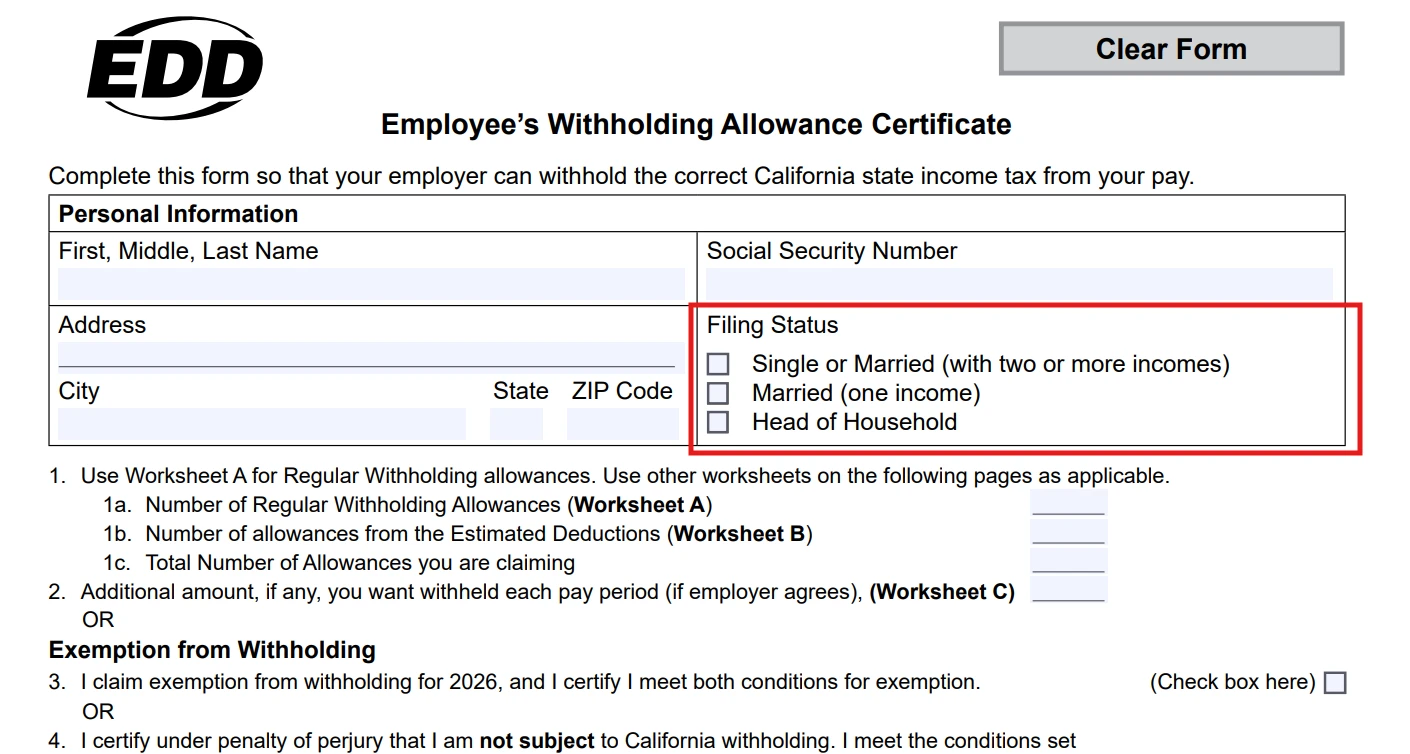
The DE-4 is California’s state withholding form, and it has its own set of boxes separate from the federal W-4. Checking “Married” on both spouses’ DE-4 forms, without adjusting the allowances, is one of the most common tax filing mistakes to avoid for dual-income California households.
The “Married” withholding tables assume only one spouse is earning income, or that the household’s total income is in a lower bracket than it actually does once both paychecks are combined. Two W-2s, each withheld as though it’s the household’s only income, routinely under-withhold a two-earner couple by thousands of dollars over a year.
Specific fixes that actually work:
- Have the higher earner claim “Married” with fewer allowances, and have the lower earner withhold at the “Single” rate or use the DE-4’s multiple-jobs worksheet.
- Recalculate withholding any time either spouse gets a raise, changes jobs, or picks up freelance income on the side.
- Check the DE-4 again after any major life event: a new baby, a home purchase, or a spouse returning to work after time off.
- Run the FTB’s withholding calculator once a year, ideally in January, rather than waiting until the following spring to find out about a shortfall.
We review this with every married dual-income client during the January engagement-letter renewal. Couples who skip this step are far more likely to owe a balance due plus an underpayment penalty.
A Worked Example: How a $250,000 Joint-Filing Couple’s California Tax Is Actually Calculated
Here’s a real walkthrough using a hypothetical but realistic household: two W-2 earners, combined wages of $250,000, no itemized deductions, no dependents, filing jointly in both federal and California returns.
Step 1: Determine federal filing status. Both spouses are legally married as of December 31, so they qualify for MFJ on the federal 1040.
Step 2: Combine income. Both spouses’ W-2 wages are reported on one return: $250,000 total.
Step 3: Calculate federal AGI. With no adjustments, retirement contributions, or other above-the-line deductions in this example, federal AGI equals $250,000.
Step 4: Apply the 2026 federal standard deduction. Subtracting $32,200 leaves $217,800 of federal taxable income.
Step 5: Apply the 2026 MFJ brackets to calculate federal income tax. Running $217,800 through the 2026 schedule, the couple lands in the 24% bracket, which starts at $211,400. Their federal tax comes to roughly $41,000 before credits, using the bracket math of $35,932 base tax plus 24% of the amount over $211,400.
Step 6: Calculate California taxable income separately. Starting again from $250,000 of California AGI (assuming no state-specific adjustments in this simplified example) and subtracting the $11,412 state standard deduction leaves $238,588 of California taxable income.
Step 7: Apply California’s Schedule Y. At $238,588, this household sits in the 9.3% bracket, which starts at $145,448 under the most recently confirmed schedule. Their state tax lands in the high-teens-of-thousands range once the base tax at the bracket floor is added to 9.3% of the excess.
Step 8: Apply credits and compare to withholding. With no dependents and income well above the CalEITC and Young Child Tax Credit thresholds, this couple doesn’t qualify for either. Their final step is comparing total tax owed, federal and state combined, against what was actually withheld from both paychecks throughout the year, adjusting for any estimated tax payments already made.
What Documents Should Spouses Gather Before Doing The Calculation?
Pull everything before you start:
- Both spouses’ W-2s
- Any 1099s for freelance, contract, or investment income
- Mortgage-interest statement (Form 1098)
- Property-tax records
- Charitable contribution receipts
- Childcare provider records and their tax ID
- Education-related tax forms (1098-T, 1098-E)
- Investment and brokerage statements
- Retirement contribution records, including any 401(k) or IRA statements
- Prior-year federal and California returns
- Any California-specific documents, like Schedule CA adjustments from last year
When Joint-Filing Couples Should Get Professional Tax Planning Advice from SWAT Advisors
A couple crossing into the 9.3% California bracket for the first time, a household adding self-employment or rental income, or a family comparing MFJ against MFS for the first time is worth a professional review from SWAT Advisors before you file.
Life events matter just as much as income level. Marriage itself, a new child, a home purchase, or one spouse starting a business all shift the calculus enough that last year’s approach may not fit this year’s numbers.
How SWAT Advisors Can Help You If You’re Married Filing Jointly in California
SWAT Advisors builds tax plans for married couples that go beyond checking the right box on Form 540. SWAT Advisors has spent more than 20 years helping California households and business owners find the deductions and credits their prior preparers missed, and we build tax-saving strategies around your actual numbers.
Here’s what that looks like in practice for a joint-filing household:
- We run the MFJ-versus-MFS comparison every year it matters, not just once, so you’re never leaving money on the table because your situation changed and nobody rechecked it.
- We coordinate your DE-4 withholding elections across both spouses’ paychecks to prevent the under-withholding trap that catches so many dual-income households.
- We identify and reduce taxable income with deduction opportunities specific to your situation, from retirement contribution timing to entity structuring if one spouse is self-employed.
- We track the federal-California nonconformity gap for you, so your quarterly estimated tax payments reflect what you’ll actually owe each state and federal government, not just an estimate based on last year’s federal refund.
If your household is growing, changing income sources, or simply hasn’t had a real review of its tax-saving strategies in a while, book a consultation and see where your joint-filing strategy stands.
Conclusion
Married filing jointly in California for 2026 runs through two independent systems that share a filing status label but almost nothing else numerically. The federal side brings a $32,200 standard deduction and seven brackets topping out at 37%; the state side, still anchored to a California standard deduction married filing jointly figure of $11,412 pending the FTB’s 2026 release, runs nine brackets topping out at 12.3% before the millionaire’s surtax.
Staying current on California tax credits and deductions for 2026 as the FTB finalizes them is part of that plan, and SWAT Advisors has spent over two decades turning that kind of surprise into a strategy instead. We build the strategy that determines what that return looks like months before the deadline arrives.
Contact SWAT Advisors today to see what a personalized joint-filing tax strategy could do for your household this year.
FAQs
Yes. Every threshold on Schedule Y for California tax brackets 2026 married filing jointly filers is exactly twice the corresponding threshold on Schedule X for single filers, at every rate level from 1% through 12.3%.
No. Most couples save money filing jointly, but households with a large medical-expense gap, income-driven student loan payments, or liability concerns should still run the married filing separately California comparison, since community-property rules change how separate filing works here.
The most recently confirmed California standard deduction married filing jointly amount is $11,412, from the 2025 tax year, pending the FTB's 2026 inflation adjustment release.
California's standard deduction is far smaller than the federal one, so more of your income is taxable at the state level even when your federal return looks favorable.
No, not without adjustment. Two spouses both checking "Married" with standard allowances routinely under-withholds for a dual-income household, since each form assumes it covers the only income in the household.