
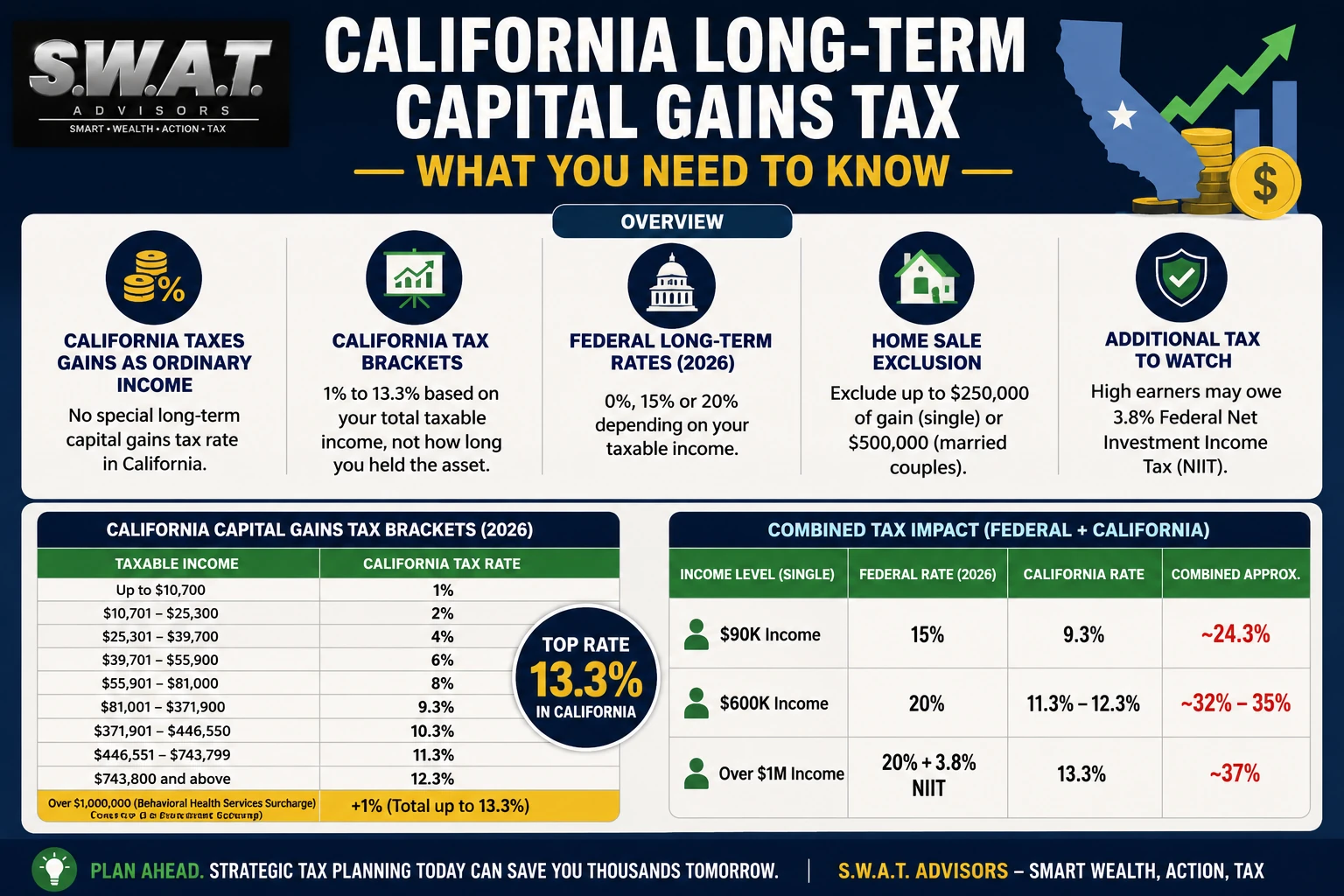
If you sold stock, a rental home, or a business this year, your California long-term capital gains tax rate decides how much profit you keep. Most sellers assume the federal 15% rate is the whole story. It is not. California adds its own bill on top, and that bill can reach 13.3%. Here is how the state taxes your gain, what exemptions apply, and which moves cut your bill before you close.
Key Takeaways
- California taxes all gains as ordinary income; there is no separate long-term capital gains tax rate in California.
- The California capital gains tax brackets run from 1% to 13.3%, based on total taxable income, not how long you held the asset.
- Federal law still rewards patience: long-term rates sit at 0%, 15%, or 20% for 2026.
- A single filer can exclude up to $250,000 of home-sale gain; married couples can exclude $500,000.
- High earners may also owe the federal 3.8% Net Investment Income Tax on top of state and federal capital gains tax.
Understanding California’s Long-Term Capital Gains Tax Rate
California has no special rate for gains on assets you held a long time. The state folds every dollar of profit into your regular income and taxes the total using its nine-bracket system, topping out at 13.3%. That is why sellers get a rough surprise at tax time: the long-term capital gains tax rate California uses ignores the holding period entirely, and the discount investors expect from Washington never shows up on the state return.
What Are Long-Term Capital Gains and How Are They Taxed in California?
A long-term capital gain is the profit from selling an asset owned for more than one year. Federally, that profit qualifies for a reduced rate of 0%, 15%, or 20%, depending on taxable income. California ignores the holding period completely.
Once you sell, your gain gets added to your wages and any other earnings for the year. Whatever long-term capital gain tax rate California imposes on your sale depends entirely on total taxable income, from 1% at the bottom to 13.3% at the top. A $50,000 gain stacked on $80,000 in wages could land in the 9.3% bracket, costing roughly $4,650 in state tax alone.
A 1% Mental Health Services Tax, also called the Behavioral Health Services surcharge, applies once taxable income crosses $1,000,000, pushing the top marginal rate from 12.3% to 13.3%.
How the California Long-Term Capital Gains Tax Rate Differs from Federal Rates
The federal system splits gains into two lanes: short-term, taxed like ordinary income up to 37%, and long-term, capped at 20%. For 2026, the 0% federal rate applies up to $49,450 of taxable income for single filers and $98,900 for married couples. The 15% rate covers income up to $545,500 (single) or $613,700 (married); anything above that hits 20%.
California runs a separate system entirely. The California long-term capital gains tax rate is simply your ordinary state bracket, whether you held the asset three months or thirty years. Combine both governments, and a top-bracket Californian pays 13.3% to the state, up to 20% federally, plus a 3.8% NIIT once modified adjusted gross income tops $200,000 (single) or $250,000 (married). That combined burden can climb past 37%.
California capital gains tax brackets run in nine tiers: 1% on roughly the first $10,700, then 2%, 4%, 6%, and 8% through the middle-income ranges, 9.3% for a wide middle band, 10.3% starting around $371,000, 11.3% around $446,000, and 12.3% above roughly $743,000, with an extra 1% surcharge above $1,000,000.
| Filing Status | Federal Rate (2026) | California Rate | Combined |
| Single, $90K income | 15% | 9.3% | ~24.3% |
| Single, $600K income | 20% | 11.3–12.3% | ~32–35% |
| Single, over $1M income | 20% + 3.8% NIIT | 13.3% | ~37% |
Key Exemptions and Reliefs on Long-Term Capital Gains in California
California grants a few carve-outs from ordinary tax treatment, but the ones that exist save real money, following federal rules for home sales, inherited property, and retirement accounts, with a couple of state wrinkles.
- Section 121 home sale exclusion: singles exclude up to $250,000 of gain; married couples exclude up to $500,000, if the 2-of-5-year residency test is met.
- Step-up in basis on inherited assets: California resets the cost basis to fair market value at death, erasing years of built-up gain.
- 1031 like-kind exchanges: investors defer gain by rolling proceeds into a similar property, though the deferred gain gets tracked if you later leave the state.
- Capital loss offsets: losses reduce your taxable gain dollar for dollar, and up to $3,000 of excess loss offsets other income yearly.
Principal Residence Exclusion and Other Common Exemptions
The principal residence exclusion is the single biggest tax break most homeowners will use. A [principal residence] is the home lived in for at least two of the five years before the sale. Meet that test, and a single filer shields $250,000 of gain, while a married couple shields $500,000, at both the federal and state levels.
Say a couple bought their Sacramento home in 2018 for $500,000 and sold it in 2026 for $1,050,000. Their $550,000 gain drops to $50,000 after the exclusion, and only that remainder gets taxed at their long-term capital gains tax rate in California. Claiming the exclusion first is one of the clearest ways to reduce capital gains tax in California available to any homeowner.
How SWAT Advisors Can Help You Plan Your Capital Gains Taxes
Selling an appreciated asset without a tax plan is one of the most expensive mistakes a California taxpayer can make, and once the sale closes, the bill is locked in. SWAT Advisors has spent more than 20 years building advanced tax planning strategies for business owners, real estate investors, physicians, and high-net-worth families across California, contributing to more than $100 million in documented client tax savings.
- We review your full income situation before you sell, so we can time the sale into a lower bracket when possible.
- We combine real estate tax planning strategies like installment sales, 1031 exchanges, and cost segregation to shrink the taxable gain legally.
- Our certified planners build tax planning for high-income individuals around entity structure, retirement contributions, and charitable giving.
- We coordinate with your CPA, so your high-net-worth tax planning strategies fit your broader estate and retirement plan.
In our practice, we have seen sellers cut six-figure tax bills to a fraction of that amount simply by restructuring the timing of a sale before it closed. One physician couple we worked with reduced their combined tax burden from $661,000 to $52,000 in a single year through proactive planning, not aggressive loopholes.
If you have an appreciated asset on the horizon, book a consultation with us before you sign anything. A short conversation now can be the difference between a painful tax bill and a plan that protects what you built.
Our Approach to Minimizing California Long-Term Capital Gains Tax Liability
Our process starts with a discovery call to understand what you are selling and when, followed by a tax assessment covering your basis, holding period, and total household income. We then build tax planning strategies for high-income individuals specific to your situation, whether that means an installment sale, a charitable remainder trust, or restructuring a sale as a stock transaction instead of an asset sale.
Our advanced tax planning strategies get reviewed every quarter, since tax law and income both shift year to year, and we adjust the plan before those shifts cost you money.
Common Mistakes to Avoid When Handling Capital Gains in California
Most costly capital gains mistakes happen before the sale, because taxpayers assume federal rules apply at the state level too.
- Assuming a long holding period lowers your bracket. It does not; the long-term capital gains tax rate California uses treats short- and long-term gains identically.
- Forgetting depreciation recapture on rental property. The full recaptured amount gets added to ordinary income at your marginal rate, with no cap.
- Selling everything in one calendar year. A large single-year gain can push your whole income into the 11.3% or 13.3% bracket.
- Ignoring the Net Investment Income Tax. Sellers near the $200,000 or $250,000 MAGI threshold often miss this extra 3.8% federal charge until they file.
- Not tracking cost basis improvements. Renovations, closing costs, and selling commissions reduce your taxable gain, but only with records.
Planning Strategies to Reduce Your California Capital Gains Tax
Cutting your bill takes planning that starts months, sometimes years, before the sale closes, and every option below aims at lowering what you owe under whatever long-term capital gains tax rate California applies to your total income.
- Installment sales spread proceeds and the resulting tax across several years, keeping you out of the top brackets entirely.
- Charitable donations of appreciated stock avoid the gain altogether while generating a deduction at full market value.
- Tax-loss harvesting pairs a losing position against a winning one in the same year to shrink your net taxable gain.
- 1031 exchanges defer gain on investment real estate indefinitely, as long as proceeds roll into another qualifying property.
These four moves make up the core ways to reduce capital gains tax in California that our planners revisit with every client each year.
Smart Investment Moves and Tax-Optimized Planning
The most reliable way to lower what you owe under the California long-term capital gains tax rate is to match your sale to a year when other income runs lower. Retirement, a career gap, or a slower business year can shift a gain from the 11.3% bracket down to 9.3% or lower, changing which long-term capital gain tax rate California ultimately applies.
Conclusion
The California long-term capital gains tax rate is your ordinary state income tax rate, from 1% up to 13.3%, applied to the entire gain regardless of holding period. Federal law rewards patience with 0%, 15%, or 20% rates; California does not, so every seller needs a combined-tax view before closing. The biggest savings come from exclusions like the $250,000/$500,000 home sale exemption, timing sales into lower-income years, and tools such as installment sales or 1031 exchanges used before the transaction closes. Planning ahead, not reacting after the fact, separates a manageable tax bill from an expensive surprise.
SWAT Advisors is the clear choice for anyone facing a significant capital gain in California. We build your plan before you sell, coordinating real estate structuring, entity planning, and charitable strategies into one approach. Contact us today to book a risk-free consultation before your next sale.
FAQs
California has no separate rate. Gains are taxed as ordinary income at the state's regular brackets, from 1% to 13.3%, based on total taxable income.
Yes. The primary residence exclusion shields up to $250,000 (single) or $500,000 (married) of home-sale gain, and inherited assets get a stepped-up cost basis.
Federal long-term rates of 0%, 15%, or 20% apply first; California then taxes the same gain again at ordinary state rates, with no offset between the two.
Yes. We regularly structure sales for clients with property or business interests in multiple states, coordinating California sourcing rules with each state's tax treatment.
Yes. Inherited assets receive a stepped-up basis to fair market value at death, so only appreciation after inheritance is subject to capital gains tax.