
California families left tens of millions of CalEITC dollars unclaimed last filing season, according to FTB outreach numbers. Most of it disappeared because people filed a state return and skipped the credit section entirely.
This guide breaks down every major California tax credit opportunity for 2026 tied to your 2025 tax year filing: what you qualify for, how much you get, and how to actually claim it on Form 540.
Key Takeaways
|
Which California Tax Credits Should You Check First in 2026?
CalEITC, YCTC, and FYTC are refundable. The state sends you a check even if you owe zero tax. The California renter’s credit and the miscellaneous credits above are nonrefundable. They reduce a tax bill to zero, but they can’t generate a refund on their own.
The table below sorts nine common situations into the specific credit tied to them.
| Your situation | Credit to check |
| Low/moderate earned income | CalEITC |
| Child under 6 | Young Child Tax Credit |
| Former/current California foster youth | Foster Youth Tax Credit |
| Paid California rent | California renters credit |
| Paid for childcare so you could work | Child & Dependent Care Credit |
| Adopted an eligible child | Adoption Costs Credit |
| Shared custody of a child | Joint Custody Head of Household Credit |
| Supported a dependent parent | Dependent Parent Credit |
| Age 65+ with prior HOH status | Senior Head of Household Credit |
CalEITC (California Earned Income Tax Credit): Who Qualifies and How Much You Can Get
The California Earned Income Tax Credit, often just called the earned income tax credit, pays up to $3,756 for 2025 to workers with earned income between $1 and $32,900. Payments rise as income climbs off the bottom, hold steady for a stretch, then phase down as you near the ceiling.
Six things decide eligibility:
- Earned income from a job, self-employment, or gig work.
- California residency for more than half the tax year.
- Age 18 or older, with no upper limit.
- A valid SSN or ITIN for you, your spouse, and any qualifying child.
- Filing status can’t be married/RDP filing separately, with narrow separation exceptions.
- Investment income, such as interest, dividends, and capital gains, has to stay under the FTB’s yearly ceiling.
Self-employed and gig workers qualify the same way employees do. Net profit from a side business or freelance work counts toward the earned income tax credit, and the FTB expects you to report it even without a W-2.
Can You Qualify For CalEITC If You Have No Qualifying Child?
Yes. A childless worker can still claim up to $302 for 2025. The FTB doesn’t require a qualifying child for CalEITC, a common assumption people carry over from the federal EITC rules.

Nonrefundable Renter’s Credit: $60 or $120, and the Income Cliff That Disqualifies You
The California renters credit pays a flat $60 for single or married-filing-separately filers, or $120 for married-filing-jointly, head-of-household, and surviving-spouse filers.
Income limits for 2025 are at $53,994 AGI for single/MFS filers and $107,987 for MFJ/HOH/surviving spouse filers. Cross that line by one dollar, and the credit vanishes completely.
To qualify, you need to have:
- Paid rent in California for at least half the year
- Lived in a property that wasn’t exempt from property tax
- Stayed under the AGI limit for your filing status
- Avoided living with someone who claims you as a dependent
- Skipped a homeowner’s property tax exemption that year
Roommates can each claim the full California renters credit on their own return, as long as each person separately meets every requirement above. Splitting the rent doesn’t split the credit.
Can One California Tax Return Qualify for CalEITC, YCTC, and Foster Youth Tax Credit?
Yes, and this is where most self-prepared returns leave money behind. CalEITC works as the gateway credit. You generally can’t claim YCTC or FYTC without qualifying for CalEITC first.
Here’s how the three connect:
- CalEITC: The base credit, up to $3,756 for 2025, tied to earned income and residency.
- YCTC: Adds up to $1,189 per qualifying child under 6, layered on a CalEITC-qualifying return.
- FYTC: Adds up to $1,189 per qualifying individual with current or former foster-youth status in California.
| A single parent earning $22,000 with one three-year-old and a foster-care history could realistically pull $2,016 from CalEITC, $1,189 from YCTC, and $1,189 from FYTC. That’s over $4,300 from three lines on one return. FYTC doubles to $2,378 if both spouses on a joint return separately qualify. |
Other California Credits Worth Checking
Most of these are in the miscellaneous credits section of Form 540, and they get skipped during a rushed filing season.
Young Child Tax Credit (YCTC)
YCTC pays up to $1,189 for 2025 if you have a child under 6 and your earned income falls under $32,901. Since 2022, you don’t need any earned income to receive YCTC, only a qualifying young child and an AGI under $35,641.
Foster Youth Tax Credit (FYTC)
FYTC pays up to $1,189 per qualifying individual, capped at two per return, if you or your spouse spent time in California’s foster care system as a qualifying young adult. It requires CalEITC eligibility first, same as YCTC.
Senior Head of Household Credit
This credit equals 2% of your California taxable income, capped around $1,860 for 2025, for filers 65 or older who qualified as head of household in one of the two prior years because a qualifying person in the home passed away.
Joint Custody Head of Household vs. Dependent Parent Credit
Both credits equal 30% of net tax, capped around $610 for 2025.
- Joint Custody HOH applies if you were unmarried, covered over half your child’s home costs, and the child lived with you 146 to 219 days.
- Dependent Parent Credit applies to MFS filers who lived apart from a spouse for six months and covered over half a dependent parent’s household costs.
You can’t claim both on one return because the FTB worksheet has you pick whichever pays more.
California Child Adoption Costs Credit
This one covers 50% of qualifying adoption costs, capped at $2,500 per child, for adopting a U.S. citizen or legal resident who was in the custody of a California public agency. Costs above the cap carry forward to future years.
Don’t overlook the standard California exemption credit 2026 filers claim automatically, either. For 2025, that’s roughly $153 for single/HOH/MFS filers, $307 for MFJ and surviving spouse filers, and $475 per dependent. Small on its own, but it stacks with everything above.
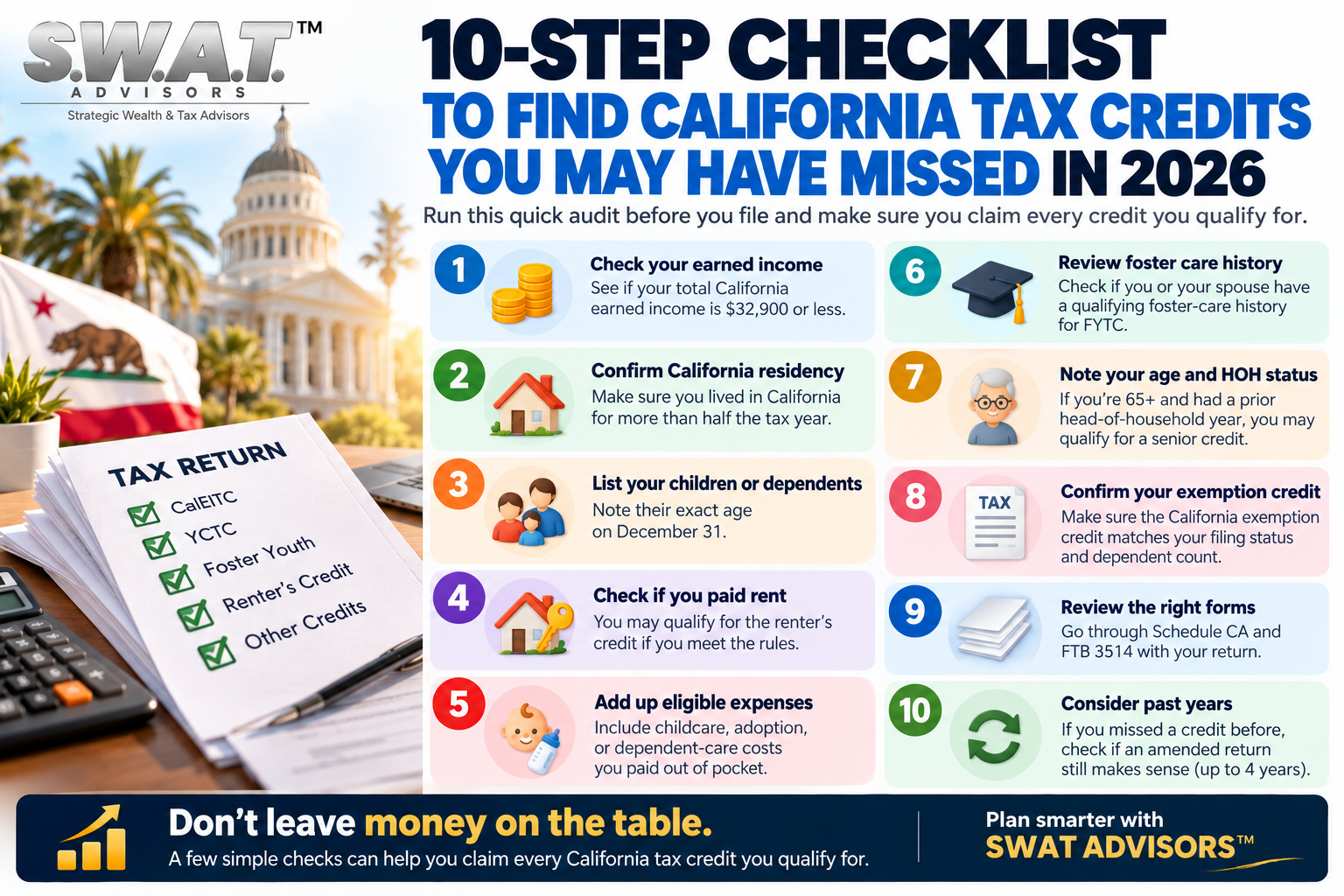
What Is the Fastest Way to Find California Tax Credits You May Have Missed?
Run this five-minute audit before you file, or before you sign off on a return someone else prepared:
- Check your total California earned income against $32,900.
- Confirm how many months you actually lived in California this year.
- List every child or dependent and their exact age on December 31.
- Confirm whether you paid rent for at least half the year.
- Add up childcare, adoption, or dependent-care costs you paid out of pocket.
- Check foster-care history for yourself or your spouse.
- Note your age and any prior head-of-household years tied to a death in the household.
- Confirm your California exemption credit 2026 matches your actual filing status and dependent count.
- Pull up Schedule CA and FTB 3514 side by side with your return.
- If a past return missed a credit, ask whether an amended return still makes sense.
The FTB generally lets you claim a refund for up to four prior tax years by filing or amending a return for a missed earned income tax credit, subject to standard statute-of-limitations rules.
How to Actually Claim These Credits on Form 540 and FTB 3514
- Confirm your filing status and residency months on Form 540 before touching any credit lines.
- Complete FTB 3514 first. This one form calculates CalEITC, YCTC, and FYTC together based on your earned income and qualifying children.
- Transfer the FTB 3514 totals to the matching lines on Form 540, page 2.
- Check the renter’s credit box on Form 540 if you meet the rental and income requirements. No separate schedule needed.
- Attach Schedule CA for adoption costs, joint custody HOH, dependent parent, or senior HOH credits; each has its own worksheet.
- Recheck your AGI against every threshold one more time before you submit. A $50 income swing can knock out the renter’s credit entirely.
- File electronically through FTB-approved software when possible. E-filed CalEITC claims process faster than paper 3514 forms.
What Should You Check Before Filing Your California Return in 2026?
Confirm the tax year you’re actually filing before anything else. FTB thresholds shift every year, and applying last year’s numbers to a 2025 return is one of the most common self-prep mistakes we see.
- Confirm the correct tax year rules apply to your return.
- Check CalEITC eligibility first, since it unlocks YCTC and FYTC.
- Complete the renter’s-credit questions honestly, including the AGI cliff.
- Add up childcare and adoption expenses before assuming you don’t qualify.
- Review foster care, joint custody, or dependent-parent situations.
- Go through Form 540 or 540NR line by line against the FTB instructions.
- Don’t assume a federal credit has an automatic California match.
California doesn’t conform to the federal Child Tax Credit at all. It runs its own Young Child Tax Credit instead, with a smaller dollar figure.
How SWAT Advisors Can Help You Review Your Credit Eligibility
Credits like CalEITC, YCTC, and the California renters credit are worth real money, but they’re one small piece of a much bigger picture. SWAT Advisors builds full tax planning strategies for 2026 for individuals and business owners in California and nationwide, not just a once-a-year credit check.
Here’s how we help:
- We review your full return for missed credits, including CalEITC, YCTC, FYTC, and the California exemption credit amounts most tax software applies incorrectly.
- We build forward-looking California tax planning strategies around capital gains timing under current California capital gains tax brackets, retirement contributions, and business exit decisions.
- We help households navigate California Proposition 19 tax rules, weigh the missing California 529 plan tax deduction against out-of-state 529 options, and plan multi-year tax projections.
We’ve worked with more than 20,000 people on California tax situations, backed by a 99.9% accuracy guarantee. Book a consultation with SWAT Advisors and find out what your return is currently missing.
Conclusion
California’s credit system rewards filers who check every line, not just the ones a tax program flags automatically. CalEITC, YCTC, FYTC, and the California renters credit can combine into thousands of dollars for the same household, and most of that value sits behind a handful of simple eligibility questions.
Filing Form 540 without running FTB 3514 and the miscellaneous credit worksheets equals losing your refund money. The California tax credits 2026 filers actually receive depend on catching every qualifying life event from the past year and matching it to the right line on the return.
Missing a credit once is common. Missing it every year because nobody flagged it is a planning problem, and it’s the kind we solve for a living. Our team at SWAT Advisors reviews your full financial picture, so credits and long-term strategy work together instead of getting handled separately by whoever prepares your taxes each spring.
Contact SWAT Advisors today to schedule a review before you file.
FAQs
No. A childless worker earning under the 2025 income limit can still claim up to $302 through the earned income tax credit.
Yes. Each roommate can claim the full California renter's credit separately if each one independently meets every eligibility requirement.
Yes. CalEITC is fully refundable, so the FTB pays it out even when your California tax liability already sits at zero.
$53,994 AGI for single/MFS filers, $107,987 for MFJ, HOH, or surviving spouse filers, for the 2025 tax year.
Yes. You calculate it using the worksheet tied to your federal Form 2441, then carry the California percentage onto Form 540.