

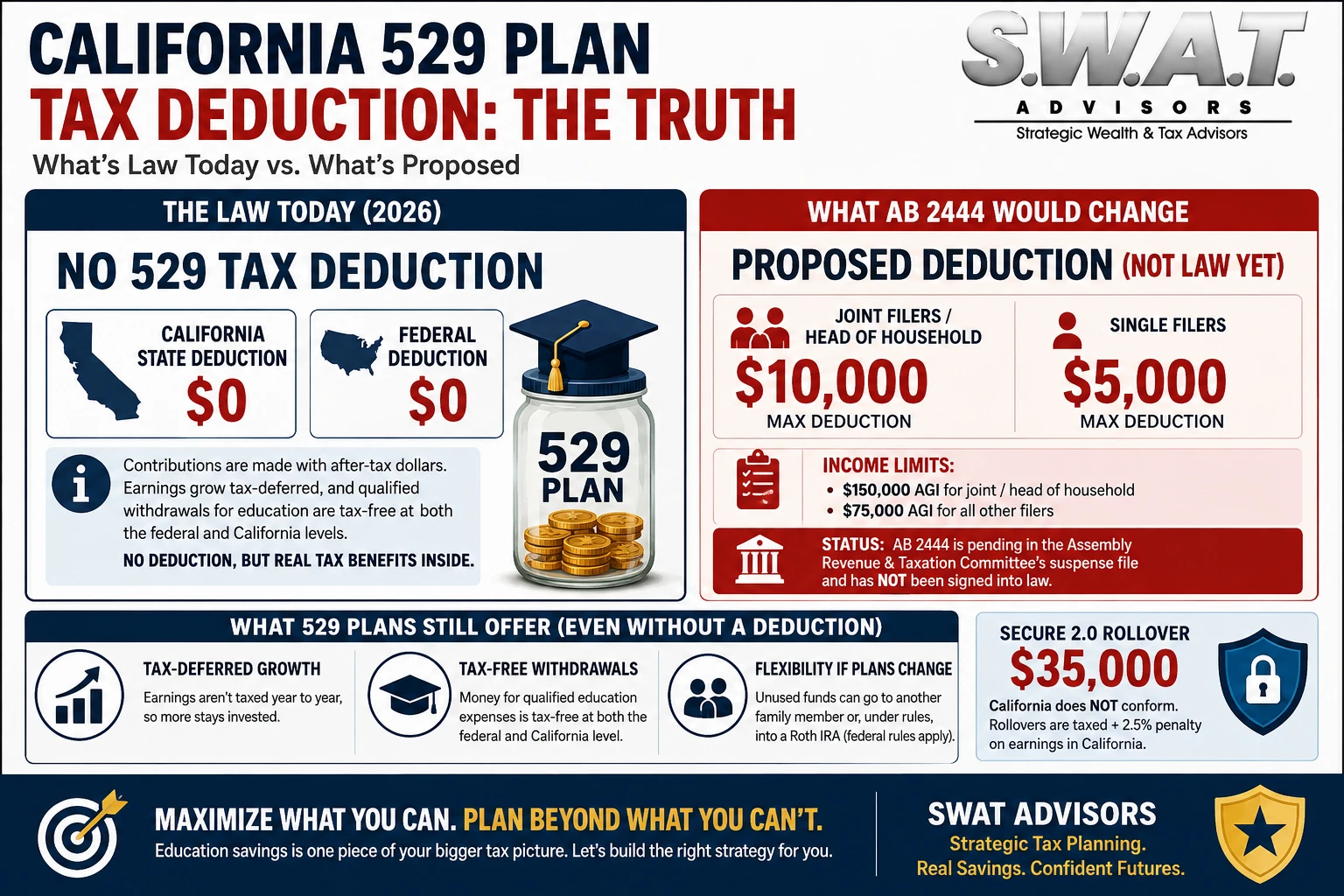
California does not allow a state income tax deduction for contributions to a 529 plan, including ScholarShare 529. A newer bill, AB 2444, proposes a deduction for qualifying ScholarShare contributions, but as of this writing it remains stuck in the Assembly Revenue and Taxation Committee’s suspense file and has not become law.
Here is what the law says today, what AB 2444 would change if it passes, and what to do with your ScholarShare 529 account in the meantime.
Key Takeaways
|
The Short Answer: California Does Not Offer a 529 Tax Deduction
No. California does not currently allow a California 529 plan tax deduction for contributions made to ScholarShare or any other state’s 529 plan. Neither does the federal government.
| Deduction type | Available in 2026? |
| California state deduction for 529 contributions | No |
| Federal deduction for 529 contributions | No |
This applies to every California taxpayer, whether you contribute $50 a month or $10,000 in one lump sum. Contributions come out of after-tax income, the same as putting cash into a regular brokerage account.
Money inside the account grows without being taxed year to year, and withdrawals for qualified education costs, tuition, books, room and board, come out completely tax-free at both the federal and state levels. The growth is tax-deferred while it is in the account, then becomes fully tax-free once you spend it on school.
According to IRS Topic No. 313, contributions made to a qualified tuition program aren’t deductible, but earnings accumulate tax-free while in the account, and distributions aren’t taxable when used for qualified higher education expenses.
Which States Do (and Don’t) Offer a 529 Tax Break
Most states with income tax give residents a California 529 plan state tax deduction-style benefit of their own.
Ten states offer no state income tax deduction for 529 contributions at all: California, Florida, Nevada, New Hampshire, North Carolina, South Dakota, Tennessee, Texas, Washington, and Wyoming. Several of those, like Texas and Florida, don’t tax income in the first place. California, Delaware, Hawaii, Kentucky, Maine, and New Jersey tax income but still offer nothing for 529 savers.
- New York deducts up to $10,000 for joint filers.
- Illinois deducts up to $20,000 for joint filers.
- Colorado and New Mexico allow unlimited deductions.
- Indiana gives a 20% tax credit instead, worth up to $1,500 a year.
- Arizona lets residents deduct contributions to any state’s plan, up to $4,000 joint.
The table below shows where California stands next to a few comparison states.
| State | 529 State Tax Deduction | Notes |
| California | None | No deduction for ScholarShare or out-of-state plans |
| New York | Up to $10,000 joint | Own-state plan only |
| Illinois | Up to $20,000 joint | Own-state plan only |
| Arizona | Up to $4,000 joint | Any state’s plan qualifies |
| Colorado | Unlimited | Own-state plan only |
Roughly 40 states plus D.C. offer some version of a 529 tax break, according to state treasury data compiled across 529 plan trackers. California’s absence from that list isn’t new, and it isn’t an oversight either. Lawmakers have tried to fix it more than once, most recently with AB 2444.
AB 2444: The Proposed California Deduction and Where It Stands
AB 2444, introduced by Assemblymember Michelle Rodriguez on February 20, 2026, would create California’s first-ever deduction for ScholarShare contributions if it becomes law. It has not passed as of this writing, so it changes nothing about your 2026 taxes right now.
The bill would allow a deduction of up to $10,000 for married couples filing jointly or head of household filers, and up to $5,000 for individual filers, for cash contributions to a ScholarShare account. It also caps eligibility by income: $150,000 adjusted gross income for joint or head of household filers, $75,000 for everyone else. The deduction would apply for taxable years beginning January 1, 2026, according to the bill text on file with the California Legislature.
As of the Assembly Revenue and Taxation Committee’s April 27, 2026, hearing, AB 2444 was placed on the committee’s suspense file, meaning it’s held for further review before a vote. A closely related bill, SB 529, carried nearly identical terms (the same 5,000/10,000 caps and income limits) but failed in the Senate Revenue and Taxation Committee and was returned to the Secretary of the Senate on February 2, 2026. That bill is dead for this session.
Assembly Member Ian Calderon introduced a nearly identical bill, AB 211, back in 2019. Governor Newsom vetoed it, citing an estimated $13 million in annual revenue loss relative to the benefit it would provide. That history tells you California has repeatedly weighed this exact tradeoff and repeatedly declined to act on it, which is a stronger signal than any single bill’s current status.
In our practice, we tell clients not to build a savings plan around legislation that hasn’t been signed. We’ve watched three separate versions of this deduction get introduced since 2019, and none have reached the governor’s desk with a signature.
Check the California Legislature’s official bill tracker for AB 2444’s current status before assuming it applies to you. Until it’s signed into law, plan around the rules that exist today.
What California 529 Plans Still Offer Without a Deduction
ScholarShare 529 still delivers real tax value even without a California 529 plan tax deduction. Three things carry the weight here:
- Tax-deferred growth. Investment earnings inside the account aren’t taxed year to year the way dividends and capital gains are in a regular brokerage account.
- Tax-free qualified withdrawals. Money used for tuition, fees, books, supplies, equipment, and room and board for at least half-time students comes out free of both federal and California income tax.
- Flexibility if plans change. Unused funds can move to another family member, or, if certain conditions are met, into a Roth IRA under federal rules.
Under SECURE 2.0, federal law now allows up to $35,000 in lifetime rollovers from a 529 account into the beneficiary’s Roth IRA, tax and penalty-free, once the account has been open at least 15 years.
California has not conformed to that rule. For California taxpayers, that rollover is treated as a non-qualified withdrawal, meaning the earnings portion gets hit with California income tax plus an additional 2.5% state penalty tax, according to ScholarShare 529’s own plan disclosures.
Should You Use ScholarShare or an Out-of-State 529 Plan?
Yes, ScholarShare 529 is still worth using for most California families, even with the 529 plan California tax deduction off the table. Because California doesn’t tie a tax benefit to using its own plan, you’re free to shop for the plan with the lowest fees and strongest investment lineup, in state or out.
ScholarShare 529’s own investment options run below the national average expense ratio for 529 plans, which matters more over an 18-year investment horizon than most people assume. A 0.3% difference in annual fees can cost thousands of dollars in lost growth by the time a child reaches college age.
When an Out-of-State Plan Might Make More Sense
An out-of-state plan makes sense when it offers meaningfully lower fees or a stronger investment menu than ScholarShare, since California gives you no tax reason to stay local. A few scenarios where it’s worth comparing:
- You want access to a specific fund manager or investment strategy ScholarShare doesn’t offer.
- You’ve found a plan with a lower expense ratio for the same target-date fund structure.
- You’re moving to a state that does offer a deduction and plan to relocate before the child reaches college age.
Since California provides no tax parity rule either way, there’s no penalty for choosing an out-of-state plan and no reward for staying with ScholarShare beyond convenience and fee comparison.
How to Still Get a Tax Benefit From College Savings in California
The most reliable 529 plan tax strategy for California residents right now involves using the tools California does offer.
- Front-load contributions using the gift tax exclusion. The 2026 annual gift tax exclusion is $19,000 per beneficiary. A single donor can contribute up to $95,000 in one year (or $190,000 for a married couple) and elect, using IRS Form 709, to spread it over five years for gift tax purposes. This is often called superfunding, and it lets money start compounding years earlier than steady monthly contributions would.
- Use grandparent-owned accounts strategically. Distributions from grandparent-owned 529 accounts no longer count against a student’s financial aid eligibility on the FAFSA, which removes a planning obstacle that used to push families toward parent-owned accounts by default.
- Coordinate with other education savings vehicles. A Coverdell ESA or a custodial brokerage account can complement a 529 depending on the family’s income and the child’s expected education path.
This kind of layered approach is what individual tax planning actually looks like when a single deduction isn’t available.
How This Fits Into Your Broader Tax and Estate Plan
A 529 plan California tax deduction would have been a nice bonus, but college savings rarely exist in isolation from the rest of a family’s finances. The gift tax exclusion strategy above overlaps directly with estate planning, since money moved into a 529 through superfunding is removed from your taxable estate the same way any completed gift would be.
For business owners and high earners, 529 contributions are one piece of a much larger picture that includes retirement account structuring, entity selection, and timing of income recognition.
How SWAT Advisors Helps You
SWAT Advisors builds tax strategies around your full financial picture, not just the accounts that come with an obvious deduction attached. With over 20 years of experience and more than $100 million in documented client tax savings, we look past the missing California 529 plan state tax deduction to find the moves that actually reduce what you owe.
Here’s how we help:
- We run a full tax savings assessment that covers education savings, retirement structuring, and business income together, so a 529 contribution decision doesn’t happen in a vacuum.
- We apply advanced tax planning strategies like pre-sale income structuring and executive retirement plans for business owners and high-net-worth families whose tax exposure goes well beyond a single account.
Every client starts with a risk-free strategy session and no obligation to move forward. Book a consultation with SWAT Advisors to see where your college savings strategy fits into a bigger tax plan.
Conclusion
California offers no California 529 plan tax deduction in 2026, and AB 2444, the bill that would change that, remains pending in committee rather than signed into law. ScholarShare 529 still delivers tax-deferred growth and tax-free qualified withdrawals regardless of that missing deduction, and strategies like superfunding through the gift tax exclusion give California families a real way to accelerate savings without waiting on the Legislature.
SWAT Advisors turns questions like this into a broader 529 plan tax strategy that accounts for your full tax picture. Contact SWAT Advisors to build a plan that works with the tax rules California actually has today.
FAQs
No. California offers zero state income tax deduction for ScholarShare or any other 529 plan contributions in 2026.
No. AB 2444 was still pending in the Assembly Revenue and Taxation Committee's suspense file as of its April 27, 2026 hearing and has not been signed into law.
No. California offers no California 529 plan tax deduction for its own ScholarShare plan or for any out-of-state 529 plan.
Yes. Investment earnings grow tax-deferred and qualified withdrawals are tax-free at both the federal and California level, deduction or not.
Qualified withdrawals for approved education expenses are tax-free. Non-qualified withdrawals owe California income tax on earnings plus an additional 2.5% state penalty tax.






)
&description=&image=https://swatadvisors.com/wp-content/uploads/2026/09/california-529-plan-tax-deduction-img2-1024x683.webp)