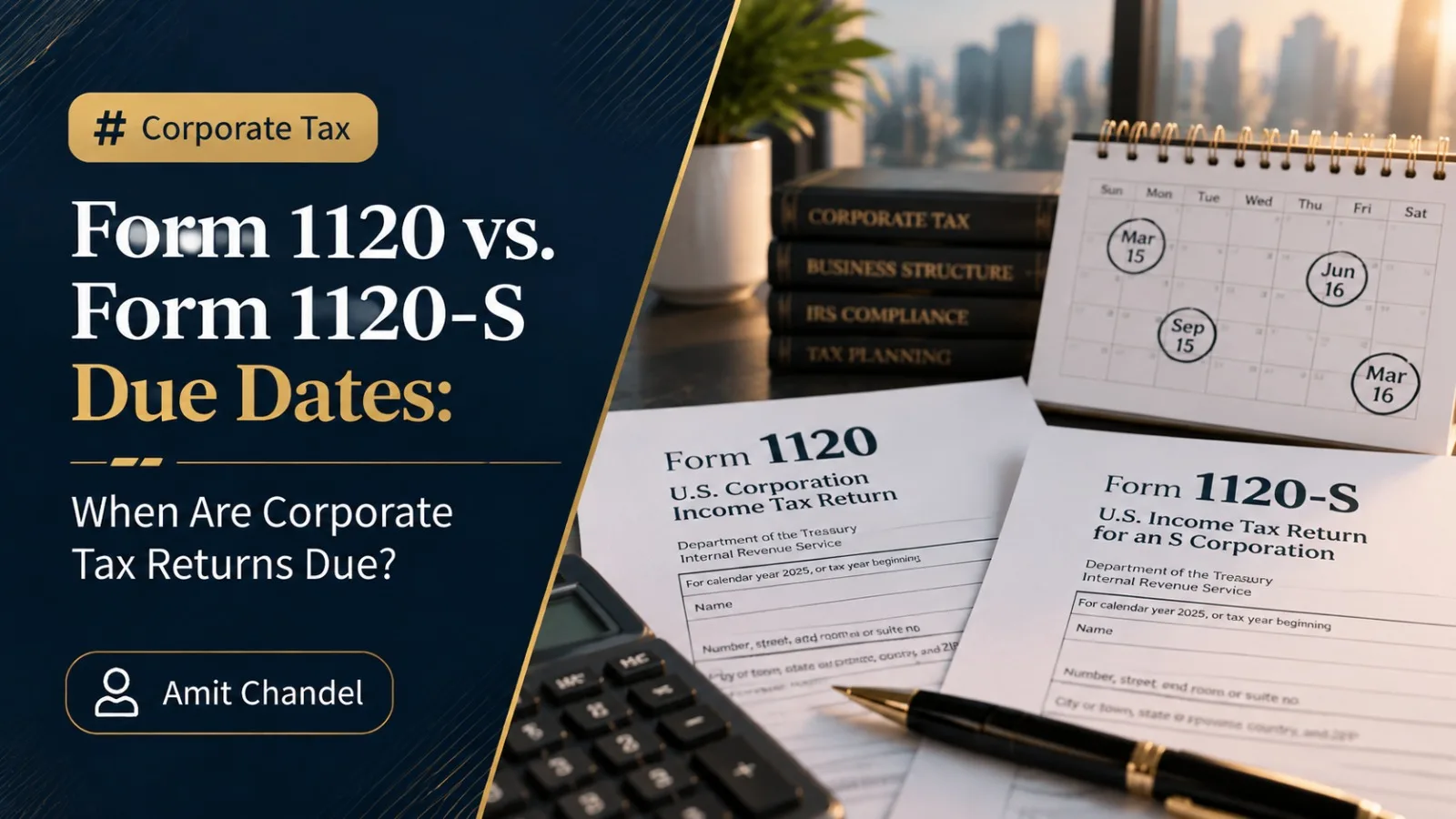
Form 1120-S is due on the 15th day of the third month after your S corporation’s tax year ends. For most calendar-year filers, that lands on March 15, moved to March 16, 2026, because March 15 falls on a Sunday. Form 1120 is due a month later, on the 15th day of the fourth month, which puts calendar-year C corporations at April 15, 2026.
This article breaks down both deadlines, fiscal-year adjustments, Form 7004 extensions, late-filing penalties, corporate estimated tax dates, and where California’s rules diverge from the IRS.
Key Takeaways
- Form 1120-S (calendar year, 2025 tax year): due March 16, 2026; extended deadline September 15, 2026.
- Form 1120 (calendar year, 2025 tax year): due April 15, 2026; extended deadline October 15, 2026.
- Late Form 1120-S penalty: $255 per shareholder, per month, up to 12 months, even with zero tax due.
- Late Form 1120 penalty: 5% of unpaid tax per month, capped at 25%.
- Minimum penalty for a 2026 return filed more than 60 days late: the smaller of the tax due or $525.
- Form 7004 extends your filing deadline by six months. It does not extend your deadline to pay.
Corporate Tax Return Due Dates at a Glance (Form 1120 vs Form 1120-S)
S corporations and C corporations do not share a filing calendar. Form 1120-S falls a full month ahead of Form 1120 for businesses running on a standard calendar year, and the extended deadlines stay a month apart too.
The table below reflects IRS Publication 509 deadlines for calendar-year filers, plus the June 30 fiscal-year exception that still applies to C corporations. Fiscal-year filers should recalculate their own dates using the rules in the next section rather than borrowing the calendar-year figures above.
| Filing Requirement | Tax Form | Standard Due Date (2025 Tax Year) | Extended Due Date |
| S Corporation | Form 1120-S | March 16, 2026 | September 15, 2026 |
| C Corporation | Form 1120 | April 15, 2026 | October 15, 2026 |
| C Corporation, fiscal year ending June 30 | Form 1120 | September 15, 2025 | April 15, 2026 |
When Are 1120-S Tax Returns Due?
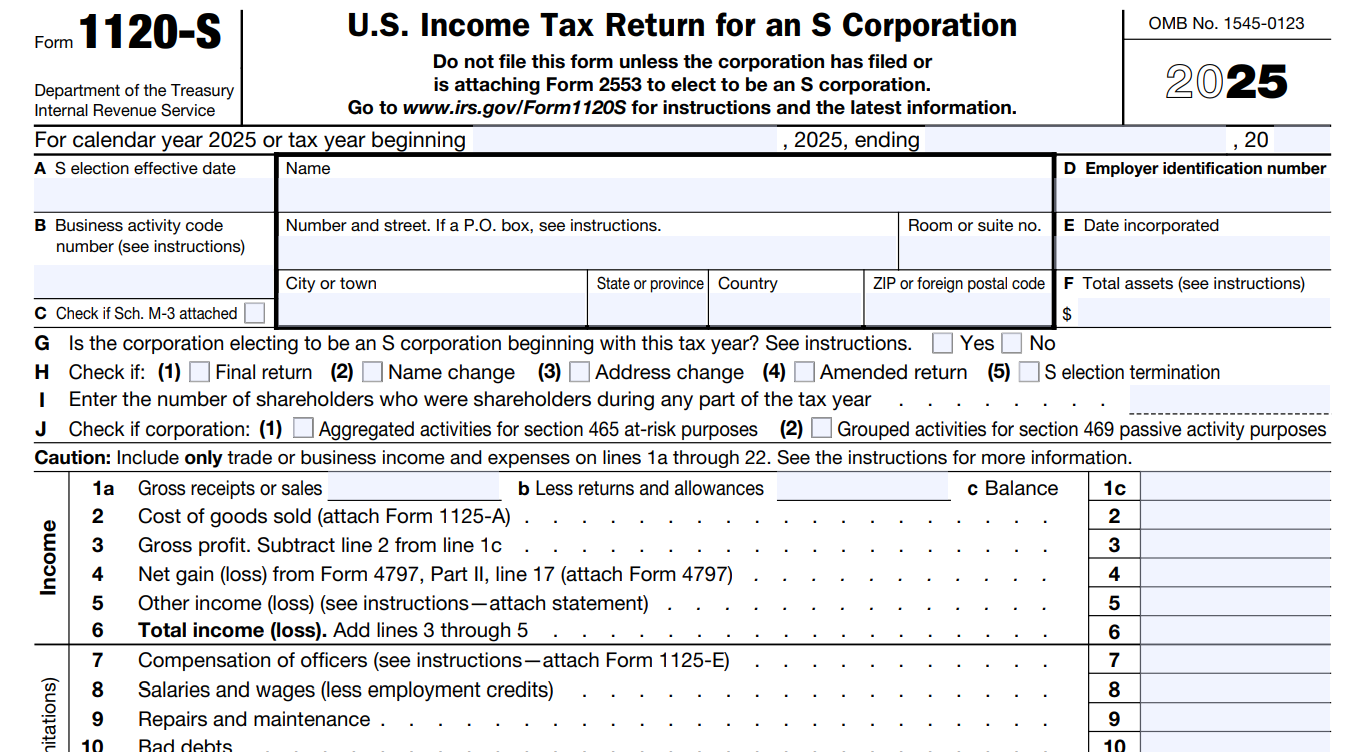
Your 1120s tax return due date is the 15th day of the third month after your tax year closes. For a calendar-year S corporation, that is March 15, shifted to March 16, 2026, because March 15 falls on a Sunday, per the IRS Instructions for Form 1120-S.
This rule applies to every domestic S corporation with a valid election under Section 1362, whether the business turned a profit or lost money all year.
In our practice, the mistake we see most often is business owners treating the S corp deadline like the personal filing deadline. It isn’t.
Shareholders need their Schedule K-1s by this date, not April 15, so they have enough time to prepare their own returns.
When Is the Form 1120 Corporate Tax Return Due?
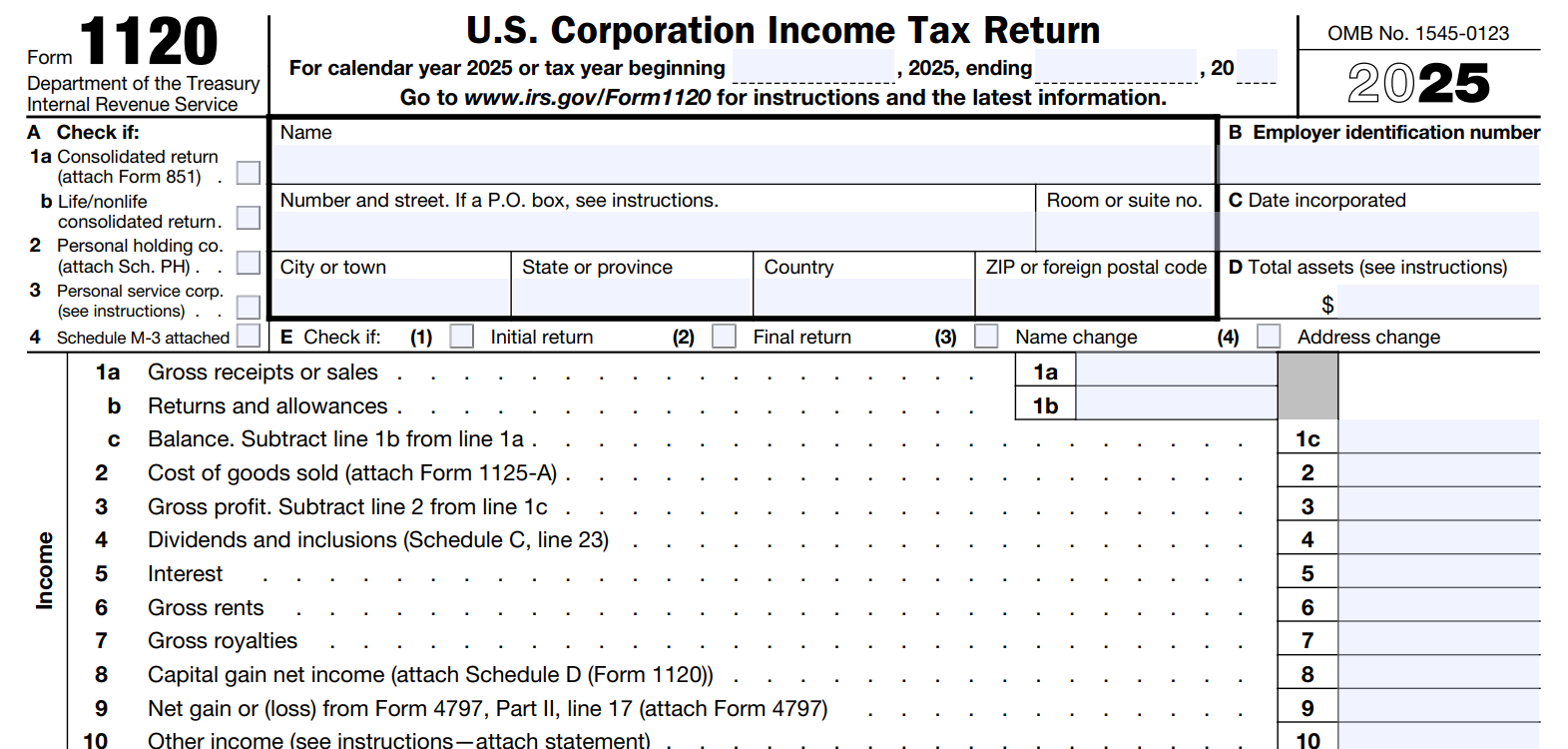
The 1120 corporate tax return due date is the 15th day of the fourth month after the tax year ends. For a calendar-year C corporation, that is April 15, 2026, for the 2025 tax year, per IRS Publication 509.
A C corporation does not distribute Schedule K-1s because it pays its own tax at the entity level, currently a flat 21% federal rate, before any dividend reaches a shareholder.
Why S Corporations File a Full Month Before C Corporations
S corporations file first because their income, deductions, and credits pass through directly to shareholders, who need those Schedule K-1 numbers before they can file their own personal returns by April 15. C corporations file later because the corporation itself carries the tax liability, so there is no downstream filer waiting on the figures.
This staggered calendar reflects how S-Corp or LLC tax treatment fundamentally differs from C-Corp taxation. Pass-through entities exist to move income onto individual returns quickly; C corporations exist to keep the tax liability at the entity level, so Congress built in the extra month.
Form 1120 or Form 1120-S: Which One Does Your Business Actually File?
You file Form 1120-S if your business has a valid S corporation election on record with the IRS through an accepted Form 2553. You file Form 1120 if you are a standard C corporation, or an LLC that elected corporate taxation without also filing for S status.
A Form 1120 S-corp election is the choice to have your corporation’s income, deductions, and credits pass through to shareholders instead of being taxed at the entity level first.
File Form 1120-S if: your Form 2553 was filed and accepted, you have 100 or fewer shareholders, and every shareholder is a US individual, a qualifying trust, or an estate.
File Form 1120 if: you never filed an S election, you have more than one class of stock, or you have a corporate or foreign shareholder, any of which disqualifies S status.
Choosing LLC classification with the state does not grant S status on its own; the federal election is a distinct step with its own deadline.
Fiscal-Year Filers: How to Work Out Your Own Due Date
If your tax year does not end on December 31, apply the same day-count rule to your own year-end date. Form 1120-S is due the 15th day of the third month after your fiscal year closes. Form 1120 is due the 15th day of the fourth month, with one notable exception.
| Fiscal Year End | Form 1120-S Due Date | Form 1120 Due Date |
| June 30 | September 15 | September 15 (exception; not October 15) |
| September 30 | December 15 | January 15 |
| March 31 | June 15 | July 15 |
The table above shows why a June 30 fiscal year-end is the one case where Form 1120 follows the same three-month rule as Form 1120-S, instead of the standard four-month rule, per IRS Publication 509.
Confirm this exception against the current-year Publication 509 rather than assuming it carries forward indefinitely; Congress has adjusted the June 30 rule before, and a filer relying on last year’s tax form 1120s calendar for a fiscal-year C corp could miss a shifted date.
Extensions: What Form 7004 Buys You, and What It Doesn’t
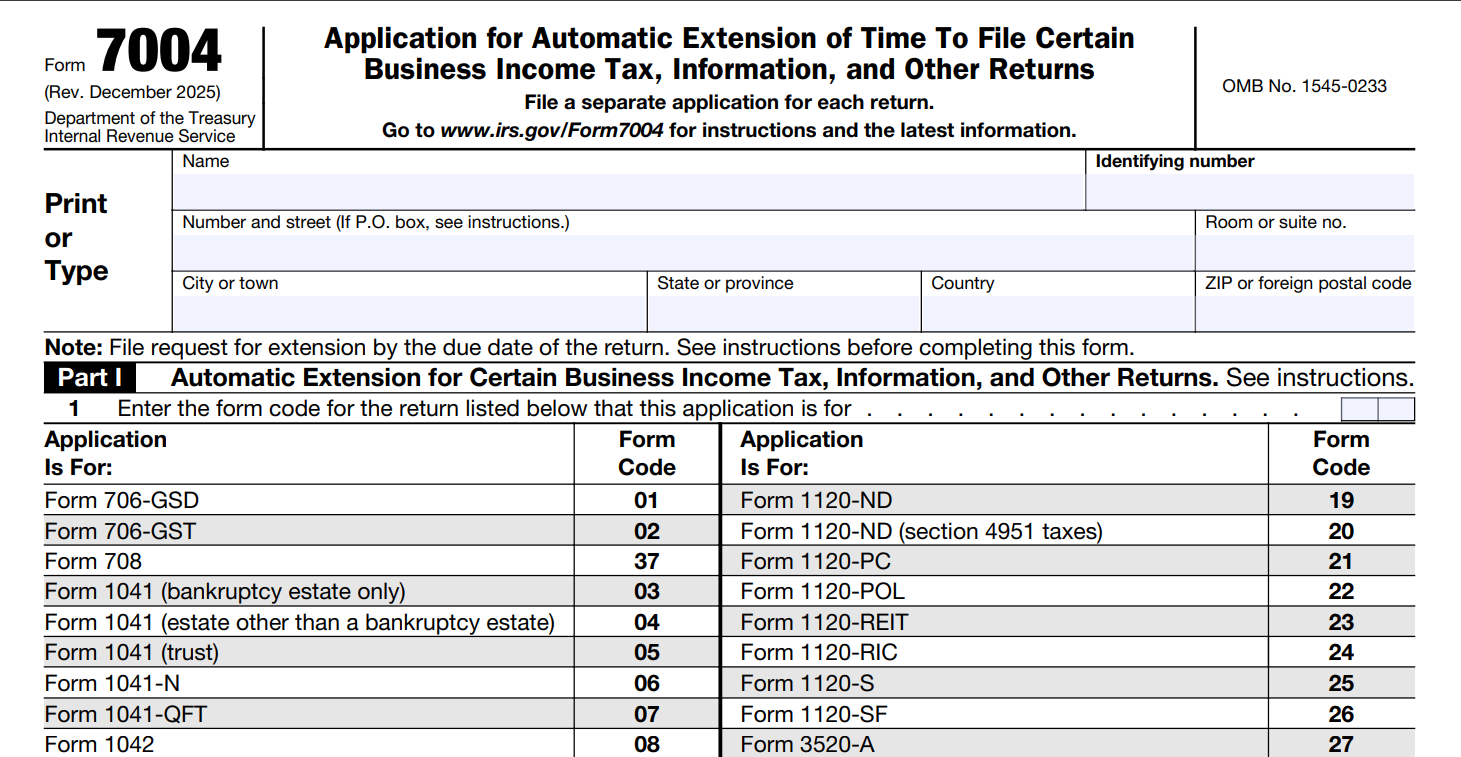
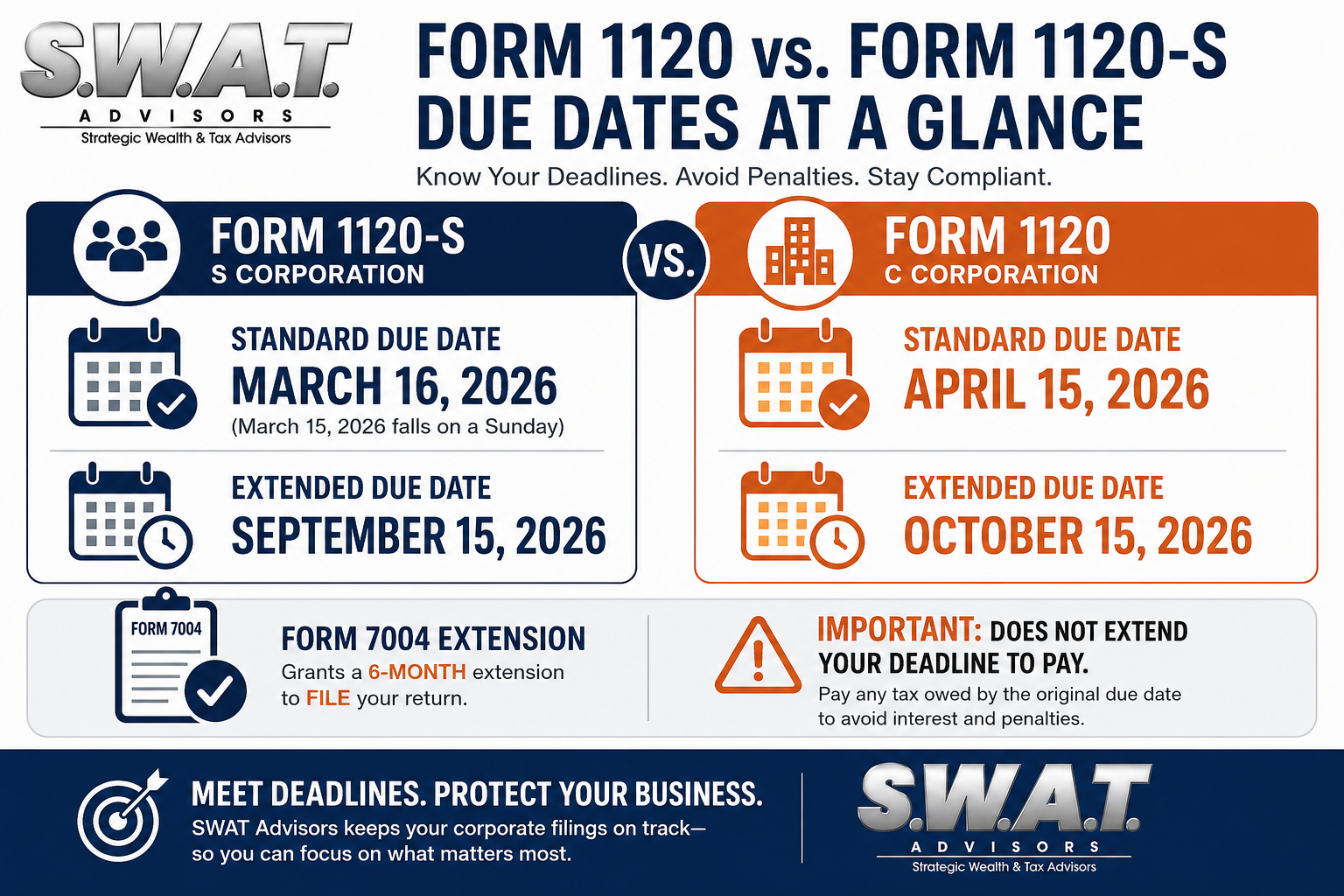
Form 7004 gives you an automatic six-month extension to file Form 1120 or Form 1120-S. It does not extend your deadline to pay any tax owed, which is the single most misunderstood part of the form.
File Form 7004 by your original due date: March 16, 2026, for calendar-year Form 1120-S filers, and April 15, 2026, for calendar-year Form 1120 filers. Approval pushes your paperwork deadline to September 15, 2026, and October 15, 2026, respectively. You still need to pay estimated taxes owed by the original date, because interest and the failure-to-pay penalty begin accruing the day after that date regardless of the extension.
Penalties for Filing Form 1120-S or Form 1120 Late
Late Form 1120-S returns cost $255 per shareholder for each month or part of a month the return is late, up to 12 months, per the current IRS Instructions for Form 1120-S. Late Form 1120 returns cost 5% of the unpaid tax for each month or part of a month, capped at 25%.
The table below shows why a multi-shareholder S corporation can face a steeper flat-dollar penalty than a C corp with a modest unpaid balance, even though the C corp’s percentage-based penalty sounds larger on paper.
| Form | Penalty Structure | Example |
| Form 1120-S | $255 × number of shareholders × months late (max 12 months) | 3 shareholders, 4 months late = $3,060 |
| Form 1120 | 5% of unpaid tax per month (max 25%) | $50,000 owed, 3 months late = $7,500 |
If either return is more than 60 days late, the 2026 minimum penalty is the smaller of the tax due or $525, per IRS Publication 509 and the current Form 1120 instructions.
One of the most expensive common tax filing mistakes we come across is a dormant S corp skipping its return because it had zero income for the year. The $255-per-shareholder penalty still applies in full. Filing Form 1120-S is mandatory for every year the S election stays active, income or no income.
Corporate Estimated Tax Payments Run on a Different Calendar
C corporations that expect to owe $500 or more in federal income tax must pay quarterly estimated taxes on April 15, June 15, September 15, and December 15 for a calendar-year business.
S corporations generally skip entity-level estimated payments, since income passes through to shareholders, who track their own estimated tax deadlines individually on their personal returns.
The exception: S corporations that owe tax on built-in gains or excess passive income still make entity-level estimated payments on that same quarterly schedule. Coordinating those corporate dates with your own personal estimated payments is one of the more overlooked tax planning strategies for business owners who split income between a corporation and a Schedule K-1.
State Filing Deadlines Do Not Always Match the IRS
State corporate deadlines often mirror federal dates, but the tax rate, minimum tax, and rules underneath them can differ sharply.
California S Corp and C Corp Filing Rules
California Form 100S, the state’s S corporation return, is due March 15, matching the federal Form 1120-S deadline, and shifts to March 16, 2026, for the same weekend reason. California Form 100, the C corporation return, is due April 15, 2026, matching Form 1120.
The table below, sourced from the California Franchise Tax Board, shows that California charges an $800 minimum franchise tax regardless of profit, a floor the IRS does not impose at the federal level.
| Entity | California Form | Due Date (2025 Tax Year) | Minimum Tax |
| S Corporation | Form 100S | March 16, 2026 | Greater of $800 or 1.5% of net income |
| C Corporation | Form 100 | April 15, 2026 | Greater of $800 or 8.84% of net income |
California grants an automatic extension to file, not to pay. The $800 minimum and any additional tax owed are still due by the original March or April date. First-year California corporations are exempt from the $800 minimum under California Revenue and Taxation Code Section 23153.
The Deadlines Around the Return That Catch Business Owners Out
The tax return itself is not the only date that matters. Several related deadlines trip up business owners more often than the main filing date does.
Form 2553 (S election): due within 2 months and 15 days of the start of the tax year you want it to apply to; for an existing calendar-year business, that is March 15.
Schedule K-1 distribution: due to shareholders by the same date as Form 1120-S, extensions included.
Form 7004: must be filed on or before the original due date, not after it has passed.
Late S election relief under Rev. Proc. 2013-30: available within 3 years and 75 days of your intended effective date, with a signed reasonable cause statement attached.
Every plan to reduce business tax liability through S corp status depends on getting that election filed on time. Miss it, and the IRS taxes you as a C corporation for the entire year you intended to operate as an S corporation; no exceptions without a successful late-election request.
How SWAT Advisors Can Help You File On Time and Pay Less
Missing an 1120 corporate tax return due date or an 1120s tax return due date is rarely about not knowing the rule. It usually comes down to not having a system that tracks it across multiple entities, elections, and states at once. SWAT Advisors builds that system for business owners who would rather run their company than track IRS calendars by hand.
We track your Form 1120 or Form 1120-S deadline, your Form 7004 extension window, and your state deadline on one calendar, so nothing slips through.
We review whether your Form 1120-S election still fits your current income, since the right entity choice shifts as a business grows.
We coordinate your corporate due dates with your personal estimated tax deadlines, so you are not scrambling on two fronts in the same month.
We handle late-filing situations, including Form 2553 relief requests filed under Rev. Proc. 2013-30, when a deadline has already been missed.
We have helped business owners recover from missed elections and stacked penalties, and we would rather help you avoid them altogether.
Conclusion
Form 1120-S is due the 15th day of the third month after your tax year ends, and Form 1120 is due one month later, on the 15th day of the fourth month. For calendar-year filers, that means March 16, 2026, for S corporations and April 15, 2026, for C corporations, with Form 7004 buying six additional months to file, not to pay.
Confirm your entity’s election status, mark both the federal and state versions of your deadline, and treat the extended date as a filing tool only, never a payment grace period. SWAT Advisors turns this calendar into a managed part of your ongoing tax strategy instead of a recurring, stressful scramble every March and April. Book a consultation with SWAT Advisors and put your corporate filing calendar on autopilot before the next deadline arrives.
FAQs
Do I still have to file Form 1120-S if my S corp made no money this year?
Yes. The IRS requires Form 1120-S every year an S election stays active, regardless of income. Skipping it still triggers the $255-per-shareholder penalty.
I filed Form 7004 for my S corp. What is my new deadline?
September 15, 2026, for a calendar-year S corp extending its 2025 return. Form 7004 adds six months to your 1120s tax returns due date, not to your payment deadline.
Can I file Form 1120-S if I never filed Form 2553?
No. Without an accepted Form 2553 on record, the IRS does not recognize a Form 1120 S corp election, so you must file Form 1120 instead.
What happens if I file Form 1120 when I should have filed Form 1120-S?
The IRS processes it as a C corporation return, taxing income at the entity level and voiding pass-through treatment until you correct the election on file.
Does my S corporation pay federal income tax on Form 1120-S?
Generally, no. Income passes through to shareholders, who report it on personal returns; the S corporation itself owes federal income tax only on limited items like built-in gains.