
California’s retirement mandate requires eligible employers to offer a qualifying retirement plan or facilitate access to CalSavers, the state’s payroll-deduction IRA program. As of January 1, 2026, the mandatory retirement plan in California reaches nearly every eligible employer with one or more employees.
CalSavers is not a plan the employer owns or manages. It is an IRA-based, payroll deduction savings program that belongs to the employee, and the employer’s only job is to set it up and keep it running.
Key Takeaways
|
Does California Require Every Employer To Provide A Retirement Plan in 2026?
No. California does not force every business to sponsor its own retirement plan. California state law requires an eligible employer to either sponsor a qualifying plan or facilitate CalSavers so employees can save through payroll deduction. This distinction matters because so many employers assume the California mandatory retirement plan means setting up a 401(k), when in most cases it does not.
What California’s Retirement Mandate Actually Requires From An Employer
An employer covered by the mandate can sponsor a qualified employer retirement plan, or it can register with CalSavers and let the state run the program. CalSavers becomes the default compliance route the moment an employer has no qualifying plan of its own.
- The employer is not required to make matching or employer contributions to CalSavers.
- CalSavers accounts belong to the employee, not the business.
- The employer’s obligation is limited to registration, roster maintenance, and payroll deduction.
- Once registered, the employer never touches investment decisions or account management.
Why Calling CalSavers a “Mandatory Retirement Plan” Can Be Misleading
The employer’s obligation to facilitate CalSavers is mandatory. Employee participation is not. Every eligible employee can opt out at any time, and opting out does not remove the employer’s duty to keep offering access to the program.
A business owner might think that once staff decline, the compliance job is finished. It is not. The employer must still maintain the roster, add new hires, and reopen enrollment during required periods, regardless of how many employees actually participate.
Which California Employers Are Required To Comply With CalSavers?
Any eligible employer with an average of one or more California employees during the prior calendar year and no qualifying retirement plan must comply. Eligibility is no longer tied to the old five-employee threshold that many business owners still remember.
The 2026 One-Employee Threshold and What Changed
Senate Bill 1126, signed in August 2022, expanded the definition of “eligible employer” from businesses with five or more employees to businesses with as few as one employee.
The table below shows how the mandate rolled out in stages before reaching its final form. Once the 1-4 employee tier hit its December 31, 2025 deadline, the phase-in was complete. From 2026 forward, the mandatory retirement plan California rule is no longer best described as a “five or more” policy. It is a one-employee policy, and newly formed businesses become mandated the first year they report an eligible employee to the EDD.
| Employer Size | Registration Deadline |
| 100+ employees | September 30, 2020 |
| 50+ employees | June 30, 2021 |
| 5+ employees | June 30, 2022 |
| 1 to 4 employees | December 31, 2025 |
How Does California Determine the Employer’s Employee Count?
Eligibility is based on the average number of employees reported to the Employment Development Department on the employer’s four quarterly DE 9C filings from the previous calendar year. A business that had three employees in January but one by December still gets measured on the full year’s average, not a single snapshot.
Do not just count heads walking through the door this morning. A seasonal spike or a temporary dip in staffing from a year ago can still trigger, or exempt, this year’s mandate.
Which Businesses Are Outside the Mandate?
Several categories fall outside CalSavers entirely:
- Businesses that employ only their owners, with no other staff.
- Sole proprietorships or self-employed individuals with no employees.
- Government entities, religious organizations, and tribal organizations.
- Employers already sponsoring a qualifying retirement plan.
Which Retirement Plans Exempt A California Employer From CalSavers?
An employer sponsoring any IRS-recognized qualified plan is exempt from CalSavers registration, though the exemption must still be reported on the CalSavers portal. Simply having a plan on paper is not enough; the exemption has to be filed.
Qualifying Plans That Can Satisfy the Employer’s Obligation
CalSavers regulations recognize the following as qualifying plans:
- 401(k) plans, including multiple employer and pooled employer plans
- 401(a) qualified plans, including profit sharing and defined benefit plans
- 403(a) or 403(b) tax-sheltered annuity plans
- 408(k) Simplified Employee Pension (SEP) plans
- 408(p) SIMPLE IRA plans
- Qualifying automatic enrollment payroll deduction IRA arrangements
This list matters when a business is choosing the right retirement plan for its size and budget. A solo-owner LLC that later hires its first employee, for example, may already be covered if it maintains a SEP or Solo 401(k).
If you are unsure whether your current plan qualifies, consult a retirement planning advisor before assuming you are exempt. The CalSavers team also has a Client Services line that can confirm your status.
What Does a California Employer Actually Have To Do After Registering For CalSavers?
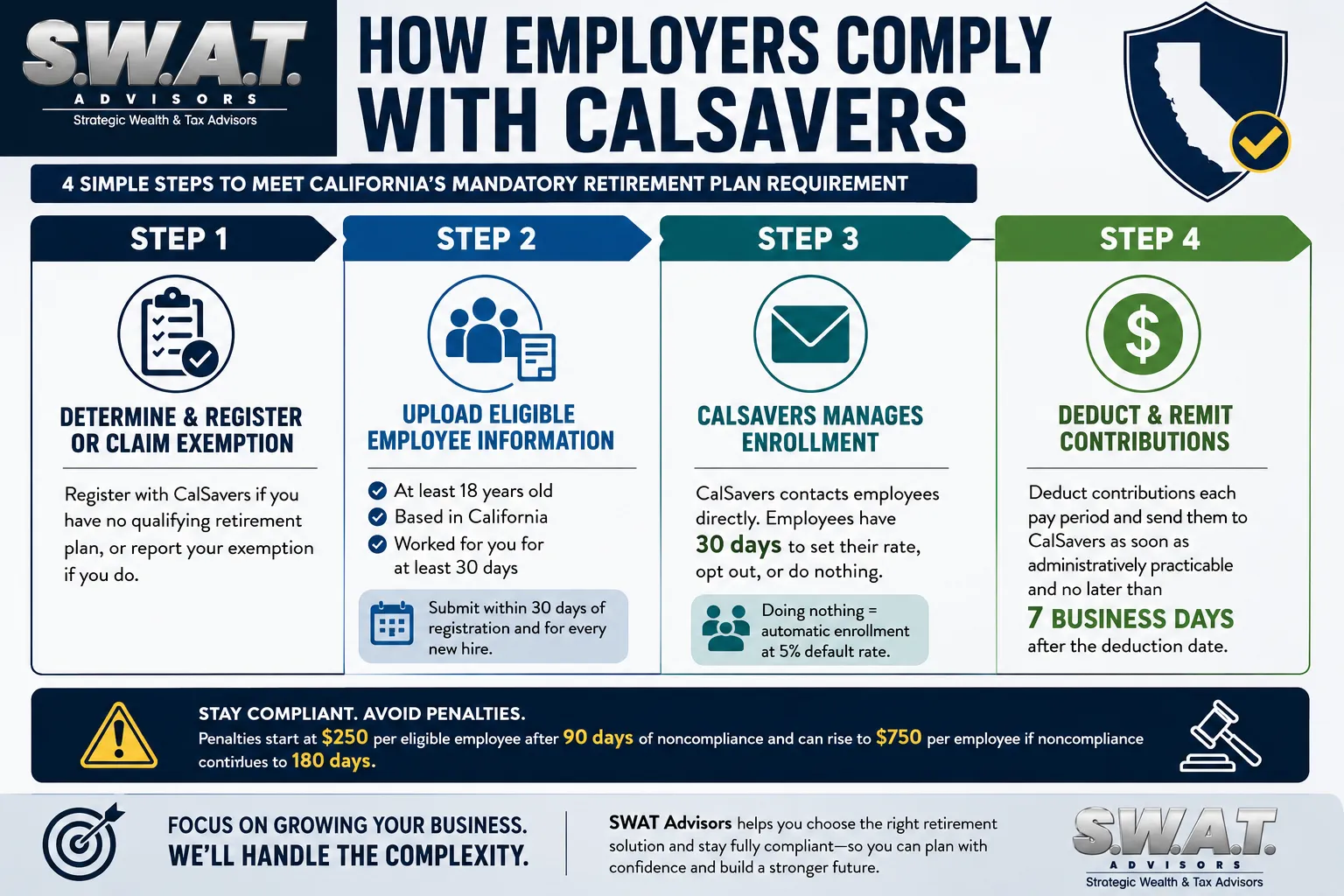
Registration is only the first of four steps. The employer must also upload employee data, let CalSavers manage enrollment, and remit contributions on a fixed schedule.
Step 1: Determine Whether The Business Must Register Or Can Claim An Exemption
If you have no qualifying retirement plan, the business registers and facilitates CalSavers. A qualifying plan means the business documents and reports its exemption instead. The CalSavers portal requires the employer’s EIN or TIN, California payroll tax account number, and the access code mailed by the program.
Step 2: Upload Eligible Employee Information Within 30 Days
An employee must meet all three criteria below to qualify:
- Must be at least 18 years old
- Must be based in California
- Must have worked for you for at least 30 days
Eligible employees get auto-enrolled at a 5% default savings rate into a Roth IRA. That rate goes up by 1% each year until it reaches 8%, unless the employee sets a different rate themselves.
Within 30 days of registration, the employer must submit the eligible employee roster: full legal name, Social Security or ITIN number, date of birth, physical address, and available phone or email contact. Any new eligible employee hired afterward must be added within 30 days of the hire date, with no exception for part-time or short-term status.
Step 3: Let CalSavers Handle The Employee Enrollment Process
CalSavers, not the employer, contacts each employee directly. The employee then has a 30-day window to customize contributions, opt out entirely, or do nothing. Doing nothing results in automatic enrollment at the program’s default 5% contribution rate.
Step 4: Deduct and Remit Contributions Correctly
Once the 30-day decision window closes, the employer’s payroll system must begin deducting contributions each pay period. Under California Code of Regulations, Title 10, Section 10003, withheld compensation must reach CalSavers as soon as administratively practicable and no later than seven business days after the deduction date.
What Are CalSavers Employers Allowed To Do, And What Are They Prohibited From Doing?
Employers must stay completely neutral about employee participation. State regulations bar participating employers from certain actions:
- Encouraging participation
- Discouraging participation
- Requiring participation
- Telling employees how much to contribute
- Recommending investments
- Providing investment or tax advice
CalSavers is not employer-sponsored, which means the business carries no fiduciary responsibility and no liability for how an employee’s account performs. The employer’s role stops at facilitation. Answering an employee’s investment question, even with good intentions, blurs a line the regulations were written to keep clear.
Employer Responsibilities (Ongoing)
Whether you use CalSavers or a private plan, ongoing compliance duties do not disappear after setup.
For CalSavers:
- Update your employee roster within 30 days of any hire or departure
- Process payroll deductions accurately each pay period
- Handle opt-out and opt-back-in requests correctly
- Respond to CalSavers compliance notices within the deadline
For a private plan:
- File Form 5500 annually with the IRS (required for most plans)
- Fulfill fiduciary duties and investment oversight
- Conduct plan audits if plan assets exceed certain thresholds
What Happens If Employees Opt Out Of CalSavers?
The employer’s obligation continues. Opt-outs by current staff do not end the requirement to maintain the CalSavers roster, add new hires, or reopen enrollment during scheduled periods.
Employees who opt out can opt back in at any point, and CalSavers periodically reopens enrollment for employees who previously declined. If every current employee has opted out, the employer still has to keep the account active and add any future eligible hire within the standard 30-day window.
What Are The Penalties For Failing To Comply With California’s Retirement Mandate?
Penalties escalate in two stages under California Government Code Section 100033(b). An employer that fails to comply without good cause faces a $250 penalty per eligible employee once noncompliance passes 90 days after a formal notice.
How the CalSavers Penalty Is Calculated
- $250 per eligible employee once noncompliance reaches 90 days after notice.
- An additional $500 per eligible employee if noncompliance continues to 180 days after notice.
- Employers can be penalized for incomplete compliance too, including failing to upload employee data or failing to submit contributions on time, not just for skipping registration entirely.
What Should An Employer Do After Missing A Deadline?
- Determine immediately whether the business must register or qualifies for exemption.
- Register right away if required.
- Upload the employee roster in full.
- Correct payroll deduction setup before the next pay cycle.
- Keep records of every registration and compliance step taken.
- Respond to any penalty notice through the process outlined by the Franchise Tax Board.
Is CalSavers Actually The Best Compliance Solution For A California Small Business?
For many small employers, yes, simply because it requires almost no ongoing administrative lift. But the right answer depends on what the business wants beyond bare compliance. CalSavers is the simpler compliance route when
- No employer contribution requirement
- No employer fee for facilitating the program
- Minimal administrative role limited to roster and payroll
- No fiduciary responsibility for investment outcomes
- Full portability, since the employee owns the IRA
How To Stay Ahead of Retirement Plan Compliance in California
California has expanded mandatory requirements for retirement plan coverage over time and will likely continue to do so.
Here is what proactive employers do year-round:
- Audit your headcount every January: If you crossed the 5-employee threshold, confirm your registration status.
- Track plan changes immediately: If you switch, pause, or terminate a private retirement plan, note your new CalSavers registration deadline.
- Work with a retirement planning advisor: An advisor can confirm your exemption status and flag whether a private plan offers better tax planning for retirement benefits for your business size.
- Build your retirement planning strategy before a deadline: Last-minute compliance always costs more, in time and sometimes in penalties.
- Set quarterly roster reminders: Employee turnover is the top reason CalSavers compliance slips.
How SWAT Advisors Helps You Navigate California’s Retirement Plan Mandate
Sorting out whether a business needs to register for CalSavers, qualifies for an exemption, or would be better served by sponsoring its own plan is not easy, especially once payroll structure, contractor classification, and multi-entity ownership get involved. SWAT Advisors works through that determination with business owners directly, using real employee data instead of guesswork, so the compliance decision holds up if it is ever questioned.
- We review payroll filings to confirm actual employee count and mandate status rather than relying on assumptions.
- We help business owners weigh CalSavers against sponsoring a 401(k), SEP, or SIMPLE IRA based on the owner’s tax situation and long-term goals.
- We build retirement plan design into a broader tax and exit planning strategy, not as an isolated compliance task.
- We handle the exemption filing and documentation so the business has a paper trail if compliance is ever reviewed.
Book a consultation with SWAT Advisors to work through your CalSavers status and find the retirement plan structure that actually fits your business.
Conclusion
California’s retirement mandate no longer applies only to larger employers. With the phase-in complete as of 2026, any business with a single eligible employee and no qualifying plan must register for CalSavers or document an exemption. The mandatory retirement plan in the California framework allows employers to sponsor a qualified plan such as a 401(k), SEP, or SIMPLE IRA, or facilitate CalSavers with minimal administrative burden and no fiduciary exposure.
SWAT Advisors help California business owners confirm their mandate status, choose between CalSavers and a self-sponsored plan, and build that decision into a broader wealth strategy. Our team handles the documentation and filing so you are not guessing at compliance. Contact SWAT Advisors to schedule your consultation.
FAQs
No. The California mandatory retirement plan applies to private-sector employers with at least one employee who do not sponsor a qualifying plan. Federal employers, sole proprietors with zero W-2 employees, and businesses with an active 401(k) plan, SIMPLE IRA, or pension are fully exempt, provided the plan is currently maintained.
Yes. An active, IRS-qualified 401(k) plan fully exempts you from CalSavers. It must be currently maintained, not lapsed. A 401(k) also allows employer matching, which CalSavers prohibits, making it a stronger benefit for employee retention and recruiting.
No. Employees opt out within 30 days of auto-enrollment, or at any point after. They can re-enroll anytime they want. CalSavers runs an automatic annual re-enrollment for past opt-outs, but employees who opt out again are not forced back in.
The mandatory retirement plan in California carries a $250 per eligible employee penalty after 90 days of notice and $500 per employee after 180 days. CalSavers sends written notices first. You get a window to fix it. A 15-employee business that misses both deadlines owes $7,500 in penalties, minimum.
You are exempt from the California mandatory retirement plan only if you actively maintain an IRS-qualified plan right now, such as a 401(k) plan, SIMPLE IRA, SEP-IRA, or pension. Verify your status directly at employer.calsavers.com or call the CalSavers Client Services line before assuming exemption.