

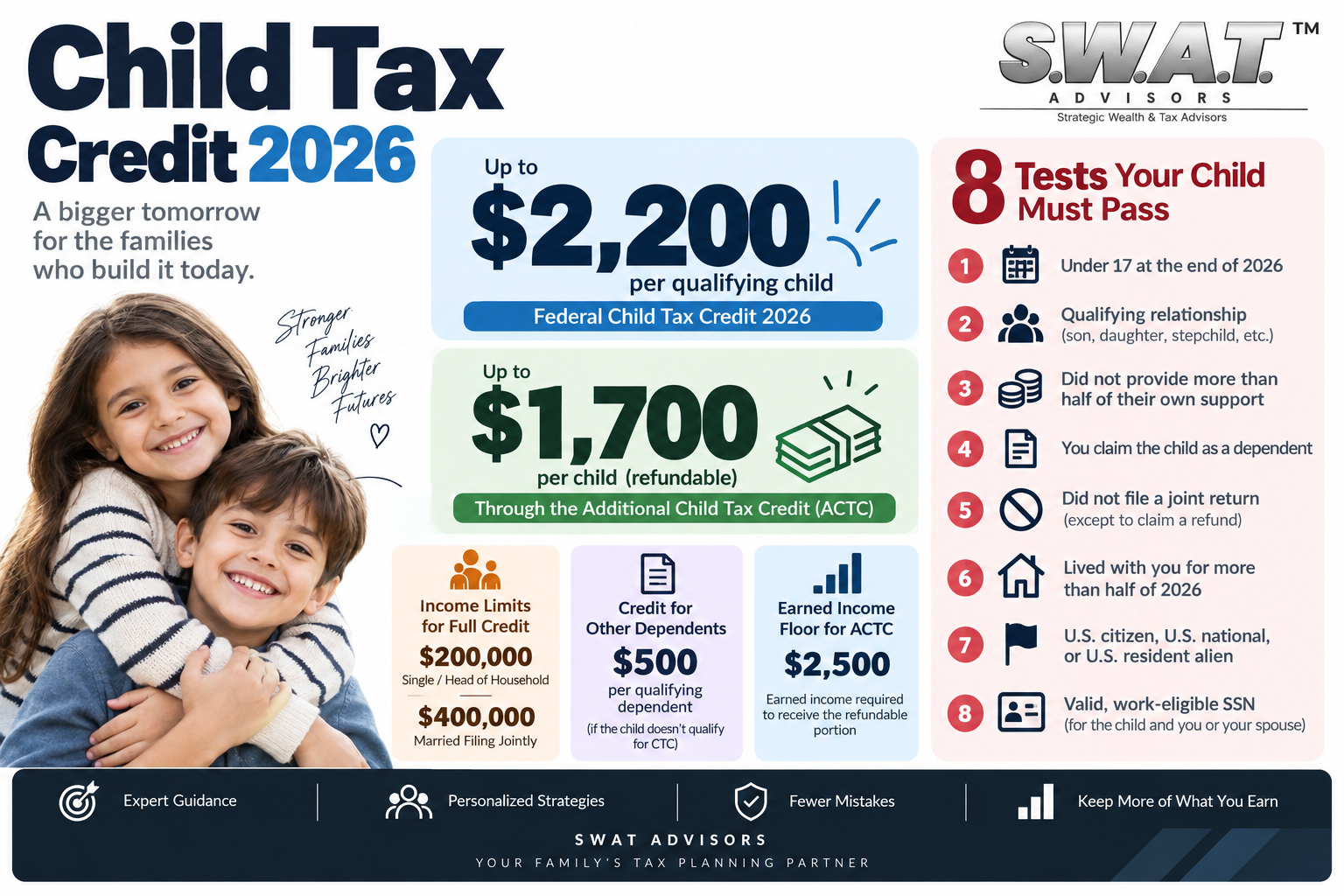
The federal child tax credit for 2026 is worth up to $2,200 per qualifying child, with as much as $1,700 of that refundable through the Additional Child Tax Credit (ACTC). Congress locked $1,700 permanently through the One Big Beautiful Bill Act (OBBBA), so the 2026 child tax credit amount will not revert to the old $1,000 cap that was scheduled to take effect this year.
This guide covers the exact CTC 2026 dollar amounts, the eight tests your child must pass, the income limits that shrink the credit, how the refundable ACTC portion is calculated, and the exact IRS forms you need to file your federal tax return correctly.
Key Takeaways
|
What Is the Child Tax Credit and How Does It Work?
The child tax credit is a federal tax break that lowers what you owe the IRS for each child under 17 who lives with you and depends on you financially. It works in two layers.
- First, it reduces your tax bill dollar for dollar, up to $2,200 per child.
- Second, if your tax bill hits zero before the full credit is used, the leftover amount, capped at $1,700 per child, can come back to you as a refund through the ACTC.
You claim both pieces on the same form, Schedule 8812, attached to your Form 1040. The IRS treats a nonqualifying dependent differently. Those cases fall under the Credit for Other Dependents instead, worth $500.
How Much Is the Child Tax Credit for 2026?
The 2026 child tax credit amount is $2,200 per qualifying child.
- The refundable ACTC portion stays at $1,700 per child.
- Both numbers are now indexed to inflation under Section 70104 of the OBBBA, but the rounding rule in the tax code only bumps the credit in $100 increments, and 2026 inflation did not clear that bar.
Quick Reference Table: 2025 vs 2026 Credit Amounts
The table below compares the two most recent tax years side by side so you can see exactly what stayed flat and why.
| Item | Tax Year 2025 | Tax Year 2026 |
| Max CTC per child | $2,200 | $2,200 |
| Refundable ACTC cap | $1,700 | $1,700 |
| Earned income floor for ACTC | $2,500 | $2,500 |
| ODC per dependent | $500 | $500 |
| Phase-out starts (single) | $200,000 | $200,000 |
| Phase-out starts (MFJ) | $400,000 | $400,000 |
The table above shows that nothing shifted between 2025 and 2026 except the indexing mechanism now sitting in the background, ready to raise these numbers once inflation clears the next $100 step.
The 2026 Child Tax Credit Amount Is Determined Per Qualifying Child, Not Per Family
Each qualifying child generates its own $2,200 credit, so a family adds $2,200 for every child who passes the eight tests below. But your actual credit can shrink because of income phase-outs, a low tax bill, or a missing SSN.
- The $2,200 child tax credit per child is not the same as $2,200 landing in your bank account.
- Part of it offsets tax you already owe.
- Only the unused, refundable slice becomes a check or direct deposit.
- Two families with three kids each can end up with very different refunds once income and tax liability enter the picture.
How the $2,200 CTC and Refundable ACTC Portions Work Together
A single parent with one qualifying child calculates a $2,200 CTC on Schedule 8812. Her federal tax liability before credits is $1,400. The nonrefundable CTC can only bring her tax bill to zero, so it absorbs $1,400 and $800 goes unused.
That $800 becomes eligible for the ACTC, subject to the separate earned-income rule. Never describe the full $2,200 as an automatic refund. For most working families, some portion offsets tax owed and only the remainder is paid out.
Who Qualifies? The 8 Tests Your Child Has to Pass
A child qualifies for the child tax credit 2026 only after clearing all eight IRS tests at once.
- Age: Under 17 at the end of 2026.
- Relationship: Your son, daughter, stepchild, foster child, sibling, half-sibling, stepsibling, or a descendant of any of them (grandchild, niece, nephew).
- Support: The child did not provide more than half of their own financial support.
- Dependent status: You claim the child as a dependent on your return.
- Joint return: The child did not file a joint return, except to claim a refund of withheld or estimated tax.
- Residency: The child lived with you for more than half of 2026.
- Citizenship: The child is a U.S. citizen, U.S. national, or U.S. resident alien.
- Social Security number: The child has a valid SSN issued for employment before your return’s due date.
Your Child Generally Must Be Under Age 17 at the End of the Tax Year
A child who turns 17 at any point in 2026, even on December 31, no longer qualifies for the CTC for that year, which alone shifts the child from the $2,200 CTC to the $500 ODC, a swing of $1,700 per child that catches families off guard every filing season.
The Child Must Meet the Relationship, Dependency, Residency, and Support Tests
These four tests work together, not separately. A grandchild you’ve raised full time can pass relationship and residency easily but still fail if the child’s other parent claims them as a dependent elsewhere. Temporary absences for school, medical care, or military service still count as living with you for residency purposes.
The Child’s Citizenship or Residency Status Matters
Only a U.S. citizen, U.S. national, or U.S. resident alien child qualifies. A nonresident alien child, even one who otherwise meets every other test, cannot generate the CTC or ACTC.
The Social Security Number Test That Now Trips People Up
Since tax year 2025, this test has two layers instead of one. The child needs a valid, work-eligible SSN, and now you, or your spouse on a joint return, must also hold one. An ITIN no longer works for the taxpayer side of this credit, even if it worked in prior years.
Income Limits and How the Phase-Out Math Actually Works
The full child tax credit is available up to $200,000 in modified AGI for single, head of household, and married filing separately filers, or $400,000 for married filing jointly. Above that line, the credit shrinks by $50 for every $1,000, or part of $1,000, of income over the threshold.
Example calculation:Formula: Reduction in Credit = ⌈(Modified AGI − $200,000) ÷ $1,000⌉ × $50 Where:
Calculation
$215,500 − $200,000 = $15,500
$15,500 ÷ $1,000 = 15.5 ⌈15.5⌉ = 16
16 × $50 = $800 Final Result Credit Reduction = $800 So, the total family credit is reduced by $800, not $800 per child. If the family’s credit before the reduction is C, then: Reduced Credit = C − $800 That reduced family-wide credit amount is then used in the ACTC calculation. |
The Refundable Part: How the Additional Child Tax Credit Is Calculated
The ACTC equals 15% of your earned income above $2,500, capped at $1,700 per qualifying child. Earned income means wages, tips, and net self-employment income. Investment income, unemployment benefits, and Social Security payments do not count toward this floor.
Example Calculation:For one qualifying child, the ACTC earned-income calculation is: Potential ACTC = (Earned Income − $2,500) × 15 Then apply the per-child ACTC cap: ACTC = min[(Earned Income − $2,500) × 15%, $1,700] CalculationGiven:
Step 1: Subtract the $2,500 floor: $22,500−$2,500 = $20,000 Step 2: Multiply by 15%: $20,000×15% = $3,000 Step 3: Apply the $1,700 per-child cap: min($3,000, $1,700) = $1,700 Final AnswerACTC = $1,700 So although the 15% earned-income calculation produces $3,000, the ACTC is limited to $1,700 for one qualifying child. |
Families raising three or more children can use an alternate calculation tied to Social Security and Medicare taxes withheld, which sometimes produces a larger refund than the standard 15% formula.
How to Claim the Child Tax Credit on Your Return

Step 1: Verify Each Child’s Eligibility Before Filing
Walk through all eight tests for every child: age, relationship, dependency, residency, support, joint-return status, citizenship, and SSN. Also confirm no other taxpayer, such as a co-parent, has the right to claim that same child this year.
Step 2: Make Sure the Required Social Security Numbers Are Available
Every qualifying child needs an SSN valid for employment, issued before your return’s due date, including extensions. You, or your spouse on a joint return, need one too. An ITIN does not substitute for the child’s required SSN under current law, even though ITIN filers can still claim the smaller ODC for dependents who don’t meet CTC rules.
Step 3: Claim the Credit Through the Federal Return and Schedule 8812 When Required
File Form 1040, 1040-SR, or 1040-NR as applicable, and attach Schedule 8812 to calculate your CTC, ODC, and ACTC amounts. Keep records such as school enrollment forms, medical bills, or custody agreements that support the residency and support tests.
Check the current instructions directly on IRS.gov before you file your federal tax return, since the agency updates line numbers and worksheets each season.
Divorced, Separated, or Sharing Custody: Who Gets to Claim the Child?
Only one taxpayer can claim a given child’s child tax credit in a single tax year. The IRS generally treats the custodial parent, the one the child lived with for more nights during the year, as the one entitled to claim the credit. A noncustodial parent can claim it only if the custodial parent signs Form 8332 releasing that right for the year.
In our work with clients going through separation, the single biggest mistake we see is two parents both claiming the same child because nobody signed or filed Form 8332. That triggers an IRS notice almost every time.
Can You Get the Child Tax Credit If You Owe Little or No Federal Income Tax?
Yes. The CTC itself is nonrefundable, meaning it can only reduce your tax bill to zero. But the ACTC exists specifically for this situation, letting you receive a refund for the unused portion, up to $1,700 per child, as long as you clear the $2,500 earned-income floor. A parent with a modest tax bill and steady W-2 or self-employment income is often the exact profile this refundable piece was built for.
What If You Cannot Claim the Child Tax Credit?
- Check whether the child qualifies for the credit for other dependents: If your dependent turned 17 or doesn’t have a work-eligible SSN, then the CTC and ACTC are off the table. The ODC steps in instead, worth up to $500 per qualifying dependent. Unlike the CTC, an ITIN or Adoption Taxpayer Identification Number can satisfy the ODC’s identification requirement, even though it can’t satisfy the child’s CTC SSN rule.
- Check whether you qualify for the earned income tax credit separately: Failing the CTC tests does not automatically mean you fail the EITC too. The two credits use different qualifying-child rules and different income limits, so check EITC eligibility on its own rather than assuming one disqualification rules out both.
Why You Might Receive Less Child Tax Credit Than Expected
Several factors shrink a refund families expected to be larger:
- Income crossed the $200,000 or $400,000 phase-out threshold.
- The child failed one of the eight qualifying tests.
- The child turned 17 by December 31, 2026.
- The child’s SSN wasn’t valid for employment or wasn’t issued in time.
- Another taxpayer, often an ex-spouse, already claimed the child.
- Tax liability was too low to absorb the full nonrefundable CTC, and ACTC rules capped the refundable portion.
- Earned income fell short of the $2,500 ACTC floor.
- A prior credit disallowance under Form 8862 rules is still in effect for your household.
How SWAT Advisors Can Help You Claim the Child Tax Credit
Claiming the right amount, for the right children, on the right form takes more than filling in a number on Schedule 8812. SWAT Advisors has spent over 20 years building personalized tax strategies for families, physicians, dentists, real estate investors, and business owners, and that experience extends directly into dependent and credit planning.
- We review your full household picture, including custody arrangements, dependent SSNs, and prior-year filings, to confirm every qualifying child is claimed correctly.
- Our Family Tax Office service coordinates credits like the CTC, ACTC, and ODC alongside your broader tax plan instead of treating them as an afterthought.
- We catch common tax filing mistakes, such as SSN issues or phase-out miscalculations, before they trigger an IRS notice.
- Our team has helped clients recover refunds and resolve IRS disputes tied to family tax credits, backed by decades of combined CPA and tax-planning experience.
If you want a certified tax planner to confirm exactly how much CTC 2026 you qualify for, and how it fits into a larger strategy to keep more of what you earn, book a consultation with us today.
Conclusion
The child tax credit 2026 stays at $2,200 per qualifying child, with up to $1,700 refundable through the ACTC, now locked in permanently under the OBBBA rather than facing a cliff-edge expiration. Eligibility depends on eight specific tests, income sitting under $200,000 or $400,000, and valid Social Security numbers for both the taxpayer and each child. Families who fall outside CTC rules still have the $500 ODC and a separate shot at the EITC.
SWAT Advisors turns this credit into part of a coordinated tax plan rather than a once-a-year form entry. Our certified tax planners verify eligibility, catch SSN and phase-out issues before they cost you money, and fold family credits into strategies that have already helped clients save hundreds of thousands of dollars.
Get in touch with SWAT Advisors to make sure your 2026 return claims every dollar your family is entitled to.
FAQs
Not confirmed yet. The IRS has not published 2027 inflation-adjusted figures, so any number you see now is an estimate, not an official amount.
Up to $2,200 per qualifying child, with as much as $1,700 refundable through the ACTC.
A child under 17 who meets all eight IRS tests: age, relationship, support, dependency, joint-return status, residency, citizenship, and SSN.
$200,000 modified AGI for single filers, $400,000 for married filing jointly, before the credit starts phasing out.
Partly. The base CTC is nonrefundable, but up to $1,700 per child comes back as a refund through the ACTC.
A child stops qualifying the year they turn 17, even if that birthday falls on December 31.
Attach Schedule 8812 to Form 1040, 1040-SR, or 1040-NR, listing each qualifying child's SSN and calculating the CTC, ODC, and ACTC amounts.
No. Only one taxpayer can claim a given child in a tax year, usually the custodial parent, unless Form 8332 transfers that right.
You need earned income above $2,500 only for the refundable ACTC portion; the nonrefundable CTC reduces tax liability regardless.
The CTC reduces tax owed and is nonrefundable; the ACTC is the refundable portion paid out when the CTC exceeds your tax bill.
Yes. Married filing separately uses the $200,000 phase-out threshold instead of the $400,000 joint threshold, often shrinking the credit sooner.
Yes. A child born anytime during 2026, including December 31, counts as living with you the entire year for this purpose.
By law, the IRS cannot issue refunds tied to the ACTC or EITC before mid-February, even for the portion unrelated to those credits.


