

California taxes your income in slices, each with its own rate. Your marginal tax rate is the rate charged on your next dollar of income, not your whole paycheck. Confusing that with your effective tax rate (the average rate you actually pay across all your income) is the single most common mix-up we see in client conversations at SWAT Advisors.
This guide breaks down the confirmed FTB rate schedule, the newest one the Franchise Tax Board has finalized heading into the California marginal tax rates 2026 filing season, and shows you exactly how to find your own bracket.
Key Takeaways
|
Marginal Rate vs. Effective Rate: The Distinction That Confuses Almost Every Filer
Your marginal tax rate is the rate applied only to your last dollar of taxable income. Your effective tax rate is your total California tax bill divided by your total taxable income.
| A single filer earning $100,000 sits in the 9.3% bracket, so people assume they owe $9,300. They don’t. They owe $5,739 because the first $72,724 of that income was taxed at 1%, 2%, 4%, 6%, and 8% before any of it touched 9.3%. |
- Marginal tax rate: the rate on your top slice of income.
- Effective tax rate: total tax paid ÷ total taxable income.
A blended tax rate calculator does this math automatically by running each slice of income through its own bracket and adding the results.
How California’s Progressive Bracket System Works, Step by Step
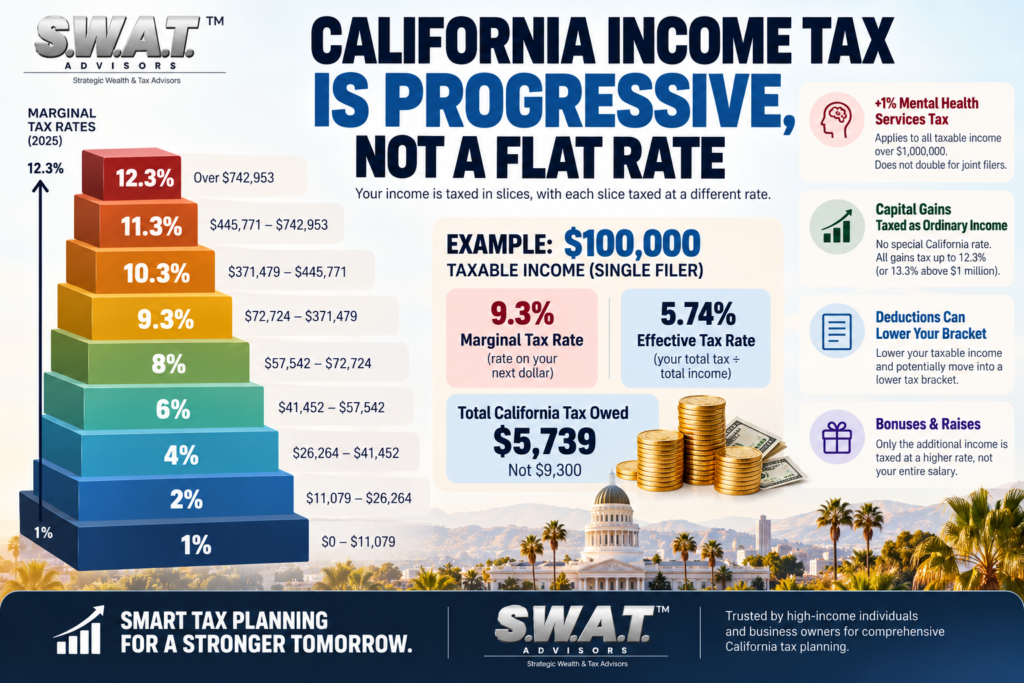
California’s system stacks nine brackets on top of each other, and each bracket only taxes the income that falls inside it. A progressive tax is a tax where the rate increases as income rises, applied one slice at a time rather than all at once.
Here’s how the stacking works for a single filer:
- The first $11,079 is taxed at 1%.
- The next $15,185 (up to $26,264) is taxed at 2%.
- The next $15,188 (up to $41,452) is taxed at 4%.
- The next $16,090 (up to $57,542) is taxed at 6%.
- The next $15,182 (up to $72,724) is taxed at 8%.
- Everything from $72,724 to $371,479 is taxed at 9.3%.
- Higher brackets run 10.3%, 11.3%, and 12.3%, topping out over $742,953.
The table below shows the full confirmed 2025 FTB Schedule X (single filers and married filing separately); the latest official numbers, since the 2026 schedule had not posted as of this writing.
| Taxable Income | Marginal Rate |
| $0 – $11,079 | 1% |
| $11,079 – $26,264 | 2% |
| $26,264 – $41,452 | 4% |
| $41,452 – $57,542 | 6% |
| $57,542 – $72,724 | 8% |
| $72,724 – $371,479 | 9.3% |
| $371,479 – $445,771 | 10.3% |
| $445,771 – $742,953 | 11.3% |
| Over $742,953 | 12.3% |
Married couples filing jointly use Schedule Y, where every threshold roughly doubles. The 9.3% bracket for joint filers starts at $145,448 instead of $72,724, which is why two-income households often land in a lower bracket than the sum of their individual salaries might suggest.
A Full Worked Example: Calculating Tax on $100,000 of Taxable Income
A single filer with $100,000 of California taxable income owes $5,739 in state tax, not $9,300.
| Bracket | Amount Taxed in This Slice | Rate | Tax Owed |
| $0 – $11,079 | $11,079 | 1% | $110.79 |
| $11,079 – $26,264 | $15,185 | 2% | $303.70 |
| $26,264 – $41,452 | $15,188 | 4% | $607.52 |
| $41,452 – $57,542 | $16,090 | 6% | $965.40 |
| $57,542 – $72,724 | $15,182 | 8% | $1,214.56 |
| $72,724 – $100,000 | $27,276 | 9.3% | $2,536.67 |
| Total | $100,000 | — | $5,738.64 |
Round that up, and you get $5,739 in California income tax. Divide it by $100,000, and the effective tax rate comes out to 5.74%, even though the taxpayer’s marginal tax rate is 9.3%.
The 1% Mental Health Services (Behavioral Health) Tax on Income Over $1 Million
California adds an extra 1% tax on all taxable income above $1,000,000. Voters passed this in 2004 as Proposition 63, and it funds county mental health and behavioral health programs statewide.
In our practice, we tell clients approaching seven figures that this threshold is one of the few in California tax law that does not adjust for filing status.
- The $1,000,000 threshold does not double for married couples filing jointly.
- A married couple earning $1.5 million combined pays the same 1% surcharge on the amount over $1 million as a single filer would.
- This makes California’s top bracket a notable exception to how every other bracket boundary in the state works.
Why California Doesn’t Give Preferential Rates on Capital Gains (Unlike Federal)
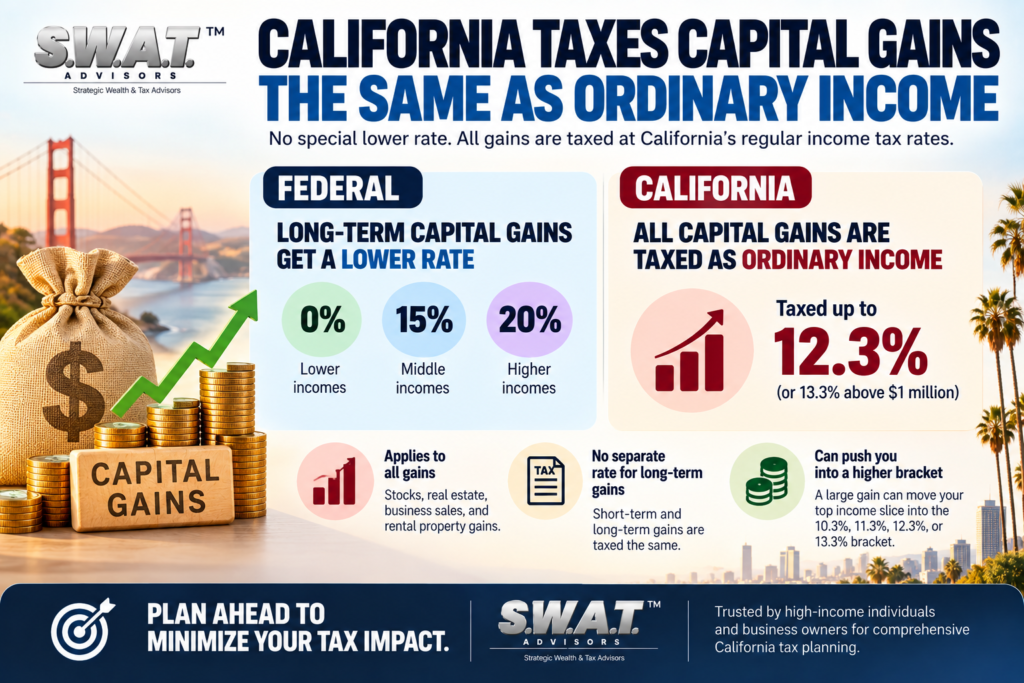
California taxes capital gains exactly like wages, at the same ordinary rates that top out at 12.3% (or 13.3% above $1 million).
Long-term federal capital gains get taxed at 0%, 15%, or 20%, which is dramatically lower than federal ordinary income rates. California simply folds the gain into your total taxable income and runs it through the same nine-bracket schedule as your paycheck.
- Federal: long-term gains get a preferential 0/15/20% rate.
- California: all gains, short or long-term, are ordinary income taxed up to 13.3%.
This is the single biggest reason a stock sale, a business sale, or a rental property sale can push a California resident’s marginal tax rate far higher than they expected, even when the federal side of the same sale looks manageable.
How Deductions and Credits Actually Move You Between Brackets
Deductions lower your taxable income before any bracket applies, which can drop your top slice of income into a lower rate entirely. A deduction is a reduction to taxable income; a credit is a dollar-for-dollar reduction to the tax bill itself, applied after brackets are already calculated.
California’s 2025 standard deduction is $5,706 for single filers and $11,412 for married couples filing jointly. If a single filer’s income sits at $73,500, that standard deduction alone drops their taxable income to $67,794, pulling their top slice back down from the 9.3% bracket into the 8% bracket.
- Deductions (standard deduction, itemized deductions, retirement contributions) reduce taxable income before brackets apply.
- Credits (child tax credit, dependent care credit, renter’s credit) reduce the tax bill directly, dollar for dollar, after brackets are calculated.
Real California tax planning strategies almost always start here, because timing a deduction into the right tax year can shift a filer’s entire top bracket.
How Can You Find Your California Marginal Tax Rate?
Finding your own marginal tax rate takes seven steps, and it’s the same process whether you’re a first-time filer or a returning one.
- Determine your California filing status.
- Calculate your California-adjusted income.
- Apply the applicable California deductions.
- Determine your California taxable income.
- Locate that amount in the correct FTB tax-rate schedule (X, Y, or Z).
- Identify the bracket containing your next dollar of taxable income.
- That percentage is your marginal California income-tax rate.
Then account separately for credits and any additional applicable taxes, like the Mental Health Services Tax. For the official numbers, check the California Franchise Tax Board’s rate schedules and the Form 540 or 540NR instructions, since FTB updates these figures every year.
What Happens to Your California Marginal Rate If You Earn a Bonus, Raise, or Investment Gain?
A bonus, raise, or capital gain only exposes the new income to your marginal rate, not your entire salary. California doesn’t have hard California tax cliffs where crossing a threshold retroactively taxes your whole income at the higher rate; each dollar still gets sorted into its own bracket.
Salary Increase
A raise only pushes the newly added income into a higher bracket, if it pushes into one at all. If a $10,000 raise lands entirely within your current bracket, your marginal rate doesn’t change at all.
Bonus
A bonus adds to your total taxable income for the year, so part or all of it may land in a higher bracket depending on where your salary already sits. Employers often withhold bonuses at a flat rate for convenience, but your actual tax owed is still calculated using the regular bracket schedule at filing time.
Capital Gain
California folds a capital gain straight into your ordinary taxable income rather than applying any special rate to it. A large one-time gain, like from selling a business or a rental property, can be the exact kind of event that pushes a filer’s top slice into the 10.3%, 11.3%, or even 12.3% bracket for that year alone.
How SWAT Advisors Can Help Your Bracket Planning Fits Into a Full California Tax Strategy
Advanced tax planning strategies are what determine where you stand next year, and that’s the work we do every day at SWAT Advisors.
SWAT Advisors builds tax planning strategies for high-income earners by timing of income, structuring business sales, and coordinating retirement contributions so a bonus or capital gain doesn’t land you a bracket higher than it needs to.
Our team has guided more than 20,000 clients through exit planning, succession planning, and California tax planning strategies built for high-net-worth individuals and business owners.
Heading into California tax planning in 2026, the difference between a plan built around your marginal rate and one built around your effective rate can run into tens of thousands of dollars. Schedule a private consultation with our tax planning team.
Conclusion
A $100,000 earner owes $5,739 (5.74% effective) despite being in the 9.3% marginal bracket, and every dollar above $1 million carries an extra 1% surcharge that never doubles for joint filers. Capital gains get no special break in California the way they do federally, and deductions remain the most direct lever for shifting your top bracket downward.
SWAT Advisors turns that bracket math into a plan built around your actual numbers. Whether you’re facing a bonus, a business sale, or a year that’s about to cross into a new bracket, our team has spent years structuring exactly these situations for California filers. Reach out to SWAT Advisors today and let’s build your next tax year before it builds your tax bill.
FAQs
No. Only the portion of your income inside the 9.3% bracket is taxed at that rate; everything below it is taxed at the lower bracket rates.
Your marginal rate taxes your last dollar; your effective rate is your total tax divided by total income, which is always lower.
No. California taxes all capital gains as ordinary income, up to 13.3%, with no preferential long-term rate.
It's the 12.3% top bracket plus the 1% Mental Health Services Tax on income over $1,000,000.
No. Only the new income that falls above your current bracket's ceiling gets taxed at the higher rate.


)
&description=&image=https://swatadvisors.com/wp-content/uploads/2026/10/effective-tax-rate-vs-marginal-tax-rate-img1-1024x683.webp)