

A Solo 401(k) has at least four deadlines. The deadline for setting up a solo 401(k) depends on whether you are talking about adopting the plan, electing your own salary deferral, making the employer contribution, or filing the annual report with the IRS.
This guide separates the four deadlines that people fold into one, walks through 401(k) plan deadlines by entity type, and covers what happens if you miss one of them.
Key Takeaways
- Sole proprietors and single-member LLCs can adopt a new Solo 401(k) and make elective deferrals retroactive to the prior year until their unextended tax filing deadline, generally April 15, 2027, for the 2026 tax year.
- S corporations and partnerships must adopt the plan by December 31, 2026, to make elective deferrals for 2026.
- The 2026 employee elective deferral limit is $24,500, plus an $8,000 catch-up (ages 50-59 and 64+) or an $11,250 super catch-up (ages 60-63).
- Combined employee and employer contributions cap out at $72,000 for 2026 under the Section 415(c) annual additions limit.
- Form 5500-EZ is due July 31, 2027, for a calendar-year plan once combined plan assets pass $250,000, with a 2.5-month extension available through Form 5558.
- Starting in 2026, catch-up contributions must be made as Roth if your 2025 FICA wages from the sponsoring employer exceeded $150,000, a rule that mostly affects S corp owners, not sole proprietors.
Solo 401(k) Deadlines at a Glance for the 2026 Tax Year
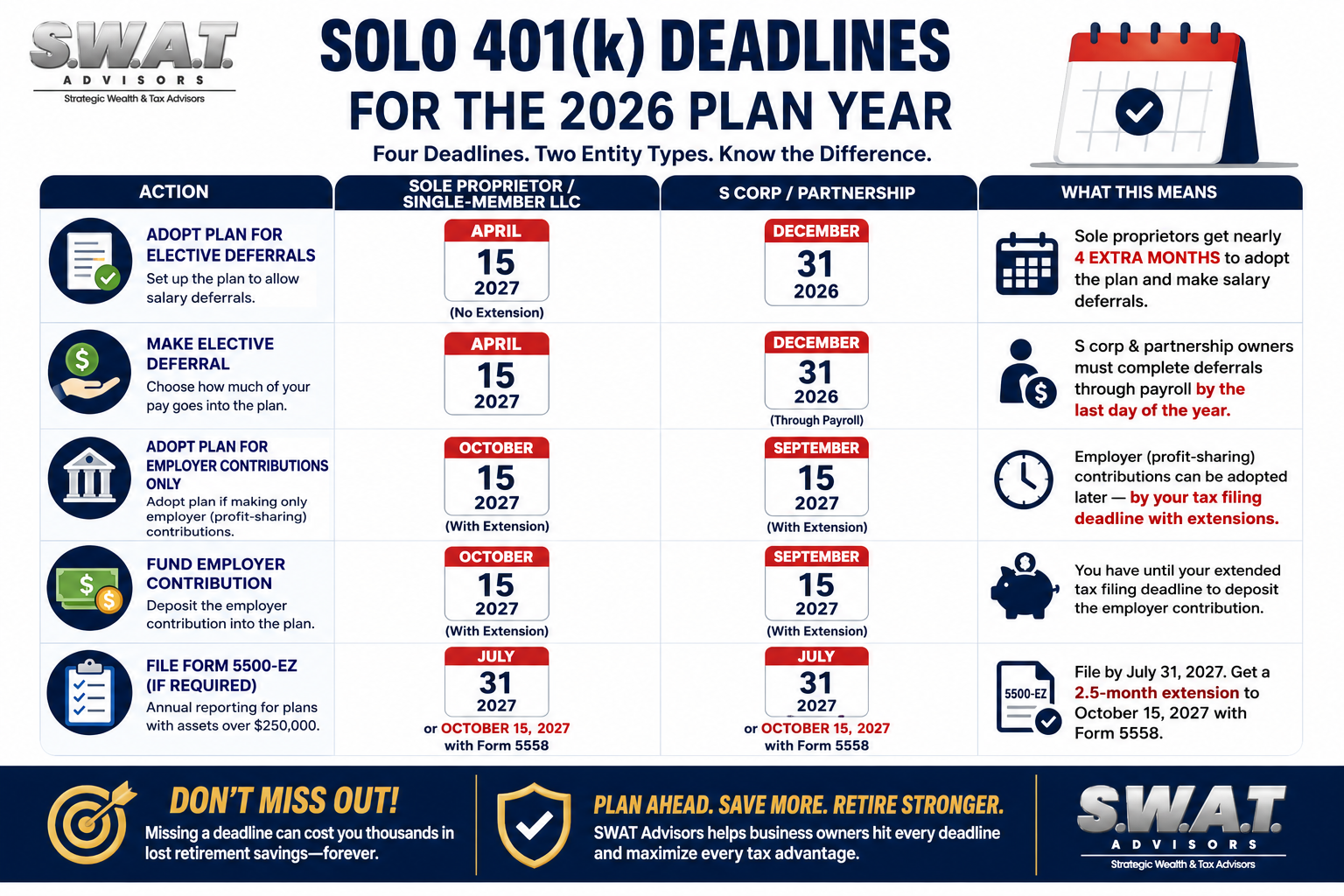
The table below lines up every deadline that applies to a calendar-year Solo 401(k) for the 2026 plan year, side by side, so you are not hunting through separate rules to figure out which date applies to your situation.
| Action | Sole Proprietor / Single-Member LLC | S Corp / Partnership |
| Adopt plan for elective deferrals | April 15, 2027 (no extension) | December 31, 2026 |
| Make elective deferral for 2026 | April 15, 2027 | December 31, 2026 (through payroll) |
| Adopt plan for employer contributions only | Tax filing deadline with extensions (up to October 15, 2027) | Tax filing deadline with extensions (up to September 15, 2027 for calendar-year entities) |
| Fund employer contribution | Tax filing deadline with extensions | Tax filing deadline with extensions |
| File Form 5500-EZ (if required) | July 31, 2027, or October 15, 2027 with Form 5558 | Same |
A sole proprietor gets nearly four extra months of runway for salary deferrals that an S corp owner simply does not have.
Three Different Deadlines People Confuse: Setup, Election, and Funding
Setup, election, and funding are three separate events, and only one of them, funding, has any flexibility once the plan year closes.
Plan setup is the legal act of adopting the plan document.
Election is the decision, made on paper, about how much of your compensation gets diverted into the plan as an elective deferral.
Funding is the actual transfer of money into the account.
An elective deferral is the portion of your own compensation you choose to redirect into the 401(k) before taxes, or as Roth after-tax dollars, instead of taking it as pay. For a W-2 owner-employee, this has to be documented through payroll by the last day of the year the compensation was earned, no exceptions, no retroactive fixes.
An employer contribution is a profit-sharing or matching contribution the business makes on the owner’s behalf, and the IRS has always allowed that money to be funded later, generally by the business tax return’s due date, including extensions.
Deadline for Setting Up a Solo 401(k), and Why Your Entity Type Changes It
Your business structure decides which calendar applies. A sole proprietor gets a deadline tied to their personal tax return; an S corp or partnership owner is locked to the calendar year the plan covers.
Sole Proprietors and Single-Member LLCs: Until April 15, 2027
A sole proprietor or single-member LLC can adopt a brand-new Solo 401(k) after December 31, 2026, and still make elective deferrals for the 2026 tax year, as long as the plan is adopted by April 15, 2027.
The business must be a sole proprietorship or single-member LLC; it cannot have any employees besides the owner, and this has to be the plan’s first year.
Once those three boxes are checked, the deadline runs to your unextended personal filing deadline, not the extended one.
If you file for an extension on your Form 1040, that extension does not push back this particular window for elective deferrals.
We tell clients who discover Solo 401(k)s in February or March that they still have a real shot at meaningful 2026 contributions, provided they act before mid-April and their books for the year are actually closed.
S Corporations and Partnerships: Hard Stop at December 31, 2026
S corporations and partnerships do not get the Section 317 extension. If you run your business through an S corp and pay yourself W-2 wages, the plan has to be adopted, and your deferral election signed, before the last paycheck of the calendar year.
Employer contributions from an S corp or partnership still follow the older rule: adopt and fund by the business return’s due date with extensions, generally September 15 for calendar-year entities that file for an extension.
Solo 401(k) Funding Deadline: When the Money Actually Has to Land
The Solo 401(k) funding deadline splits along the same line as everything else: elective deferrals must be funded close to when they are earned, while employer contributions can wait until the return is filed.
For a sole proprietor, elective deferrals are technically funded when the return is filed, and the deferral is designated, up to April 15 of the following year (or the SECURE 2.0-extended window described above for first-year plans).
For an S corp owner, deferrals move out of each paycheck in real time, so funding effectively happens all year.
A sole proprietor computing a profit-sharing contribution off net self-employment income can fund it any time up through the extended filing deadline, October 15 for most individuals who file for an extension.
What You Forfeit by Setting Up Late
Missing a deadline permanently erases contribution room for that tax year. No “catch-up” mechanism lets you go back and defer 2025 wages in 2027 once the window for that year has closed.
For an S corp owner who misses the December 31 cutoff, the cost is the entire elective deferral opportunity, potentially $24,500 or more in tax-deferred savings depending on age.
For a sole proprietor who misses April 15, the cost is both the deferral and any related employer contribution tied to a first-year plan, since the plan technically never existed for that tax year.
The forfeited space does not roll forward. Retirement account limits reset every January 1, and unused room from a prior year is gone for good.
2026 Contribution Limits: What Hitting the Deadline Is Actually Worth
The 2026 employee elective deferral limit is $24,500, up $1,000 from 2025. Workers 50 and older can add an $8,000 catch-up for a $32,500 personal maximum, and anyone turning 60, 61, 62, or 63 during 2026 qualifies for a larger $11,250 super catch-up under SECURE 2.0, bringing their maximum to $35,750.
| Limit | 2026 Amount |
| Employee elective deferral | $24,500 |
| Catch-up, ages 50-59 and 64+ | $8,000 |
| Super catch-up, ages 60-63 | $11,250 |
| Combined employee + employer (415(c)) | $72,000 |
| Compensation cap (401(a)(17)) | $360,000 |
The table shows your personal deferral ceiling and the combined 415(c) cap that includes the employer contribution on top of it. Add the age-50 catch-up to the $72,000 combined limit, and a sole proprietor over 50 can reach $80,000 in total 2026 contributions; someone 60 to 63 can reach $83,250.
The New Roth Catch-Up Rule That Hits S Corp Owners Differently
Starting January 1, 2026, catch-up contributions must be made as Roth for anyone whose 2025 FICA wages from the plan-sponsoring employer exceeded $150,000. This is the mandatory Roth catch-up rule under Section 603 of SECURE 2.0, and it splits Solo 401(k) owners into two very different groups depending on how their business is structured.
FICA wages are compensation reported on a W-2 and subject to Social Security and Medicare taxes.
A sole proprietor or partner earning self-employment income reported on Schedule C or a K-1 has no FICA wages at all, so the rule generally does not reach them.
They can keep making pretax catch-up contributions regardless of income. An S corp owner who pays themselves a W-2 salary is a different story.
If that salary topped $150,000 in 2025, every dollar of their 2026 catch-up contribution, whether the standard $8,000 or the $11,250 super catch-up, has to go into a Roth account.
The same S corp structure many owners use to lower self-employment tax now also determines whether their catch-up savings get taxed going in or coming out.
If your plan document does not currently allow Roth contributions and you are an S corp owner over the wage threshold, you cannot make any catch-up contribution at all until the plan is amended to add a Roth feature.
401(k) Plan Deadlines for Businesses That Have Employees
The moment a Solo 401(k) sponsor hires a common-law employee who meets the plan’s eligibility requirements, the plan stops being a true one-participant plan and picks up a full set of ERISA obligations.
Nondiscrimination testing, a summary plan description, and a standard Form 5500 (not the simplified 5500-EZ) all come into play.
Plan documents typically have to be amended before the new employee’s eligibility date, and employer contributions for that employee follow the same funding deadline as the owner’s own contribution.
Business owners who expect to hire within the next year should build that timeline into their 401(k) plan deadlines planning now, because converting a Solo 401(k) into a standard 401(k) mid-year is far more complicated than starting a standard plan from scratch.
What Is the Form 5500-EZ Deadline for a Solo 401(k)?
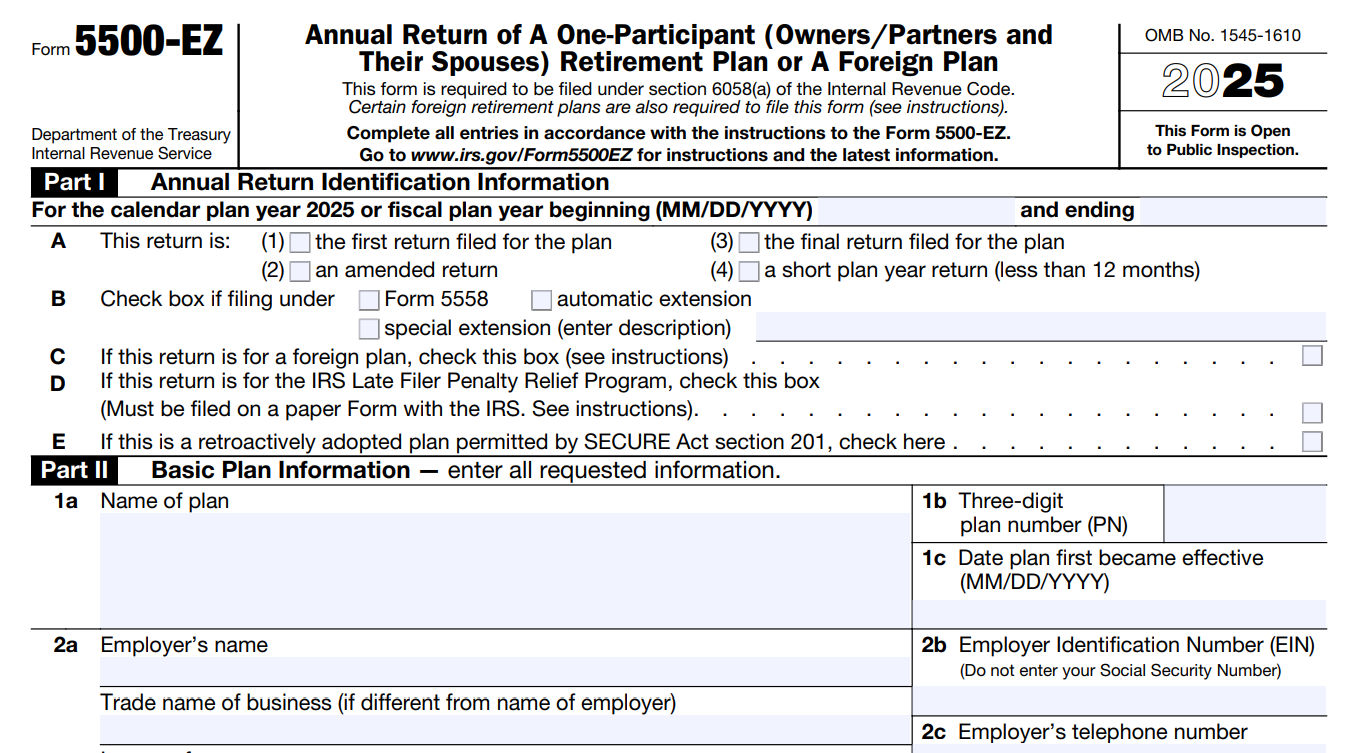
Form 5500-EZ is due the last day of the seventh month after your plan year ends; for a calendar-year plan, that is July 31 of the following year. For the 2026 plan year, that means July 31, 2027.
You only need to file if combined assets across every one-participant plan you sponsor exceeded $250,000 at the end of the plan year, or if 2026 is the plan’s final year regardless of balance.
Form 5558 gets you an automatic 2.5-month extension to October 15 if filed by the original July 31 deadline; you do not need to explain why you are asking.
IRS guidance confirms both the July 31 due date and the $250,000 asset threshold for one-participant plans.
What Deadline Applies if You Missed the Solo 401(k) Deadline?
If You Missed the Plan-Establishment Deadline
Start by nailing down four facts before assuming the year is a loss.
Confirm your business structure, since sole proprietors get a later window than S corps.
Confirm whether this is genuinely the plan’s first year, since the SECURE 2.0 retroactive rule only applies then.
Check whether a plan document was ever actually signed and dated, since an unsigned draft does not count as adoption.
Finally, check whether any contribution was already deposited, since that can affect how a correction gets classified.
If You Made a Contribution Late
Pin down which type of contribution is at issue.
An elective deferral problem is treated differently from a late employer contribution, and a late deposit of amounts already withheld from an employee’s pay is treated as a separate operational failure under Department of Labor rules.
The IRS maintains correction procedures under the Employee Plans Compliance Resolution System, or EPCRS, which allows self-correction for many common retirement plan errors without a formal IRS filing, provided the error is fixed within a reasonable period.
What Is the Solo 401(k) Deadline Checklist You Should Follow Each Year?
Before year-end: confirm your plan is adopted and your entity type’s deferral deadline.
Before making elective deferrals: confirm your election paperwork and your actual compensation basis.
After year-end: calculate the employer contribution using final net earnings.
Before filing taxes: reconcile employee and employer contribution totals against plan limits.
After the plan year closes: check whether Form 5500-EZ is required based on the $250,000 threshold.
By July 31 (calendar-year plans): file Form 5500-EZ or submit Form 5558 for an extension.
If anything was late: identify the specific failure type and look into EPCRS self-correction before it compounds.
How SWAT Advisors Can Help You Hit Every Solo 401(k) Deadline
Keeping four separate deadlines straight while running a business is a lot to track alone, and getting even one of them wrong can cost thousands of dollars in permanently lost contribution room. SWAT Advisors builds retirement plan deadlines directly into the same tax planning calendar we already use to manage your quarterly reviews, so nothing gets left for April.
Here is how we help:
We calculate your employer contribution using your actual year-end numbers, not a rough estimate, so you fund the correct amount the first time.
We track entity-specific deadlines for sole proprietors, S corps, and partnerships so a Section 317 window never gets missed by accident.
We coordinate Form 5500-EZ filings and Form 5558 extensions alongside your business return so nothing falls through the cracks between your CPA and your plan administrator.
We flag the new mandatory Roth catch-up rule for S corp owners early enough to amend the plan document before it becomes a problem.
If you are unsure which deadline applies to your business, or you think you may have already missed one, book a consultation with our team before you assume the opportunity is gone.
Conclusion
A Solo 401(k) has four separate deadlines, not one, and the entity type you operate under decides how much room you actually have. Sole proprietors get until their unextended filing deadline to set up a plan and defer income retroactively; S corp and partnership owners do not get that grace period and must act by December 31.
SWAT Advisors has spent over 20 years helping business owners, physicians, dentists, and real estate investors build tax strategies around exactly this kind of deadline pressure. We do not just prepare your return once a year; we run quarterly reviews specifically so a Solo 401(k) deadline never sneaks up on you the way it does for people working from a generic checklist.
If your Solo 401(k) situation involves a recent entity change, a first-year plan, or a missed contribution you are trying to fix, contact us today, and we will map out exactly which dates still matter for your specific structure.
FAQs
It’s already the new year. Can I still open a Solo 401(k) and contribute for last year?
Yes, if you are a sole proprietor or single-member LLC with no employees and this is the plan’s first year; you have until your unextended filing deadline, generally April 15.
Do I have to fund the account on the same day I set the plan up?
No. Plan adoption and contribution funding are separate deadlines; employer contributions can typically wait until your tax return’s extended due date.
What happens to my Solo 401(k) if I hire an employee?
The plan generally stops qualifying as a one-participant plan and must be amended to meet standard 401(k) nondiscrimination and reporting rules, including a full Form 5500.
I already contribute to a 401(k) at my day job. Can I still use a Solo 401(k)?
Yes, but your combined elective deferral across both plans cannot exceed the single $24,500 (plus catch-up) limit for 2026.
If I’ve missed the Solo 401(k) deadline, is a SEP IRA a better fallback?
Often, yes, for that specific year, since a SEP IRA can still be established and funded up to your extended filing deadline, while a missed Solo 401(k) deferral cannot be recovered.


:+Every+401(k)+Plan+Deadline+You+Need+to+Know)
:+Every+401(k)+Plan+Deadline+You+Need+to+Know&description=&image=https://swatadvisors.com/wp-content/uploads/2026/09/Deadline-for-Setting-Up-a-Solo-401k-Every-401k-Plan-Deadline-You-Need-to-Know-1024x576.webp)