
Long-term vs. short-term capital gains comes down to the number of months you have held an asset. Sell an asset you’ve owned for a year or less, and the IRS taxes your profit like a paycheck. Hold it past that mark, and you unlock a lower rate reserved for patient investors.
A $50,000 gain taxed as short-term might cost a middle-income investor 22% in federal tax; held one extra day past the one-year mark, it could drop to 15%. This guide breaks down how the IRS classifies each gain, what determines your rate, and where investors lose money through avoidable mistakes.
Key Takeaways
|
Understanding Capital Gains in the U.S. Tax System
A capital gain is the profit from selling a capital asset, such as stock, a rental property, or a business interest, for more than your adjusted basis. Per IRS Topic No. 409, almost anything you own for personal or investment use counts as a capital asset. The IRS splits every gain into two buckets based on holding period, and that split decides your tax rate.
What Are Long-Term and Short-Term Capital Gains?
A short-term capital gain is profit from an asset held one year or less; a long-term capital gain is profit from an asset held more than one year. The IRS counts your holding period from the day after you acquired the asset through the day you sold it. Miss the 12-month mark by even a day, and your gain drops into the short-term bucket.
Inherited property is an exception, automatically qualifying for long-term treatment regardless of actual holding time. Commodity futures and certain partnership interests follow separate rules under IRS Publication 550.
How Are Capital Gains Taxed Differently?
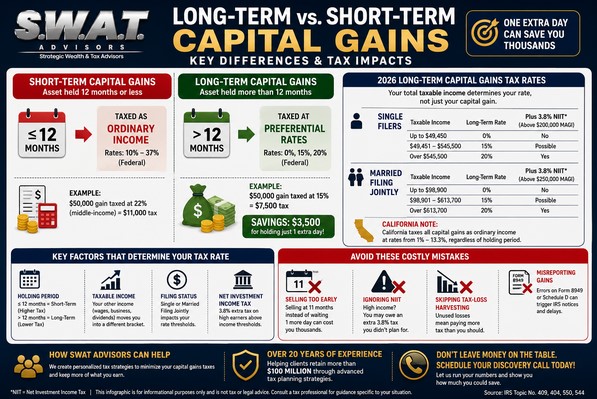
Short-term gains are taxed as ordinary income at your regular federal bracket, 10% to 37% in 2026. Long-term gains get preferential treatment at 0%, 15%, or 20%, depending on total taxable income. This gap is exactly why long-term vs. short-term capital gains planning matters more than the size of the gain itself.
A single filer earning $80,000 who realizes a $10,000 short-term gain pays 22%, or $2,200. Hold the same asset for more than 12 months, and the rate falls to 15%, a $700 saving from one timing decision. Special assets carry their own caps: collectibles like art, coins, and stamps top out at 28%, and unrecaptured real estate depreciation caps at 25%, per IRS Publication 544.
Factors That Determine Your Capital Gains Tax Rate
Your capital gains rate isn’t set by profit size alone. The IRS stacks your gain on top of your other taxable income, so wages, business income, and other earnings all shape which bracket your gain lands in.
Investment Holding Periods: Short vs Long Term
The 12-month holding period is the biggest lever you control before selling. Assets sold at 365 days or less are short-term; 366 days or more makes them long-term, a hard IRS cutoff with no exceptions.
Investors who track purchase dates, then delay a sale by a few weeks to cross the one-year line, routinely save thousands. On a $100,000 gain, the gap between the top ordinary rate and the top long-term rate is $17,000.
Income Bracket Impact on Capital Gains
Your total taxable income, not your capital gain alone, determines your 2026 long-term rate. Single filers pay 0% up to $49,450, 15% from $49,451 to $545,500, and 20% above that. Married couples filing jointly pay 0% up to $98,900, 15% up to $613,700, and 20% beyond. High earners also face the 3.8% Net Investment Income Tax once modified adjusted gross income passes $200,000 single or $250,000 married filing jointly, a rule central to tax planning for high-income individuals.
California treats every gain as ordinary income with no long-term discount, so the California capital gains tax brackets run from 1% up to 13.3% regardless of holding period. A blended tax rate calculator shows your true combined liability before you sell; a $200,000 gain at a blended 33% costs $66,000, while the same gain timed into a lower-income year could cost far less.
How SWAT Advisors Can Help You Optimize Capital Gains Taxes
Structuring a sale, business exit, or real estate transaction around them is where most investors leave money on the table, and where SWAT Advisors steps in.
SWAT Advisors is a California tax planning firm with over 20 years of experience. The firm has helped clients retain more than $100 million through advanced tax planning strategies, working with business owners, doctors, dentists, and high-net-worth families statewide.
Personalized Strategies for Minimizing Tax Liability
We start every engagement with a discovery call and a full tax assessment before recommending a strategy. One recent case involved a physician couple earning $1.589 million who paid $661,000 in combined taxes; after our planning, their bill dropped to $52,000 on a restructured $304,000 income, saving over $600,000. Every plan under our high-net-worth tax-planning strategies framework starts with your actual numbers.
Investment Portfolio Review and Tax Planning
We review your full portfolio, not just the asset you’re selling, and map how a gain interacts with your other income for the year. For business owners, this often pairs tax planning for business owners with retirement plan design, since one sale can shift your entire year’s bracket without advance planning. Book a consultation, and we’ll run your numbers to see where your long-term vs short-term capital gains picture stands before your next sale.
Common Mistakes Investors Make With Capital Gains
Most capital gains mistakes are timing and reporting errors, not complicated tax code issues, and the IRS doesn’t offer do-overs on a completed sale.
- Selling right before the 12-month mark, turning a 15% rate into 22% or higher for no real gain in flexibility.
- Ignoring the Net Investment Income Tax threshold, then getting hit with an unexpected 3.8% surcharge.
- Skipping tax-loss harvesting in a down year, leaving losses unused instead of offsetting gains.
- Forgetting a large gain can push wages or dividends into a higher bracket for the whole year.
Selling Too Early and Paying Higher Taxes
Selling at 11 months instead of waiting one more is the most avoidable mistake investors make. On a $50,000 gain, that month of patience is the difference between $11,000 at 22% and $7,500 at 15%, a $3,500 cost for selling too soon.
Misreporting Gains on Tax Returns
Every sale must be reported on Form 8949, then summarized on Schedule D of Form 1040. Missing a transaction or using the wrong cost basis triggers IRS notices and delays refunds. Cross-checking your broker’s 1099-B against your own records before filing catches most errors early.
Conclusion
Long-term vs short-term capital gains treatment hinges on one factor: whether you held the asset for more or less than 12 months. That rule sets your federal rate anywhere from 10% up to 37% for short-term sales, or as low as 0% for long-term sales in the right bracket. Taxable income, filing status, and state of residence all layer on top to determine your final bill. Investors who plan sale timing around their income for the year, rather than reacting after the fact, keep more of what they earn.
SWAT Advisors turns that knowledge into an actual savings plan, combining two decades of California tax planning experience with a track record of seven-figure savings, built through year-round tax planning, not one-time filing.
We map your capital gains events against your full income picture, then apply ways to reduce capital gains tax in California before you file. Contact us today to schedule your discovery call and see what a customized strategy could save you.
FAQs
A short-term capital gain is profit from selling an asset held for 12 months or less. The IRS taxes it at your ordinary income rate, up to 37% in 2026.
You must hold an asset more than 12 months, meaning 366 days or longer, to qualify for long-term rates of 0%, 15%, or 20%.
Yes. Capital losses offset capital gains dollar for dollar, and any excess reduces up to $3,000 of ordinary income per year, with the remainder carried forward.
No. Qualified dividends are taxed at the same 0%, 15%, or 20% rates as long-term gains, but ordinary dividends are taxed as regular income, per IRS Topic No. 404.
We build personalized sale timing, entity structuring, and real estate strategies around your full income picture, helping clients like a physician couple save over $600,000 in one year.