
The federal One Big Beautiful Bill Act (OBBBA), passed in July 2025, changed how California tax planning in 2026 and federal taxes interact. And California’s Franchise Tax Board (FTB) has its own updated numbers for credits, deductions, and income thresholds that take effect this filing season.
This guide covers everything about California income tax rates, credits available right now, deductions that actually move the needle, and strategies that work in 2026.
Key Takeaways
|
What Changed in California Tax Law for 2026 and What Carries Into 2026
California does not automatically follow federal tax law. That matters more than ever in 2026.
The OBBBA made most TCJA provisions permanent at the federal level. California conforms to some of them, but not all. The federal SALT deduction cap ($10,000) still applies to your federal return.
California does not cap the state and local tax deduction on California returns in the same way. This creates a planning gap that smart taxpayers use.
A Notable California Update: Alimony Rules ChangedFor divorces finalized on or after January 1, 2026, California no longer allows payers to deduct alimony on state returns, aligning closer to post-TCJA federal treatment. |
California tax brackets, credit limits, and standard deductions are adjusted annually using the California Consumer Price Index. The 2025 figures (filed in 2026) are confirmed and final from the FTB.
 How California Tax Planning Works in 2026
Tax planning in 2026 in California means reducing what you owe California separately from what you owe the IRS. The state does not conform to every federal deduction, credit, or exclusion.
- California taxes all worldwide income for residents
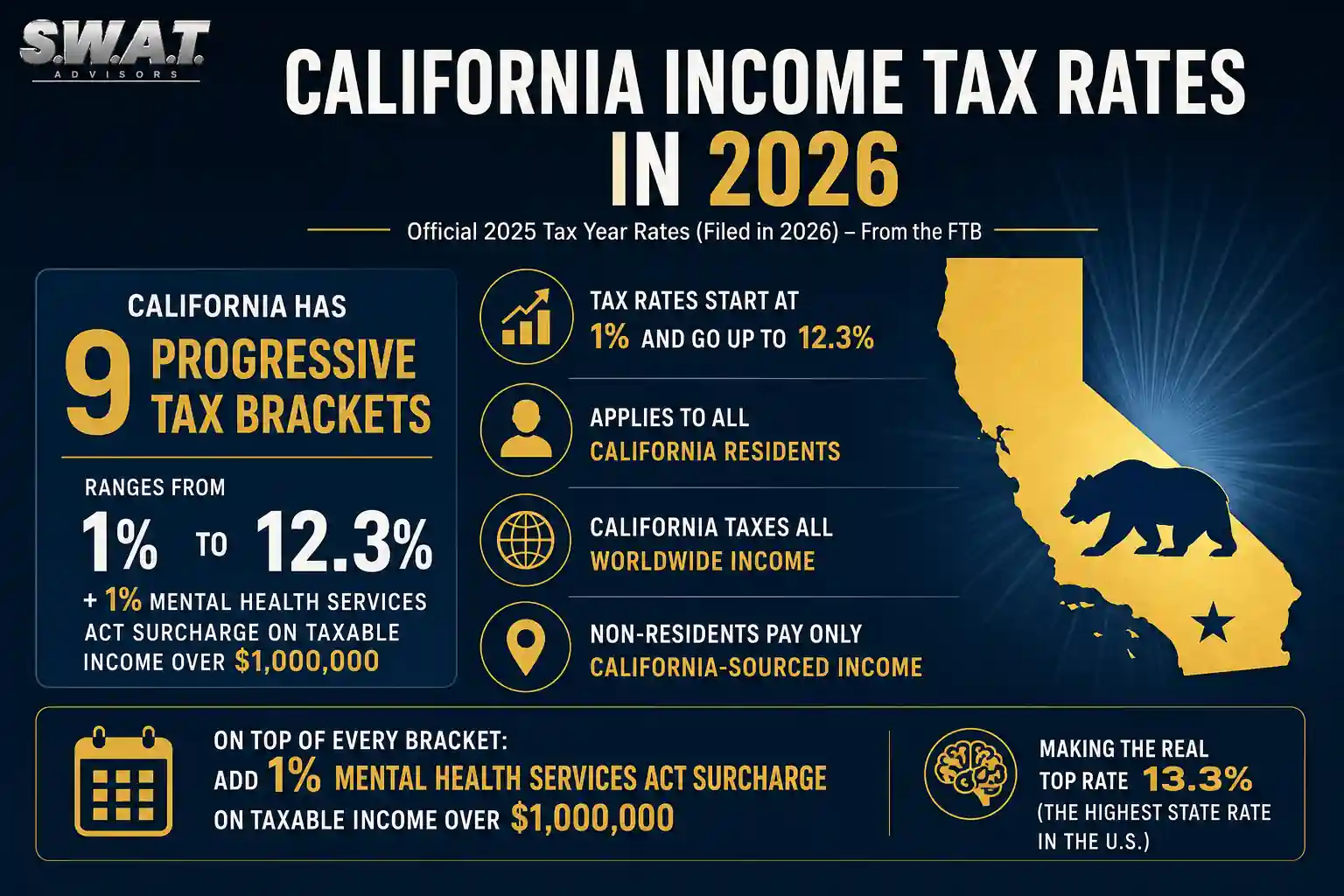
- California income tax rates run from 1% to 12.3%, with an extra 1% Mental Health Services Act (MHSA) surcharge on taxable income above $1 million, making the real top rate 13.3% (the highest state rate in the U.S.).
- Non-residents only pay California tax on California-sourced income
- Part-year residents file Form 540NR
California Income Tax Rates in 2026 and How They Affect Planning
California runs nine progressive tax brackets. These are the official 2025 tax year rate schedules published by the FTB in the 2025 Personal Income Tax Booklet, the figures you’ll use when you file in 2026.
Single or Married/RDP Filing Separately (Schedule X)
| Rate | Taxable Income Range |
| 1% | $0 – $11,079 |
| 2% | $11,079 – $26,264 |
| 4% | $26,264 – $41,452 |
| 6% | $41,452 – $57,542 |
| 8% | $57,542 – $72,724 |
| 9.3% | $72,724 – $371,479 |
| 10.3% | $371,479 – $445,771 |
| 11.3% | $445,771 – $742,953 |
| 12.3% | $742,953 and over |
Married/RDP Filing Jointly or Qualifying Surviving Spouse/RDP (Schedule Y), and Head of Household (Schedule Z)
| Rate | MFJ / Qualifying Surviving Spouse | Head of Household |
| 1% | $0 – $22,158 | $0 – $22,173 |
| 2% | $22,158 – $52,528 | $22,173 – $52,530 |
| 4% | $52,528 – $82,904 | $52,530 – $67,716 |
| 6% | $82,904 – $115,084 | $67,716 – $83,805 |
| 8% | $115,084 – $145,448 | $83,805 – $98,990 |
| 9.3% | $145,448 – $742,958 | $98,990 – $505,208 |
| 10.3% | $742,958 – $891,542 | $505,208 – $606,251 |
| 11.3% | $891,542 – $1,485,906 | $606,251 – $1,010,417 |
| 12.3% | $1,485,906 and over | $1,010,417 and over |
On top of every bracket above, add the 1% Mental Health Services Act surcharge on taxable income over $1,000,000 that threshold doesn’t change by filing status.
(Source: California Franchise Tax Board, 2025 Tax Rate Schedules, 2025 tax year figures, filed 2026)
These are marginal rates, not flat ones. Crossing into a higher bracket only raises the rate on the income sitting inside that bracket, never on the dollars below it.
How California Tax Brackets Apply in a Real-World ScenarioSingle filer, $80,000 taxable income. You don’t pay 9.3% on all $80,000. You pay 1% on the first slice, 2% on the next, and so on, until you reach your top bracket. Only the roughly $7,276 that sits inside the 9.3% bracket gets taxed at that rate. Total California tax comes to about $3,879, an effective rate of roughly 4.9%, even though your marginal rate is 9.3%. Single filer, $120,000 taxable income. Same bracket, more of it filled in. The 9.3% bracket now holds $47,276 of your income. Total tax lands around $7,599, an effective rate of about 6.3%. Notice the marginal rate hasn’t moved, but the effective rate climbed almost a point and a half just from filling more of the same bracket. Single filer, $400,000 taxable income. This is where the math changes shape. You’ve now crossed into the 10.3% bracket, which starts at $371,479. Total tax comes to roughly $33,924, an effective rate of about 8.5%. The jump from $120,000 to $400,000 more than tripled the effective rate, because a meaningful chunk of income is now taxed at 9.3% and 10.3% instead of the lower rungs. |
Key Details That Impact California Tax Planning in 2026
California tax planning in 2026 gets complicated fast because of how the state treats income differently from the IRS.
- California taxes Social Security income (the federal government does not, for lower earners)
- California does not allow the federal standard deduction; it uses its own lower amount
- California does not recognize Roth IRA conversion tax benefits the same way
- Stock options and RSU income follow California source rules even if you leave the state
Legislative Changes That Influence California Tax Planning Decisions
The OBBBA made the 20% pass-through deduction permanent at the federal level. California does not conform to this deduction. California business owners claiming the Section 199A deduction on their federal return get nothing from California for it.
California also maintained its own net operating loss (NOL) rules. The state had temporarily suspended NOL deductions in prior years; those suspensions have since expired, so NOL carryforwards are usable again in 2026, subject to current FTB rules.
Coordinating California and Federal Tax Planning
Tax planning in 2026 works best when you treat federal and California taxes as two separate puzzles to find where they overlap.
- Retirement contributions reduce both federal and California taxable income (401k, traditional IRA)
- Health Savings Account (HSA) contributions reduce federal taxes but not California income taxes. California does not conform to the federal HSA exclusion
- Capital gains rates are the same in California, regardless of holding period. California taxes all capital gains as ordinary income
- Mortgage interest is deductible on both returns (subject to limits)
California Tax Credits Available in 2026
California tax credits reduce what you owe dollar-for-dollar. Some are refundable, meaning the FTB pays you back even if your tax bill is zero.
California Earned Income Tax Credit (CalEITC)
For tax year 2025 (filed in 2026), the CalEITC offers up to $3,756 for working Californians earning up to $32,900. It is refundable. ITIN holders qualify.
Over 3.4 million Californians claimed it in 2025, receiving more than $1.4 billion combined (FTB, February 2026). Claim it on Form FTB 3514.
Young Child Tax Credit (YCTC)
If you qualify for CalEITC and have a child under 6 years old, you get up to $1,189 extra. For tax year 2025, you can qualify even with zero earned income if your wages don’t exceed $35,640 and your net loss doesn’t exceed $35,640. (Source: FTB, Form 3514, 2025)
Foster Youth Tax Credit (FYTC)
Former foster youth ages 18–25 at the end of the tax year get up to $1,189 refundable. If both spouses qualify, the household gets up to $2,378. Claim it on FTB 3514 alongside CalEITC. (Source: FTB, Form 3514, 2025)
Child and Dependent Care Expense Credit
A percentage-based credit for childcare expenses for working parents. The credit rate depends on your income. It is non-refundable; it reduces what you owe but does not pay out if your bill hits zero. (Source: FTB, Form 3506, 2025)
Adoption Cost Credit
California’s adoption credit covers 50% of the cost of adopting a child who is a U.S. citizen or legal resident and was in the custody of a California public agency or political subdivision at the time of adoption. Qualifying costs include adoption fees, court costs, and related legal expenses tied to the adoption itself.
The credit is capped at $1,860 per adoption. Claim it using the worksheet in the FTB 540 instructions in the year the adoption becomes final. (Source: FTB, 2025 Form 540 Instructions)
Joint Custody Head of Household Credit
If you have joint custody of a child, stepchild, or grandchild, pay more than half their household expenses, and don’t qualify to file as head of household yourself, this credit is worth 30% of your net tax, capped at $610.
You must have a custody agreement in place, and your home must have been the child’s main home for between 146 and 219 days of the year. You cannot claim this credit and the Dependent Parent Credit in the same year. (Source: FTB, Credit Code 170, 2025)
Dependent Parent Credit
If you cared for a parent (they don’t need to live with you), were married but filed separately, and your spouse didn’t live with you during the last six months of the year, you may claim 30% of your net tax, capped at $610, the same cap and formula as the Joint Custody Head of Household Credit. You can claim one or the other, not both. (Source: FTB, Credit Code 173, 2025)
California Renter’s Tax Credit
Renters who do not own property and meet the California income thresholds get a flat credit: $60 for single filers and $120 for married/RDP joint filers (tax year 2025). It’s non-refundable. You must live in a California residence for which you paid rent, and you cannot be claimed as a dependent. (Source: FTB, 2025)
California Head of Household Credits for Joint Custody Situations
California provides the joint custody head of household credit described above for taxpayers who share custody and don’t otherwise qualify for head of household filing status. This is a non-refundable credit and applies when a non-custodial parent qualifies under specific FTB rules.
California Motion Picture and Film Production Tax Credit
California’s film tax credit runs as a competitive program managed by the California Film Commission. Productions meeting spending thresholds in California get a credit against California income tax.
Program 4.0, the current version, offers a credit equal to 20% or 25% of qualified production expenditures, depending on the type of production, allocated on a rolling basis between July 2025 and July 2030. (Source: FTB, Form 3541 Instructions, 2025)
Low-Income Housing Tax Credit (LIHTC) in California
The state LIHTC works alongside the federal LIHTC to fund affordable housing construction. California’s credit is administered by the California Tax Credit Allocation Committee (CTAC). Investors in qualifying projects claim the credit over 10 years.
Clean Energy and Environmental Tax Credits in California
California’s clean energy credits include the California Competes Tax Credit (for businesses committing to jobs) and various credits tied to clean vehicle purchases through CARB programs.
The IRA-era federal EV credits still interact with state planning. California does not offer a separate state EV credit but integrates with federal incentives.
Business and Economic Development Tax Credits
The California Competes Tax Credit is a negotiated credit for businesses creating jobs or expanding in California. Administered by the Governor’s Office of Business and Economic Development (GO-Biz), the credit runs in quarterly application rounds.
California also offers the New Employment Credit (NEC) for hiring in designated geographic areas.
How California Tax Deductions Fit Into a Strategic Tax Plan
The California standard deduction for 2025 (the tax year you file in 2026) is:
- $5,706: Single or Married Filing Separately
- $11,412: Married Filing Jointly, Head of Household, or Qualifying Surviving Spouse
These numbers are far lower than the federal standard deduction. Most Californians with significant mortgage interest, property taxes, or medical costs do better itemizing on their state return, even if they take the federal standard deduction.
If You’re 65 or Older, or Blind
The federal return adds a higher standard deduction for filers who are 65+ or blind. California doesn’t do that. Instead, California gives you a separate, flat exemption credit:
- $153 senior exemption credit if you (or your spouse/RDP) are 65 or older, doubled to $306 if both spouses/RDPs qualify
- $153 blind exemption credit if you (or your spouse/RDP) are visually impaired, doubled to $306 if both qualify
- These stack on top of the $153 personal exemption credit everyone gets, and the $475 credit per dependent
(Source: FTB, 2025 Form 540 and Form 540 2EZ instructions)
So a 68-year-old single filer doesn’t get a bigger standard deduction than a 35-year-old single filer. Both get $5,706. The 68-year-old instead gets an extra $153 knocked directly off their tax bill as a credit, which is a different mechanism with a different (and usually smaller) dollar effect than the federal age-based deduction bump.
Standard vs. Itemized: A California-Specific Framework
Before defaulting to the standard deduction on your California return, run these three numbers:
- Mortgage interest threshold. California allows interest on acquisition debt up to $1 million ($500,000 if married filing separately), well above the federal $750,000 cap on post-2017 loans. If you’re carrying a large mortgage on a California home, this alone can push you over the standard deduction amount.
- Property tax and SALT math. California doesn’t cap the state and local tax deduction the way the federal $10,000 SALT cap does. If you paid $18,000 in property tax, all $18,000 counts toward your California itemized total, even though only $10,000 of it counts federally.
- Medical expense floor. Medical expenses above 7.5% of your California AGI are deductible on both returns. For anyone with a major medical year, this bracket alone can tip the scale toward itemizing.
Add up mortgage interest, full property tax, medical expenses above the floor, and charitable giving. If that total beats $5,706 (single) or $11,412 (joint), itemize on your California return, regardless of what you did federally. California calculates the two returns independently, so taking the federal standard deduction doesn’t lock you into doing the same thing at the state level.
Itemized Deductions and California-Specific Limitations
California allows mortgage interest, property taxes, charitable contributions, and certain medical expenses as itemized deductions. But California does not allow the federal deduction for state and local taxes paid to other states. California also does not allow the qualified business income (Section 199A) deduction.
Strategic California Tax Planning Strategies for 2026
Income Timing and Deferral Strategies
If you expect to earn significantly more in 2026 than in 2025, push income into 2025 where possible or defer it into 2027. A $50,000 bonus hitting in the 9.3% bracket costs less than one hitting the 10.3% bracket.
Multi-State Tax Planning for California Residents
California aggressively audits people who claim to have moved out of the state. The FTB looks at where your family lives, where you vote, and where you hold a driver’s license.
Remote workers employed by California companies while living out of state still face potential California tax exposure on wages earned during California assignments.
Integrating Estate and Gift Tax Planning
California does not have a state estate tax or gift tax. But California residents with large estates still face federal estate tax exposure. Irrevocable trusts, gifting programs, and business entity structuring can reduce the taxable estate without California-specific complications.
Business Entity and Structure Optimization
California charges an $800 minimum franchise tax on LLCs, LPs, and corporations, even if they make nothing. For LLCs, the annual fee scales up based on gross receipts. Multi-entity structures sometimes create unnecessary franchise tax exposure. Review the entity structure every year.
| Example: A Bay Area consulting business owner earning $650,000 a year in net business income was operating as a sole proprietor, with the full amount flowing straight through to the 11.3% California bracket. Restructuring as an S-corp and paying a reasonable $180,000 salary, with the remainder taken as a distribution, didn’t lower the California income tax bill dollar for dollar; California taxes S-corp distributions at the same personal rates as wages. What it did do was reduce payroll tax exposure on the distribution portion and clear the way for the owner to route part of the following year’s income into a SEP-IRA and a defined benefit plan contribution. Between the retirement contributions and the timing shift, roughly $95,000 of income moved out of the 11.3% bracket and back down into 9.3%. Combined, the restructuring and the income-timing moves produced somewhere between $14,000 and $18,000 in first-year California tax savings, and most of that came from bracket management, not from the entity change itself. |
Maximizing Credits and Layering Deductions
Stack credits in the right order. Claim CalEITC first, then YCTC, then FYTC; they build on each other. Non-refundable credits should offset tax liability created after refundable credits reduce the bill. Applying them in the wrong order wastes money.
Record-Keeping and California Tax Compliance
California has a four-year statute of limitations for income tax audits, longer if income is substantially underreported. Keep W-2s, 1099s, K-1s, receipts for business expenses, and all credit documentation for at least five years.
The FTB uses data-matching from IRS records, so discrepancies between your federal and state returns flag audits.
Industries Where California Tax Planning Has the Biggest Impact
Tax Planning for Film and Television Production
Productions using the California Film Tax Credit must apply and receive allocation before spending. Credits can be sold or transferred, a valuable option for smaller productions that do not have large California tax bills to offset.
Tax Planning for Clean Energy and Environmental Businesses
Solar, EV charging, battery storage, and clean fuel businesses in California intersect federal IRA credits with state enterprise zone incentives.
Planning the timing of qualified property purchases affects both federal bonus depreciation and California’s separate depreciation rules (California does not conform to federal bonus depreciation; assets depreciate more slowly for state purposes).
Tax Planning for Real Estate Investors and Developers
California’s Prop 13 caps annual property tax increases at 2%, but reassessment occurs on sale. For developers and investors, 1031 exchanges work federally, but California imposes a clawback mechanism if you exchange into out-of-state property. Know this before you execute any exchange.
Tax Planning for Technology and Manufacturing Businesses
R&D tax credits exist at both the federal level and in California. California’s Research Credit (Form 3523) offers a 15% credit on qualified research expenses above a base amount. It is non-refundable but carries forward indefinitely.
Tax Planning for Agriculture and Specialty Producers
California farmers can use income averaging on federal returns (Schedule J), but California does not conform to this provision. Farmers also face different estimated tax rules at the state level. Qualifying farmers can skip the January estimated payment and pay in full by March 1, 2027, for the 2026 tax year.
Technology and Tools Supporting California Tax Planning
The right tools for California tax planning in 2026 cut errors and find credits that manual review misses.
- MyFTB: View your tax documents, check balances, and send secure messages to FTB staff
- SWAT Advisors: A California-focused tax advisory firm that handles proactive tax planning in 2026 year-round; particularly useful for business owners, real estate investors, and high-income earners navigating the federal-California conformity gap
- CalFile: Free e-filing directly through the FTB, available to most California residents
- EITC Calculator (FTB): Check CalEITC, YCTC, and FYTC eligibility before you file
- VITA locations: Fee tax preparation for qualifying individuals
- Tax software with California-specific modules: Platforms like Drake Tax and UltraTax integrate California nonconformity adjustments automatically
- GO-Biz portal: For business tax credit applications, including California Competes
Plan Your California Taxes with SWAT Advisors
Most people think about California tax planning in April 2026, but the real savings happen before, when your income is still adjustable, and your options are still open.
SWAT Advisors is the right team for this. With 20+ years in California and $100M+ in documented tax savings, we do what most CPAs simply miss.
Here is exactly how SWAT Advisors helps you:
- Proactive year-round planning: We review your tax position every quarter, not once a year in March
- California-specific strategies: We know the federal-California conformity gaps cold and use them legally in your favor
- Credit stacking and deduction layering: We identify every credit you qualify for and apply them in the right order to maximize savings
- Entity structure reviews: If your LLC, S-Corp, or pass-through setup is costing you extra in franchise taxes or missing deductions, we catch it
California’s 13.3% top rate is not changing anytime soon. The only smart move is planning around it before the year closes.
Book your tax planning consultation today or contact SWAT Advisors directly to get started.
FAQs
California passed SB 711; alimony paid under divorce agreements signed on or after January 1, 2026, is no longer deductible on state returns. California also rejected the OBBBA's 100% bonus depreciation and the 20% pass-through deduction (Section 199A); both remain unavailable on California returns. Business owners now carry two separate depreciation schedules.
California’s high tax rates mean you need to plan carefully to avoid overpaying. For higher earners, it’s important to manage income timing and use strategies like retirement contributions or deductions to stay in a lower bracket. The mental health surcharge for those making over $1 million is another consideration. Proper planning helps minimize taxes and maximize savings.
Yes, in many cases you can. Some credits, like the CalEITC in California, are state-specific. However, credits like those for charitable donations or energy-efficient upgrades can be claimed on both your federal and state taxes. Just make sure you meet the requirements for each credit.
Keep receipts for expenses like medical bills (over 7.5% of your AGI), property taxes, charitable donations, and business expenses if you’re claiming work-related deductions. Having accurate records will help you claim all your eligible deductions and avoid issues if you’re ever audited.
You may want to change your residency status if you move out of California and no longer spend most of your time here. If you’ve established a home in another state and want to take advantage of lower taxes there, it might make sense to change your residency, but be careful, as California is strict about this. It’s a good idea to talk to a tax pro before making the switch.
It's the same $5,706 (single) or $11,412 (joint) as everyone else. Unlike the federal return, California doesn't increase the standard deduction for age. Instead, you claim a separate $153 senior exemption credit (or $306 if both spouses/RDPs are 65+), which reduces your tax bill directly rather than reducing your taxable income first.
Joint filers use Schedule Y instead of Schedule X. The thresholds are close to double the single-filer amounts through most of the ladder, though not identical at every rung. The 9.3% bracket, for example, runs from $145,448 to $742,958 for joint filers, versus $72,724 to $371,479 for single filers. You walk your combined taxable income up through each bracket the same way a single filer would, just against the wider joint thresholds.
No, and the gap is large. California's 2025 standard deduction is $5,706 single / $11,412 joint, against a federal standard deduction of $15,000 single / $30,000 joint for the same year. This is the Nonconformity Gap in practice, and it's a major reason itemizing on your California return can make sense even for people who take the federal standard deduction.